
Managing business calls becomes more complicated as a company grows.
- 1 Top Cloud Telephony & IVR Service Providers Available in Thane
- 2 What Calling Problems Do Businesses in Thane Need to Solve?
- 3 Bhiwandi Logistics Businesses Need Faster Routing Between Sales and Operations
- 4 Pharma and Chemical Businesses Need Better Call Visibility
- 5 Growing Sales Teams Need a Clear Process for Missed Calls
- 6 Multi-Location Teams Need One Customer-Facing Calling System
- 7 Why CallerDesk Can Be a Strong Fit for Growing Businesses in Thane
- 8 What Should a Thane Business Check Before Choosing a Cloud Telephony Provider?
- 9 Conclusion
A manufacturer may receive calls about quotations, dealer orders, dispatch, and after-sales service. A logistics company may need to handle pickup, delivery, warehouse, and billing queries. A sales team may receive new leads while simultaneously following up with existing prospects.
When all these conversations happen through separate employee mobile numbers, calls can become difficult to track. Customers may reach the wrong person, important enquiries may go unanswered, and managers may have limited visibility into follow-ups.
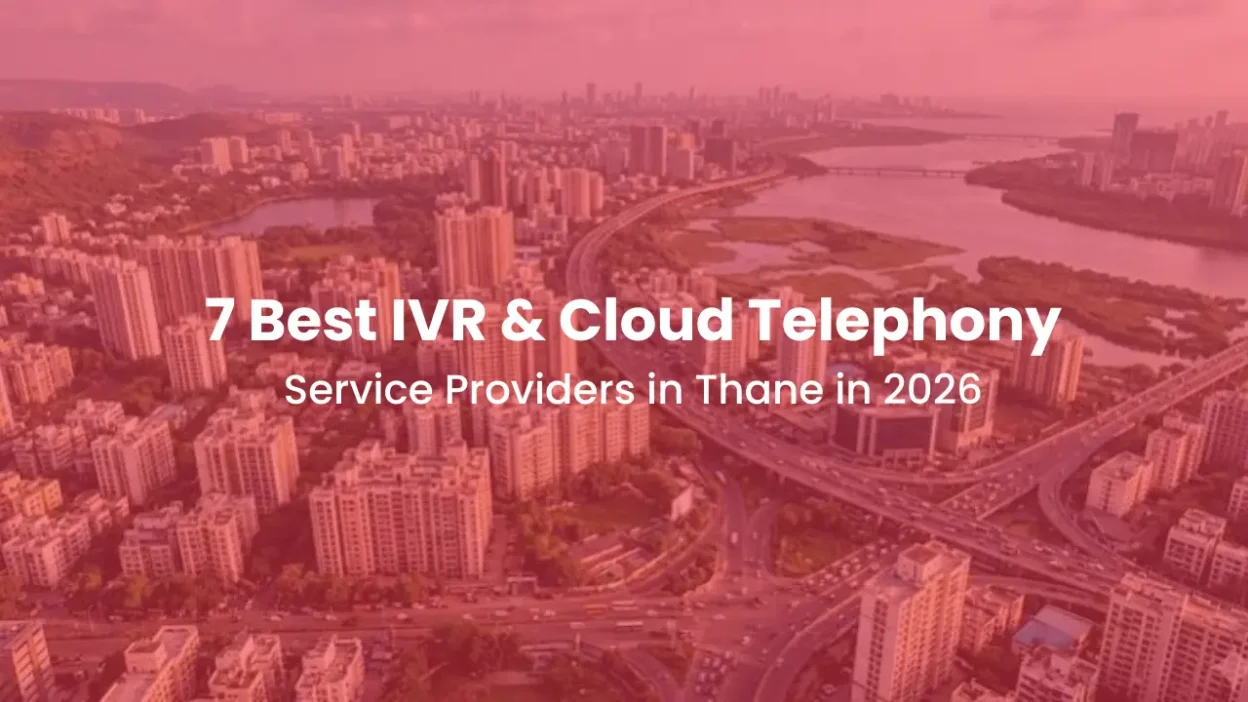
This is particularly relevant in Thane.
The Thane district administration identifies the region as one of Maharashtra’s major industrial areas, with significant activity in chemicals, pharmaceuticals, plastics, iron products, textiles, and other industries. The district also has multiple industrial estates.
Bhiwandi further strengthens the region’s business ecosystem. MMRDA describes the Bhiwandi Surrounding Notified Area as a hub for logistics, warehousing, and industries, supported by its proximity to Thane and Mumbai and access to major transport corridors.
For businesses looking to manage customer calls more systematically, here are seven IVR and cloud telephony service providers to evaluate in Thane in 2026.
Top Cloud Telephony & IVR Service Providers Available in Thane
1. CallerDesk
Particularly relevant for: SMEs, manufacturers, distributors, logistics businesses, sales teams, and customer support operations that need both inbound and outbound calling.
CallerDesk combines business IVR, call routing, outbound calling, call tracking, and integrations within one cloud telephony platform.
Its platform includes multi-level IVR, multilingual IVR, time-based call flows, call recording, click-to-call, predictive auto dialling, automated callbacks, CRM integration, Google Sheets integration, APIs, and webhooks.
CallerDesk also supports routing strategies such as round-robin, sequential, random, and least-idle routing.
How CallerDesk Can Fit a Thane Manufacturing or Distribution Business
Consider a company handling calls related to:
- New sales enquiries
- Existing dealers
- Order status
- Dispatch
- Service
- Accounts
If customers directly contact different employees, the calling process can quickly become fragmented.
With CallerDesk, the business can create one structured customer entry point:
Business Number
→ New Sales
→ Dealer Support
→ Dispatch
→ Service
→ Accounts
Customers do not need to know which employee handles each requirement. The system can route them to the appropriate team.
CallerDesk Also Connects Inbound Calls With Sales Follow-Ups
For many B2B businesses, an incoming enquiry is only the beginning.
The complete sales journey may look like:
Enquiry → Requirement Discussion → Quotation → Follow-Up → Negotiation → Order
CallerDesk combines inbound call management with outbound capabilities such as click-to-call, auto dialling, and automated follow-up callbacks.
This allows businesses to build a more connected process:
Customer Enquiry → Sales Executive → Call Activity → Follow-Up → CRM
This can be particularly useful when the business wants more than a basic IVR and needs visibility across the complete sales calling journey.
2. Exotel
Particularly relevant for: Businesses that need scalable virtual numbers, configurable call flows, queues, and business-software integrations.
Exotel provides cloud telephony and customer communication solutions built around virtual business numbers.
Its virtual-number platform supports IVR, call forwarding, recordings, smart call routing, call queues, parallel ringing, reporting, and integrations with CRM and helpdesk tools.
Exotel also provides cloud call-centre capabilities and supports integrations with platforms such as Zoho CRM, Freshdesk, Shopify, and Zendesk.
Where Exotel Can Fit a Thane Business
A company may need different call flows depending on who is calling.
For example:
New Customer → Sales
Existing Customer → Support Queue
Priority Account → Dedicated Team
After-Hours Call → Alternate Number or Voicemail
Exotel’s routing and call-flow capabilities can support businesses that require more configurable customer communication journeys.
It can also be relevant for organisations that want to connect telephony deeply with existing CRM, ERP, or customer-support systems.
3. Smartflo by Tata Tele Business Services
Particularly relevant for: Businesses that require cloud calling with dynamic routing and integration with existing applications.
Smartflo is Tata Tele Business Services’ cloud telephony platform.
It supports IVR-based call handling and provides APIs that businesses can use to integrate calling with their own applications and workflows.
One particularly relevant capability is Smartflo’s API Dialplan.
Instead of sending every caller through the same fixed call flow, businesses can use application data to decide where a call should go.
Smartflo documents use cases such as:
- CRM-based customer identification
- Lead allocation
- Location-based routing
- Language-based routing
- Priority-customer handling
- Skill-based routing
- Time-based routing
- Order and delivery-status routing
Where Smartflo Can Fit a Thane Business
Consider a company with several branches, warehouses, service teams, or customer categories.
Its application could identify the caller and route the call accordingly:
Existing Dealer → Assigned Account Manager
Delivery Query → Operations
Priority Customer → Dedicated Support
New Lead → Available Sales Executive
This makes Smartflo worth evaluating for businesses that want telephony to work closely with their internal applications and customer data.
4. TeleCMI
Particularly relevant for: Distributed teams, cloud PBX requirements, remote agents, and businesses that need flexible call-flow design.
TeleCMI provides a cloud-based business phone system with features such as:
- Multi-level IVR
- Automated call routing
- Call recording
- Call transfer
- Conferencing
- Call barging
- Click-to-call
- Voicemail
- APIs
- Webhooks
It also provides a visual call-flow designer for configuring incoming calls.
Where TeleCMI Can Fit Distributed Thane Teams
Not every employee needs to work from the same office.
A business may have:
Office Staff + Warehouse Team + Field Sales + Remote Support
TeleCMI provides web, desktop, and mobile access while giving administrators visibility into answered calls, missed calls, outgoing calls, waiting customers, and user activity.
This can make it relevant for businesses with employees working across multiple locations.
5. Airtel IQ
Particularly relevant for: Enterprises and larger businesses that want telecom-backed cloud telephony and programmable voice capabilities.
Airtel IQ Cloud Telephony provides voice communication tools for handling incoming and outgoing business calls through a centralised system.
Its current cloud telephony offering includes:
- IVR
- Click-to-call
- Outbound dialler
- Toll-free calling
- Number masking
- Mobile and landline caller ID options
- Automated voice announcements
Airtel also provides programmable Voice APIs that can be used to integrate calling functionality into applications.
Where Airtel IQ Can Fit a Thane Business
A larger company may need more than basic call routing.
For example, a logistics or delivery operation may want to:
Trigger automated delivery confirmations
Mask customer and employee phone numbers
Connect application events with voice calls
Run outbound campaigns
Build customised IVR journeys
In such cases, programmable voice and telecom infrastructure may become an important consideration.
6. Knowlarity
Particularly relevant for: SMEs and enterprises looking for virtual numbers, IVR, cloud business calling, and CRM integration.
Knowlarity offers business communication solutions including virtual numbers, IVR, cloud contact-centre capabilities, number masking, outbound calling, and CRM integrations.
Its business phone system also includes call recording, smart routing, mobile call routing, auto dialling, and real-time communication insights.
Where Knowlarity Can Fit a Thane SME
For some businesses, the primary problem is straightforward:
Too many customer-facing employee numbers.
A business may want to move from:
Salesperson Number + Service Number + Accounts Number + Owner’s Number
to:
One Business Number → Sales / Service / Accounts
Knowlarity’s multi-level IVR and call-routing capabilities can support this type of centralised communication structure.
It can therefore be considered by businesses looking to replace fragmented phone communication with a more organised cloud-based setup.
7. Ozonetel
Particularly relevant for: Larger support teams, contact centres, BPOs, and businesses requiring advanced agent and campaign management.
Ozonetel is positioned more strongly toward cloud contact-centre operations.
Its cloud telephony platform includes intelligent IVR, smart call routing, skills-based routing, CRM and business-application integrations, automatic call logging, click-to-call, auto diallers, and campaign management.
Its broader contact-centre platform also provides real-time analytics, operational monitoring, omnichannel support, and integration with CRM and helpdesk systems.
Where Ozonetel Can Fit a Larger Thane Operation
Consider a customer-support operation with dozens of agents.
Managers may need visibility into:
- Customer queues
- Agent availability
- Service levels
- Campaign performance
- Call recordings
- Agent productivity
- Missed and unanswered calls
At this scale, a basic IVR may no longer be sufficient.
Ozonetel provides predictive and progressive diallers, live monitoring, call recording, and detailed contact-centre reporting for more complex operations.
What Calling Problems Do Businesses in Thane Need to Solve?
The business requirements of Thane are not limited to standard sales and support calls.
Its industrial and logistics ecosystem creates several specific communication challenges.
Manufacturing Businesses Need Separate Sales, Dealer, and Service Call Flows
Thane district has significant industrial activity in chemicals, pharmaceuticals, plastics, iron products, textiles, and other manufacturing sectors.
For these companies, one customer relationship can generate several different types of calls.
A typical journey may be:
New Enquiry → Technical Discussion → Quotation → Order → Dispatch → After-Sales Service
The salesperson who manages the first enquiry may not be the correct person to handle dispatch or service later.
A structured calling setup could therefore separate:
New Sales
Existing Dealers
Dispatch
Technical Support
Accounts
This reduces the dependence on individual employee numbers.
Bhiwandi Logistics Businesses Need Faster Routing Between Sales and Operations
Bhiwandi and its surrounding area have become an important hub for warehouses, logistics operations, storage, and industrial activity.
Calls in a logistics operation may include:
- New business enquiries
- Pickup requests
- Shipment status
- Warehouse coordination
- Delivery issues
- Documentation
- Billing
A salesperson may not be able to answer an operational delivery question.
Similarly, an operations employee should not need to handle every new commercial enquiry.
A better structure could be:
Business Number
→ New Business
→ Operations
→ Delivery Coordination
→ Accounts
Call routing becomes particularly valuable when several employees are available within each team.
Pharma and Chemical Businesses Need Better Call Visibility
Thane district has an established chemicals and pharmaceutical industry.
Businesses in these sectors may handle customer, distributor, procurement, technical, and support conversations throughout the day.
When calls remain spread across employee mobile phones, management may struggle to answer basic questions:
Who spoke with this customer?
When was the last conversation?
Was the call recorded?
Does someone need to follow up?
Centralised call logs and recordings can make customer communication easier to review and manage.
Growing Sales Teams Need a Clear Process for Missed Calls
A missed call is not always just an unanswered phone call.
It could be a prospective customer who found the business through a website, Google search, referral, advertisement, or marketplace.
The key question should therefore be:
What happens after the call is missed?
Businesses should evaluate whether their cloud telephony platform can support:
- Missed-call visibility
- Backup routing
- Queues
- Follow-up callbacks
- Call history
- Lead follow-up
CallerDesk, for example, provides automated follow-up callbacks and caller-wise history alongside its inbound and outbound calling capabilities.
The objective is to ensure an unanswered call becomes a visible action rather than a forgotten notification.
Multi-Location Teams Need One Customer-Facing Calling System
Businesses across Thane, Bhiwandi, Kalyan, Ambernath, and surrounding areas may operate across offices, warehouses, factories, and field locations.
Customers should not need to understand that internal structure.
A central number can become the entry point while the telephony system manages the routing.
For example:
Customer Calls
→ Sales Team
→ Warehouse Operations
→ Service Department
→ Accounts
The employee’s physical location becomes less important than their responsibility for the call.
Why CallerDesk Can Be a Strong Fit for Growing Businesses in Thane
Different providers in this list address different requirements.
A large contact centre may need the depth provided by Ozonetel. An application-heavy operation may value Smartflo’s dynamic routing. An enterprise may consider Airtel IQ’s programmable communication infrastructure.
For many growing Thane SMEs, manufacturers, distributors, and sales-led organisations, however, the requirement can be different.
They may need more than a basic IVR but not a highly complex enterprise contact-centre setup.
This is where CallerDesk can be particularly relevant.
CallerDesk Connects the First Enquiry With the Next Follow-Up
Many cloud telephony discussions focus heavily on incoming calls.
But a sales opportunity rarely ends with the first conversation.
The actual customer journey may be:
Enquiry → Sales Call → Requirement → Quotation → Follow-Up → Order
CallerDesk combines incoming IVR and routing with click-to-call, auto dialling, callbacks, integrations, and outbound calling capabilities.
This helps businesses manage the journey before and after the first call.
Different Teams Can Use Different Routing Strategies
Not every department should route calls in the same way.
A sales team may want new enquiries distributed evenly.
A support team may want calls directed to the least-idle employee.
Another department may prefer sequential routing.
CallerDesk supports multiple routing strategies including round-robin, random, sequential, and least-idle routing.
This allows businesses to design calling around how their teams actually operate.
Repeat Customers Can Maintain Better Conversation Continuity
CallerDesk also provides a Sticky Member capability that can help reconnect returning callers with an agent they previously interacted with.
This can be useful where continuity matters, such as:
- Dealer relationships
- Key accounts
- Ongoing sales discussions
- Customer service cases
Instead of starting every conversation from the beginning, the customer may be able to reconnect with someone who already understands the context.
Calling Can Connect With Existing Business Tools
A sales representative should not have to repeatedly move between different tools simply to make and record a call.
CallerDesk supports CRM integration, Google Sheets integration, APIs, and webhooks.
A connected workflow can look like:
Lead → Call → Call Activity → Outcome → Follow-Up → CRM
This can reduce the gap between communication and sales tracking.
Managers Gain Better Visibility Into Customer Calls
As teams grow, managers need more information than simply the total number of calls.
They may need to understand:
- Which calls were answered
- Which enquiries were missed
- Who handled each customer
- Which callers contacted the business repeatedly
- How agents are performing
- Which conversations require another action
CallerDesk provides call analytics, member-level visibility, caller history, and business calling reports designed to make these activities easier to monitor.
What Should a Thane Business Check Before Choosing a Cloud Telephony Provider?
Start with your business requirement rather than the advertised starting price.
For example, a Thane manufacturer could define its requirement as:
Users: 20
Departments: Sales, Dealers, Dispatch, Service, Accounts
Incoming Calls: Required
Outbound Calling: Required
IVR: Five departments
Call Recording: Required
Missed-Call Tracking: Required
CRM Integration: Required
Reports: Required
API or Webhooks: May be required later
A Bhiwandi logistics company may have a different structure:
Sales → Operations → Delivery → Warehouse → Accounts
Once the workflow is clear, compare providers on:
- Inbound and outbound calling
- IVR flexibility
- Routing strategies
- Number and concurrent-call requirements
- Call recordings
- Missed-call management
- CRM integrations
- Reporting and analytics
- APIs and webhooks
- Team management
- Implementation support
- Scalability
- Total cost
This gives businesses a much clearer basis for comparison than choosing a platform simply because it advertises more features.
Conclusion
Thane’s business environment includes manufacturing, pharmaceuticals, chemicals, distribution, logistics, warehousing, services, and growing sales operations.
Each business needs a different calling structure.
Exotel can be evaluated for configurable cloud communication and virtual-number workflows. Smartflo may suit businesses requiring application-driven routing. TeleCMI offers flexibility for distributed teams. Airtel IQ provides programmable cloud voice capabilities. Knowlarity offers broad cloud communication tools, while Ozonetel is geared towards more advanced contact-centre operations.
For SMEs, manufacturers, distributors, logistics companies, and sales-driven teams that want to connect IVR, smart call routing, inbound enquiries, outbound follow-ups, recordings, CRM integration, and call analytics, CallerDesk can be a particularly relevant platform to evaluate.
The purpose of cloud telephony should not be simply to replace one phone number with another.
A well-designed system should create a clear process:
Customer Calls → Right Team Answers → Conversation Is Tracked → Missed Enquiry Is Visible → Follow-Up Happens → Next Action Is Clear
For a growing business in Thane, that visibility can make customer communication much easier to manage.