
Every time your phone rings and nobody picks it up, you’re not just missing a call; you’re handing a paying customer to your competitor. Indian businesses lose an estimated ₹2–5 lakh per month in revenue from calls that simply go unanswered, according to Caller Digital’s 2026 industry analysis. That’s not a small leak; that’s a hole in the bucket.
- 1 What Is Interactive Voice Response IVR?
- 2 How Does an Interactive Voice Response IVR Work?
- 3 What Is an IVR Call?
- 4 Why Are Businesses Using Interactive Voice Response IVR?
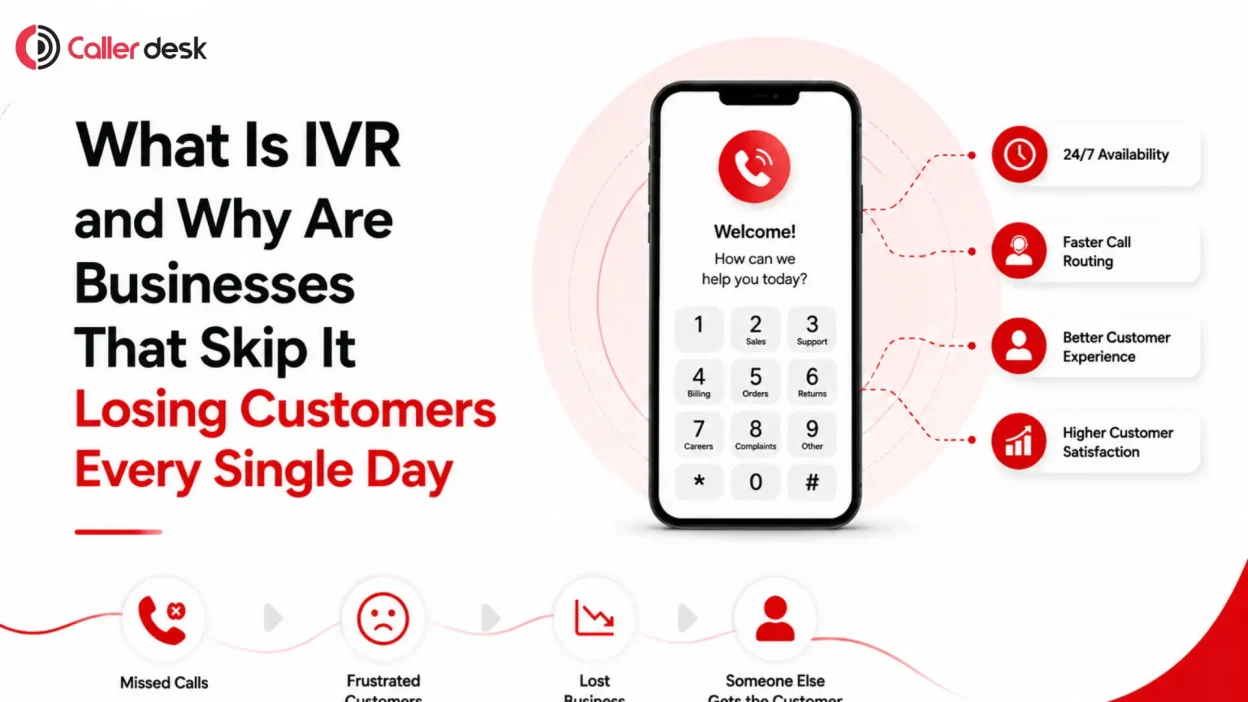
- 5 Benefits of an Interactive Voice Response IVR System
- 6 Key Features of a Modern IVR System
- 7 Who Should Use IVR Software?
- 8 Common Misconceptions About IVR
- 9 Signs Your Business Needs an IVR System
- 10 IVR Solutions in India: What to Look For
- 11 Frequently Asked Questions
- 12 Why Choose CallerDesk for Your IVR Needs
This is exactly the gap interactive voice response IVR technology was built to close. If your business still routes calls manually, or lets them ring out, you’re losing customers every single day without realizing it.
What Is Interactive Voice Response IVR?
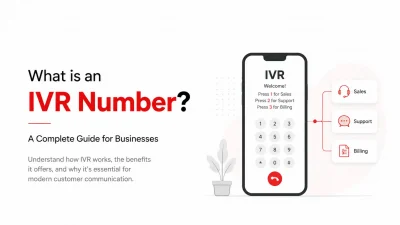
Interactive voice response IVR is an automated telephony system that greets callers, offers menu options, and routes them to the right department based on their input, without needing a human to pick up first. It uses pre-recorded or dynamically generated voice prompts combined with keypad or voice input to understand what a caller needs.
An interactive voice response IVR system works round the clock; it doesn’t take breaks, doesn’t get overwhelmed during peak hours, and never forgets to greet a customer professionally. For any business handling more than a handful of daily calls, this single feature changes how customers experience your brand from the very first ring.
The full form of IVR is Interactive Voice Response, a term that describes exactly what it does: it interacts with the caller’s voice or keypad input and responds intelligently.
How Does an Interactive Voice Response IVR Work?
- Step 1: Customer calls the business. The call reaches a virtual or toll-free number instead of a single desk phone, so it never depends on one person being at their desk.
- Step 2: Greeting message. The IVR call opens with a professional, branded welcome message that plays automatically the moment the call connects.
- Step 3: Menu options. The caller hears simple choices, such as “Press 1 for Sales, Press 2 for Support,” so they can direct themselves without waiting for a human.
- Step 4: Customer input. The caller responds using their keypad or, in modern systems, their voice.
- Step 5: Smart call routing. Based on that input, the system routes the call to the correct department, agent, or time-based queue, for example, sending after-hours calls to a different flow than daytime calls.
- Step 6: Agent connection. The caller is connected to the right person directly, with zero manual transferring and no risk of the call getting lost in between.
What Is an IVR Call?
An IVR call is any inbound call handled by an automated voice system instead of a live receptionist; the caller interacts with recorded prompts before reaching a human agent.
The IVR call full form refers to this same Interactive Voice Response process. The difference from a regular business call is significant: a regular call depends on someone being available to answer, while an Interactive Voice Response IVR call is handled instantly, every time, regardless of staff availability.
Why Are Businesses Using Interactive Voice Response IVR?
Customer expectations have shifted permanently. People expect an instant response, not a ringing phone that eventually goes to voicemail. A widely cited 2023 study by 411 Locals, which tracked 85 businesses across 58 industries, found that only 37.8% of business calls were answered by a live person, meaning nearly two out of three callers got no response at all. That is the exact gap IVR service meaning addresses: giving every caller an immediate, structured response instead of silence.
An Indian NBFC running a 350-agent contact center across 72 landline numbers was handling 2–3 lakh calls a month, but manual routing caused frequent call abandonment, worsened when agents shifted to personal mobiles during the pandemic. After implementing a toll-free number with multi-level IVR, call recording, and analytics (Acmatel, 2020 case study), abandonment dropped sharply, and agents could take calls from anywhere, with full reporting visibility for the first time.
Benefits of an Interactive Voice Response IVR System
- Faster call routing – no manual transfers or hold music loops.
- Better customer experience – professional, consistent greetings every time.
- Reduced missed calls – critical, since 85% of callers who reach voicemail never call back (Aircall).
- 24/7 availability – calls are handled even outside business hours.
- Increased productivity – agents only handle calls that need a human touch.
- Lower operational costs – less need for large front-desk teams.
- Better analytics – every call is logged and reportable.
Key Features of a Modern IVR System
A modern interactive voice response IVR setup typically includes multi-level IVR menus, smart routing, call recording, CRM integration, queue management, business-hour-based routing, voice recognition, detailed analytics, and multilingual support, all built to make sure no caller feels stuck or ignored.
Who Should Use IVR Software?
- Small businesses and startups – project a professional image without a full reception team.
- Growing businesses – handle rising call volumes without losing service quality.
- Enterprises – manage multiple departments, locations, and complex routing rules.
- Industry-specific use – healthcare, banking, e-commerce, education, real estate, and logistics all rely on IVR for high call volumes.
Aakash International Business Management (AIBM), a Bangalore-based institute, struggled with untracked student enquiries, no call recordings, and unavailability after hours. After deploying a toll-free number with IVR-based routing, calls were automatically categorized by student interest and forwarded even after hours. Per MyOperator’s case study, AIBM reported rising call traffic with every call handled properly thanks to immediate forwarding, replacing what had been a fully unstructured enquiry process.
Common Misconceptions About IVR
Many businesses hesitate because of myths: that IVR is only for large companies, that it is expensive, that it replaces agents entirely, or that it’s hard to set up. In reality, cloud-based IVR deploys in days and is built to route customers to humans faster, not replace them. People searching for the full form IVR often stop at the definition without realizing how affordable deployment actually is today.
Signs Your Business Needs an IVR System
- Your call volume is increasing month over month.
- You’re missing calls regularly, especially after hours.
- You have multiple departments customers need to reach.
- Customers report long wait times.
- Your business is scaling faster than your front-desk capacity.
If two or more apply, your IVR calls are already costing you customers you never see recorded anywhere.
IVR Solutions in India: What to Look For
Choosing the right provider is not just about picking the cheapest plan. Here is what actually matters:
- Understand your business needs first. Before comparing vendors, map out your real call volume, how many departments need separate routing, and whether you need support in more than one language. A provider that fits a 10-agent team will not fit a 200-agent enterprise, and vice versa.
- Look for scalability. Your call volume today is not your call volume in a year. Choose a system that lets you add lines, agents, or departments without switching platforms or rebuilding your entire call flow from scratch.
- Check integration options. Your IVR should connect with the tools you already use: your CRM, WhatsApp Business, or helpdesk software, so customer data flows automatically instead of being entered manually by your team.
- Evaluate the analytics you get. A good IVR system should show you call volume trends, abandonment rates, peak hours, and agent performance. If a provider only gives you basic call logs, you are missing the insights that help you actually improve service.
- Consider the quality of customer support. Ask what happens when your IVR setup breaks during business hours. A provider with slow support turnaround can cost you more in downtime than you saved on price.
- Prioritize security and compliance. This is especially critical for finance, healthcare, and telecom businesses. Any provider handling IVR full form in telecom contexts, meaning regulated call data, should offer encryption, secure servers, and compliance with relevant Indian telecom regulations.
| Type | Best For |
| Basic IVR | Small teams, single department |
| Cloud IVR | Growing businesses, remote teams |
| Multi-level IVR | Enterprises, multiple departments |
Frequently Asked Questions
What is Interactive Voice Response IVR?
Interactive Voice Response, or IVR, is an automated telephony system that answers incoming calls, plays a greeting, and offers menu options through keypad or voice input. It then routes the caller to the right department or agent without needing a receptionist to manually pick up and transfer every single call.
How does IVR work?
A caller dials a virtual or toll-free number and hears a recorded greeting followed by menu choices. Based on the option they select, the system routes the call to the correct department, agent, or queue automatically. Modern IVR systems can also route based on time of day or agent availability.
What is an IVR call?
An IVR call is any inbound call that is first handled by an automated voice system rather than a live person. The caller interacts with recorded prompts, selects options, and gets routed accordingly, which means the call is managed instantly even before a human agent becomes involved.
Is IVR suitable for small businesses?
Yes, absolutely. Cloud-based IVR requires no physical hardware, no dedicated IT team, and can be set up within days at an affordable monthly cost. For small businesses without a full-time receptionist, IVR creates a professional first impression while making sure no incoming call ever goes completely unanswered.
Can IVR improve customer service?
Yes. IVR reduces wait times by routing customers directly to the right department, eliminates missed calls through 24/7 availability, and ensures every caller receives the same consistent, professional greeting. This consistency builds trust, especially for businesses handling high call volumes across multiple departments or locations.
Is IVR different from an auto attendant?
Yes, though the two are related. An auto attendant is a simpler system mainly used for basic call routing, like directing calls to the right extension. Full IVR systems go further, supporting self-service options, data collection, call recording, and deeper integration with CRM and business tools for detailed reporting.
What industries use IVR?
IVR is used across nearly every sector that handles high call volumes, including healthcare, banking and finance, e-commerce, education, real estate, and logistics. Each industry uses it differently, from routing patient calls in hospitals to managing student enquiries in educational institutions, but the underlying goal stays the same: no missed calls.
Why Choose CallerDesk for Your IVR Needs
The NBFC that stopped losing calls and the institute that stopped losing student enquiries both solved the same problem with the same fix: structured, automated call handling instead of manual routing. CallerDesk gives you that same fix, built specifically for Indian businesses:
- Cloud-based, multi-level IVR that goes live in days, with no hardware or IT setup required.
- CRM integration so every call, caller detail, and conversation history is logged automatically instead of tracked by hand.
- Real-time analytics showing call volume, abandonment rates, and agent performance, so you always know where calls are being lost.
- Dedicated support to fix issues quickly, since a broken IVR during business hours costs you and your customers by the hour.
If missed calls, long wait times, or messy manual routing sound familiar, CallerDesk can build an IVR setup around your actual call volume and departments, not a generic one-size-fits-all template.
Get a free CallerDesk IVR demo today and stop losing customers to unanswered calls.
Sources:
Caller Digital, “Missed Call Callback Voice AI: Recover ₹2–5 Lakh/Month” (2026) / 411 Locals, Business Phone Answering Study (2023) / Aircall Research on Callback Behavior / Acmatel, “Resolve High Call Flow with Toll-Free Number Solution for NBFC” Case Study (2020) / MyOperator, “AIBM: Scale Student Enquiries With Toll-Free Number” Case Study