
Ask five business owners what an “IVR number” is, and most will describe an “IVR system” instead. The two terms get used interchangeably in everyday conversation, but they aren’t the same thing. One is the phone number your customers dial. The other is the technology working behind it. This guide breaks down what an IVR system actually does, where the IVR number fits into that picture, and how Indian businesses use both together.
- 1 What Is an IVR Number?
- 2 How Does an IVR System Work with an IVR Number?
- 3 What Is IVRs Number?
- 4 Types of IVR Numbers Businesses Can Choose
- 5 Key Features of a Modern IVR System
- 6 How Different Industries Use IVR Services
- 7 Benefits of Using an IVR System for Your Business
- 8 Common Mistakes Businesses Make When Setting Up an IVR System
- 9 How to Choose the Right IVR Services
- 10 Frequently Asked Questions
- 11 Why Choose CallerDesk for Your IVR Number and System
- 12 Sources:
What Is an IVR Number?
An IVR number is a business phone number, usually toll-free, virtual, or local, that’s connected to automated call-handling technology instead of ringing straight to one desk phone. So, what is the IVR number really doing? It’s the entry point that triggers a greeting and menu before the call ever reaches a person, unlike a regular number.
The number is just the entry point. What happens once the customer dials depends entirely on the IVR system working behind it, the software that plays the greeting, listens to the caller’s input, and decides where the call should go next.
How Does an IVR System Work with an IVR Number?
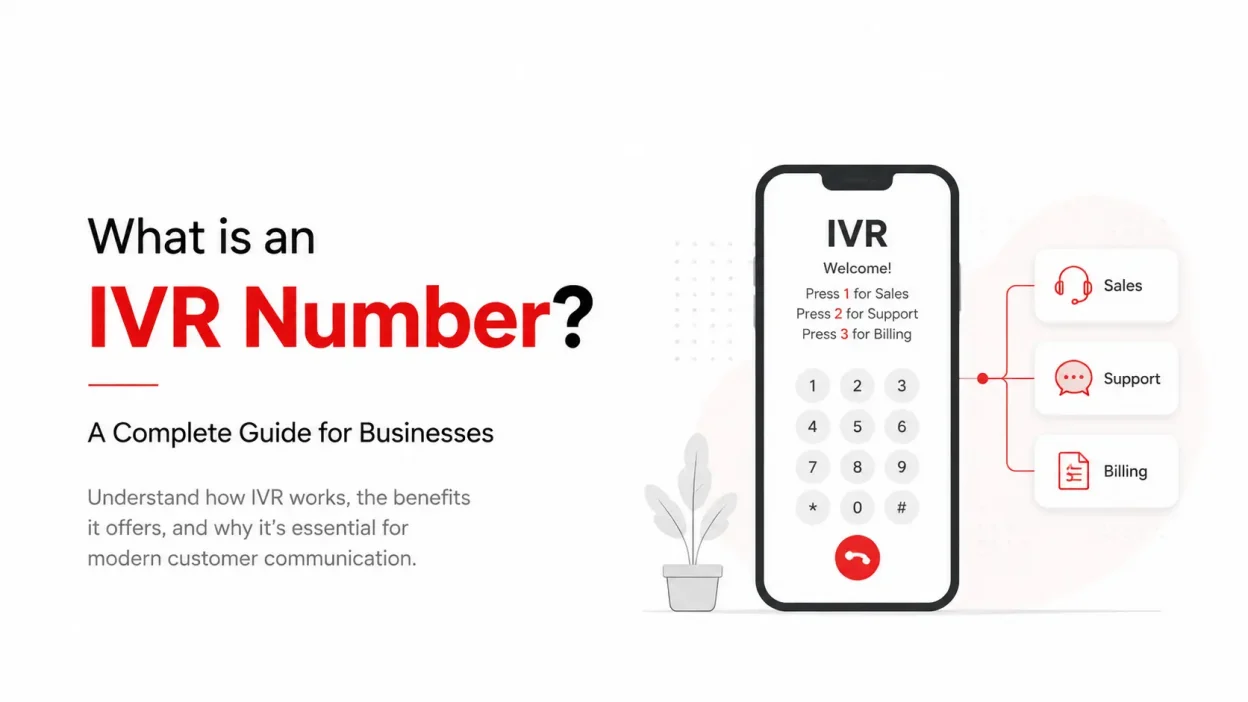
The IVR number receives the call, and the IVR system takes over from there, playing a greeting, offering menu options, and routing the caller to the right department automatically.
The flow looks like this:
- Customers dial the business number – they reach the IVR number, not a single desk line. What IVR number the customer dials determines which department greeting they hear first.
- Greeting message plays – a recorded, branded welcome greets them instantly.
- Caller chooses an option – “Press 1 for Sales, Press 2 for Support.”
- Intelligent call routing – the IVR system directs the call based on the selection, time of day, or agent availability.
- The customer reaches the right department – with zero manual transferring.
What Is IVRs Number?
IVRs stands for Interactive Voice Response System; it’s simply a longer, more formal name for the same technology most people call IVR. In practice, IVRs number means the same thing as an IVR number in everyday business conversation.
You’ll mostly see “IVRs” used in technical documentation or telecom paperwork, while “IVR” is the common term used in day-to-day business discussions.
Types of IVR Numbers Businesses Can Choose
Not every IVR number works the same way. Here’s how the main types compare:
| Type | Best Use Case | Advantage | Limitation |
| Toll-free IVR number | Nationwide brands, customer support lines | Free for callers, builds trust | Higher monthly cost |
| Virtual mobile number | Startups, remote sales teams | Quick setup, works from anywhere | Less “official” feel |
| Local landline number | Region-specific businesses | Builds local trust, familiar area code | Not ideal for national reach |
| Vanity number | Brand recall, marketing campaigns | Easy to remember, boosts recall | Limited number availability |
Key Features of a Modern IVR System
A modern IVR system isn’t just a menu of options; each feature solves a specific, measurable business problem:
- Multi-level IVR – routes callers through layered menus to the exact department they need. CSG, a top technology company, cut misrouted calls from 60% to 30% after implementing multi-level routing (Teneo.ai case study).
- Smart call routing – directs calls based on department, time, or agent availability. Telefónica Germany handled over 900,000 monthly calls with this approach and saw a 6% increase in IVR resolution rates (Teneo.ai case study).
- Call recording and analytics dashboard – logs every call for training, compliance, and performance review. An Indian NBFC deploying multi-level IVR with call recording gained full call visibility across 72 landlines for the first time, after previously tracking nothing (Acmatel, 2020 case study).
- CRM integration – syncs caller data automatically instead of manual entry. A global healthcare provider that integrated its IVR with backend systems cut call-handling costs by 20%, saving roughly $6 million a year (Teneo.ai case study).
- Business-hour-based routing – sends after-hours calls to a different flow instead of dropping them. A Bangalore-based education institute (AIBM) used this to forward student enquiry calls even outside office hours, increasing overall call traffic handled (MyOperator case study).
- Queue management – holds and sequences calls during high volume instead of dropping them.
- Voice recognition – lets callers speak instead of pressing keys, speeding up navigation.
- Multilingual menus – serve diverse customer bases in their preferred language. Swisscom’s IVR now manages over 10 million customer interactions annually across four languages (Teneo.ai case study).
How Different Industries Use IVR Services
- Healthcare – routes patient calls for appointments, prescription refills, and emergencies without overwhelming front-desk staff.
- Banking & financial services – handles balance checks, fraud alerts, and loan enquiries securely, 24/7.
- E-commerce – manages order status and returns during high-traffic sale periods.
- Education – routes admission and fee enquiries without losing a single prospective student.
- Logistics – handles shipment tracking calls at scale during peak seasons.
- Real estate – routes site-visit and property enquiries to the right agent instantly.
A global healthcare provider that modernized its IVR reported a 20% cut in call-handling costs, saving roughly $6 million annually (Teneo.ai case study), a reminder that IVR services pay for themselves quickly once call volume is high enough.
Benefits of Using an IVR System for Your Business
- Never miss customer calls – every call gets an instant response, even after hours.
- Route customers faster – no manual transfers or guesswork.
- Improve customer experience – consistent, professional greetings every time.
- Reduce operational costs – automate routine queries instead of staffing for every call.
- Increase agent productivity – agents only handle calls that truly need them.
- Scale customer support easily – add lines or menus without rebuilding your setup.
An Indian NBFC managing 350 agents across 72 landlines was handling 2–3 lakh calls a month with manual routing, which caused frequent delays and rising staffing pressure during peak hours. After switching to a toll-free number with multi-level IVR (Acmatel, 2020 case study), the business cut down on the extra agent hours previously needed just to manually triage incoming calls, while call recording and analytics gave management visibility they never had before, directly reducing operational overhead, not just abandonment.
Common Mistakes Businesses Make When Setting Up an IVR System
- Too many menu options, which frustrates callers.
- No option to reach a live agent quickly.
- Poor call routing logic that sends callers in circles.
- Outdated greetings that no longer match current offerings.
- Ignoring analytics instead of using them to improve.
- No regular testing after the initial setup.
How to Choose the Right IVR Services
- Business size – CallerDesk scales from small teams to enterprise call centers without switching platforms.
- Call volume – built to handle both a handful of daily calls and lakhs per month.
- Customization – multi-level menus tailored to your exact departments.
- CRM integration – connects with tools like Zoho, LeadSquared, and Pabbly out of the box.
- Reporting – real-time analytics dashboards, not just basic call logs.
- Support & uptime – dedicated support when something breaks mid-day.
- Scalability – add agents or lines as you grow, without rebuilding your call flow.
Frequently Asked Questions
What is an IVR number?
A business phone number connected to automated call-handling technology. Instead of ringing straight to one desk, it plays a greeting and menu, then routes the caller to the right department, making it different from a standard number that depends on someone physically answering.
What is IVRs number?
IVRs stands for Interactive Voice Response System, a formal name for the same technology commonly called IVR. Businesses use both terms interchangeably in everyday conversation, though “IVRs” appears more often in technical or telecom documentation than in casual discussion.
Is an IVR number different from a mobile number?
Yes. A regular mobile number rings directly to one phone and depends on someone answering manually. An IVR number connects to automated software that greets callers, offers menu choices, and routes them intelligently, regardless of whether a specific person is available.
How does an IVR system work?
A caller dials the IVR number, hears a greeting, and selects a menu option using their keypad or voice. The system then routes the call automatically to the correct department or agent, based on that input and factors like time of day or agent availability.
Can small businesses use an IVR system?
Yes. Cloud-based IVR needs no hardware and can be set up within days at an affordable cost, letting even small teams project a professional image and avoid missed calls without hiring a dedicated receptionist.
Is IVR available with toll-free numbers?
Yes, toll-free numbers are one of the most common ways businesses deploy IVR, since they’re free for callers and build immediate trust, particularly for customer support and nationwide sales lines.
Why Choose CallerDesk for Your IVR Number and System
The Acmatel example above shows exactly what the right IVR number and system combination can do: fewer manual transfers, lower staffing pressure, and full visibility into every call. CallerDesk builds that same setup for Indian businesses, toll-free, virtual, or local IVR numbers backed by a cloud-based, multi-level IVR system with CRM integration, real-time analytics, and dedicated support. If your current number just rings and hopes someone’s free, it’s time for a setup that actually routes.
Get a free CallerDesk IVR demo today and see how the right number and system work together.
Sources:
Teneo.ai, “Customer Service IVR Systems Case Studies” / Acmatel, “Resolve High Call Flow with Toll-Free Number Solution for NBFC” Case Study (2020) / CallerDesk, “Best IVR Service Providers in India 2026”