

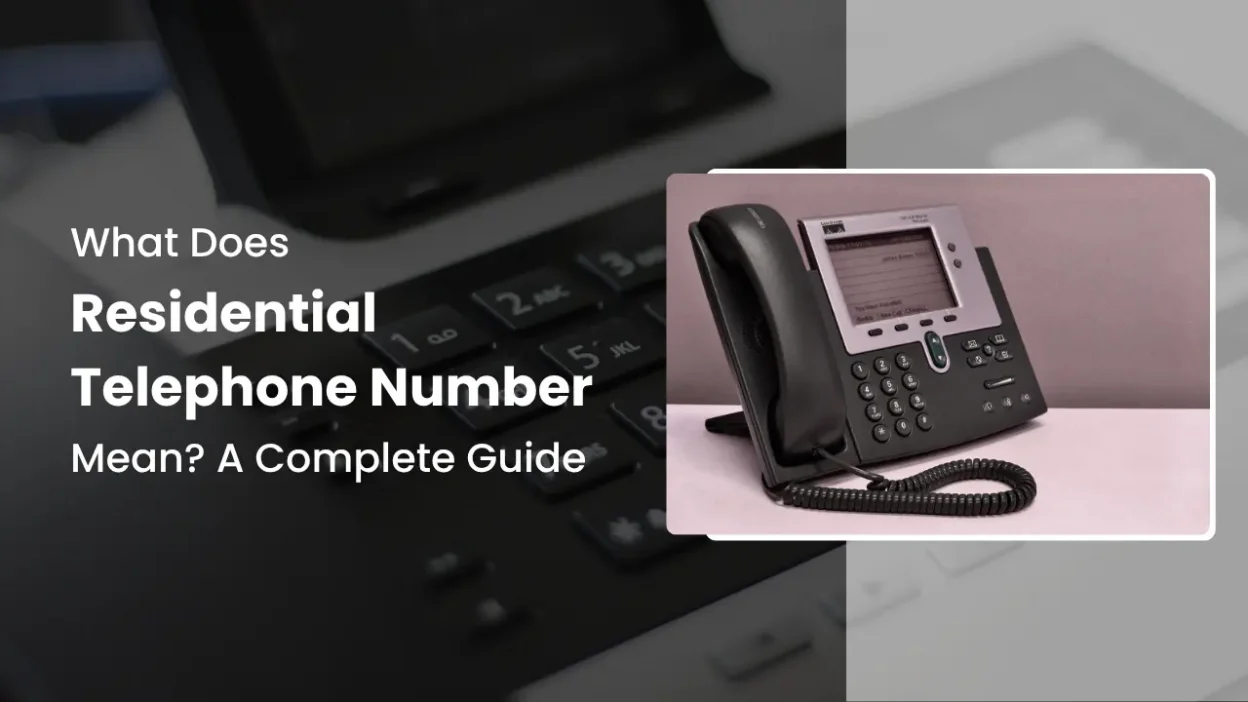
You’re filling out a form, everything is going smoothly, and then you see a field that says “Residential Telephone Number.”
- 1 What Is a Residential Telephone Number?
- 2 Is a Residential Telephone Number the Same as a Landline Number?
- 3 Residential Telephone Number Examples
- 4 Residential vs Mobile vs Business Phone Number
- 5 Why Do Forms Ask for a Residential Telephone Number?
- 6 What Should I Enter as My Residential Telephone Number?
- 7 What If I Don’t Have a Residential Telephone Number?
- 8 Common Mistakes When Entering a Residential Telephone Number
- 9 Conclusion
You stop for a second.
“What number am I supposed to enter here?”
Your mobile number is the one you use every day. You don’t have a landline at home. And your house number is already mentioned in the address section. So what exactly is the form asking for?
This is a common point of confusion because “residential telephone number” isn’t a term most people use in everyday life.
If you’ve ever been unsure what to enter in this field, don’t worry. In this guide, we’ll explain what a residential number means, give you simple examples, show the difference between a residential, mobile, and business number, and explain what to enter if you don’t have a landline.
What Is a Residential Telephone Number?
A residential telephone number is a telephone number associated with a person’s home or residential address rather than a business or office.
In simple words:
A residential telephone number is the phone number used to contact you at your home.
Traditionally, a residential telephone number usually meant a home landline installed at a house or apartment. Today, the term can be used more broadly, depending on the form or service asking for the information.
For example, if a landline is installed at your home and its number is 0542-XXXXXXX, that can be your residential telephone number.
A residential telephone number may also be called:
- Residential phone number
- Residential number
- Home telephone number
- Home phone number
- Residence telephone number
- Home landline number
The exact terminology can vary between forms and countries.
Is a Residential Telephone Number the Same as a Landline Number?
Usually, yes, but the terms are not exactly the same.
A residential telephone number describes where and how the number is used or registered, while a landline describes the type of telephone connection.
For example:
- A landline installed at your home can be a residential telephone number.
- A landline installed at an office is generally a business telephone number.
- A mobile number can be your main personal contact number, but a form may still treat “residential telephone” and “mobile telephone” as separate fields.
This distinction is important when filling out official forms.
Residential Telephone Number Examples
Here are a few simple examples.
Example 1: Home landline
Suppose you have a landline installed at your home:
Residential telephone number: 0542-XXXXXXX
This is a straightforward example of a residential telephone number.
Example 2: A home telephone in another country
A residential number might look different depending on the country’s telephone numbering system.
For example:
+1 212 XXX XXXX
or
+44 20 XXXX XXXX
The format changes by country, but the basic idea is the same: the number is associated with a residence.
Example 3: A mobile-only household
Suppose you live in an apartment but do not have a landline. Your only telephone is your mobile:
+91 98XXXXXXXX
Whether you should enter this as your residential number depends on the form.
If the form separately asks for Home/Residential Phone and Mobile Phone, enter your mobile number in the mobile field unless the instructions specifically allow you to use it for the residential field.
Residential vs Mobile vs Business Phone Number
These terms are easy to confuse, especially when filling out online applications.
| Type | Usually used for | Example |
| Residential telephone number | Home or personal residence | 0542-XXXXXXX |
| Mobile number | A person’s mobile phone | +91 98XXXXXXXX |
| Business telephone number | Office, company, or shop | 011-XXXXXXX |
| Toll-free number | Customer service or business calls | 1800-XXX-XXXX |
The important difference is the purpose and registration of the number.
A residential number is associated with a home. A business number is associated with a business. A mobile number is connected to a mobile device and can be used from different locations.
Modern telephone services can make these categories less obvious. For example, internet-based telephone services can provide numbers that work without a traditional copper landline. This is why the instructions on the particular form should always take priority.
Why Do Forms Ask for a Residential Telephone Number?
Forms may ask for a residential telephone number because they want an additional way to contact you or need information about your home contact details.
You may see this field on:
- Visa and immigration applications
- Bank forms
- Loan applications
- Insurance forms
- Job applications
- School or college forms
- Government applications
- Utility applications
- Rental or housing documents
The exact requirement depends on the organization.
What Should I Enter as My Residential Telephone Number?
The correct answer depends on what the form means by the field.
If you have a home landline
Enter your home landline number.
For example:
0542-XXXXXXX
If the form asks for the country code, you may need to enter it as:
+91 542 XXXXXXX
Follow the format requested by the form.
If you only have a mobile number
First, check whether the form has a separate mobile phone field.
If it does, enter your mobile number there.
If there is only one telephone field and the form says to provide the number where you can be reached, your mobile number may be appropriate.
For example, the U.S. DS-160 specifically allows either a landline or mobile number as the primary phone number.
If the form specifically requires a residential landline
Do not replace it with your mobile number unless the form’s instructions allow you to do so.
If you do not have a residential landline, look for options such as:
- N/A
- Does Not Apply
- No residential telephone
- A checkbox indicating that you do not have one
Never make up a telephone number simply because the field is required.
What If I Don’t Have a Residential Telephone Number?
This is common today because many people use their mobile phone as their only telephone.
If you don’t have a home landline, you generally have three possibilities:
1. Enter your mobile number if the form allows it
Some forms use the telephone field as a general contact number rather than strictly requiring a landline.
Read the instructions before entering your number.
2. Select “N/A” or “Does Not Apply”
If the form provides this option and you don’t have a residential telephone number, use it.
3. Contact the organization if the field is mandatory
If the form requires a residential number but you do not have one and there is no “N/A” option, check the organization’s instructions or contact its support team.
The safest rule is:
Give accurate information and follow the instructions for that specific form. Do not invent a number.
Common Mistakes When Entering a Residential Telephone Number
1. Entering your house number
A house number is part of your postal address. It is not a telephone number.
2. Entering your office number
If the number belongs to your workplace, it is generally a business or work telephone number, not a residential number.
3. Entering a random number
Never create a number just to complete a required field. Incorrect contact information can cause problems if the organization needs to contact you.
4. Using an old disconnected number
If you no longer use the number, check whether the form is asking for your current telephone number or a previous number.
5. Adding the country code twice
If the form already provides +91 through a country selector, don’t enter another +91 unless the instructions tell you to.
6. Assuming every form defines the term the same way
This is particularly important.
A form asking for a residential telephone number may specifically want a home landline. Another form may simply want a telephone number where you can be reached.
Always follow the instructions provided by the organization.
Conclusion
A residential telephone number is the telephone number associated with your home or residence, traditionally a home landline.
It is not your house number.
If a form asks for a residential telephone number:
- Have a home landline? Enter your landline number.
- Only have a mobile? Check whether the form allows a mobile number.
- No residential number and “N/A” is available? Select “N/A” or “Does Not Apply.”
- Not sure what the form means? Follow the form’s instructions or contact the organization.
The most important thing is to enter accurate information in the format requested by the form.