

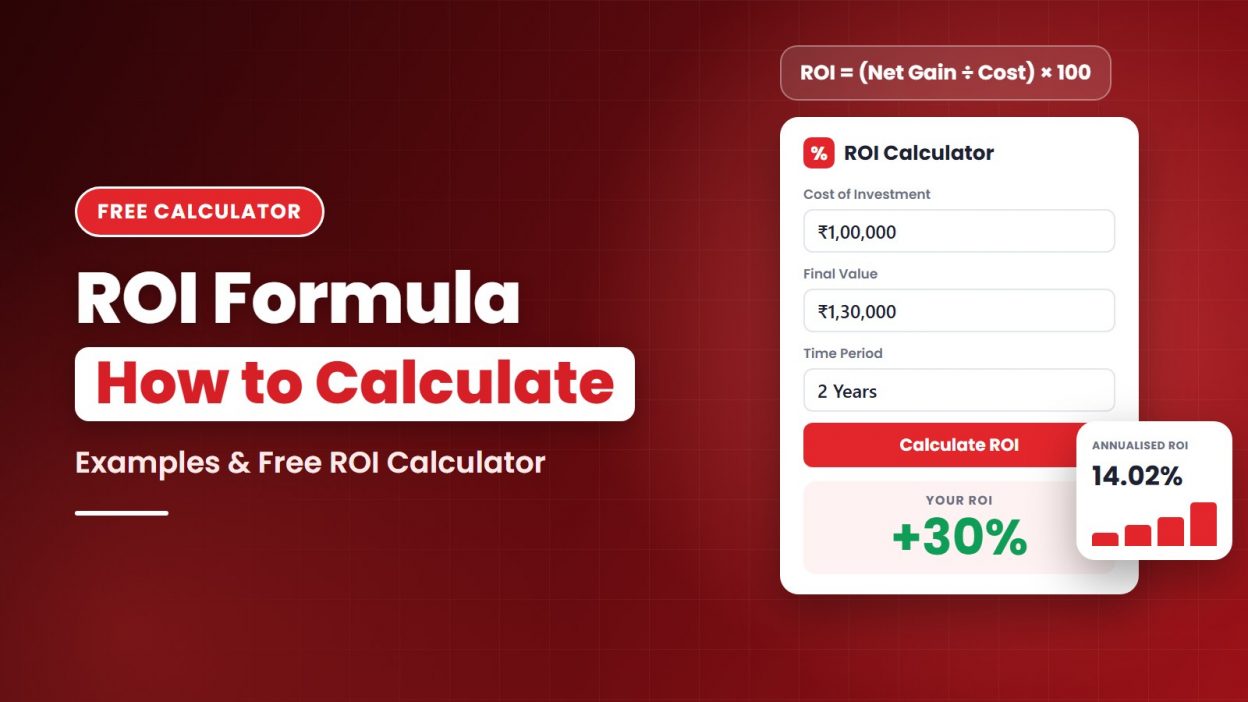
The Return on Investment (ROI) formula shows how much you gained or lost compared with the amount you invested. It is usually written as a percentage.
- 1 Free ROI Calculator
- 2 The ROI Formula Explained
- 3 How to Calculate ROI Step by Step
- 4 ROI Examples
- 5 Annualised ROI: How to Include Time
- 6 How to Calculate ROI in Excel or Google Sheets
- 7 How Borrowed Money Changes ROI: Leverage
- 8 Expected ROI vs Actual ROI
- 9 Other Formulas Related to ROI
- 10 Common Mistakes When Calculating ROI
- 11 Frequently Asked Questions
- 12 Conclusion
ROI = (Net Gain ÷ Cost of Investment) × 100
For example, if you invest ₹50,000 and its value rises to ₹60,000, your net gain is ₹10,000. Your ROI is 20%.
The calculation is simple, but an accurate result depends on including the right costs and considering how long the investment took to earn a return. This guide explains the formula, walks through common examples and shows how to calculate annualised ROI. Use the calculator below to check your own figures.
New to the term? Read our guide to ROI full form and meaning.
Free ROI Calculator
Enter the cost of your investment and the final value. Add the time period to calculate annualised ROI as well. The calculator uses the formulas explained in this guide.
ROI Calculator
Calculate your Return on Investment (ROI) instantly.
Annualised ROI = ((Final Value ÷ Cost of Investment)1/n − 1) × 100, where n = number of years
The ROI Formula Explained
There are two common ways to write the Return on Investment formula. They produce the same result when you use the figures consistently.
Formula 1: Calculate ROI Using Net Gain
ROI = (Net Gain ÷ Cost of Investment) × 100
Net gain is the amount left after you subtract the investment cost and any other relevant expenses from the total value received.
Formula 2: Calculate ROI Using Initial and Final Values
ROI = ((Final Value − Initial Value) ÷ Initial Value) × 100
This version works when the final value includes all the income received from the investment and any relevant selling costs have been deducted.
| Term | Meaning | Examples to include |
| Cost of investment or initial value | The total amount spent to make the investment | Purchase price, brokerage, fees, taxes and setup costs |
| Final value | The total value received from the investment | Sale proceeds, dividends, rent or interest, after relevant selling costs |
| Net gain | Final value minus the total investment cost | May be positive if you made a gain or negative if you made a loss |
The costs you include depend on the investment. For example, property ROI may include purchase-related expenses and maintenance, while campaign ROI should account for product costs as well as advertising spend.
How to Calculate ROI Step by Step
Step 1: Add Up the Total Investment Cost
Start with the amount invested. Add related expenses such as brokerage, setup charges, platform fees, repairs or other costs that are part of the decision.
Step 2: Calculate the Total Value Received
Add the final sale value and any income received during the investment period, such as dividends, rent or interest. Deduct relevant selling charges.
Step 3: Work Out the Net Gain or Loss
Subtract the total investment cost from the total value received. A positive result is a gain. A negative result is a loss.
Step 4: Apply the ROI Formula
Divide the net gain or loss by the total investment cost, then multiply by 100 to express the result as a percentage.
This method works for many decisions, including shares, property, business purchases and marketing campaigns. The key is to use costs and returns that relate to the same investment and time period.
ROI Examples
Example 1: Calculating ROI on Shares, Including Brokerage
Suppose you buy 100 shares at ₹500 each and pay ₹100 in charges. Later, you sell the shares at ₹560 each and pay another ₹100 in charges.
Your total cost is (100 × ₹500) + ₹100 = ₹50,100. After deducting the selling charge, the amount received is (100 × ₹560) − ₹100 = ₹55,900. Your net gain is ₹55,900 − ₹50,100 = ₹5,800.
ROI = (₹5,800 ÷ ₹50,100) × 100 = 11.58%
If you leave out the charges, the ROI appears to be 12%. Even small costs can change the final result.
Example 2: Calculating ROI on a Property
Suppose you buy a flat for ₹40,00,000 and spend another ₹3,00,000 on stamp duty, registration and repairs. Five years later, you sell it for ₹55,00,000.
Your total cost is ₹43,00,000 and your net gain is ₹55,00,000 − ₹43,00,000 = ₹12,00,000.
ROI = (₹12,00,000 ÷ ₹43,00,000) × 100 = 27.91%
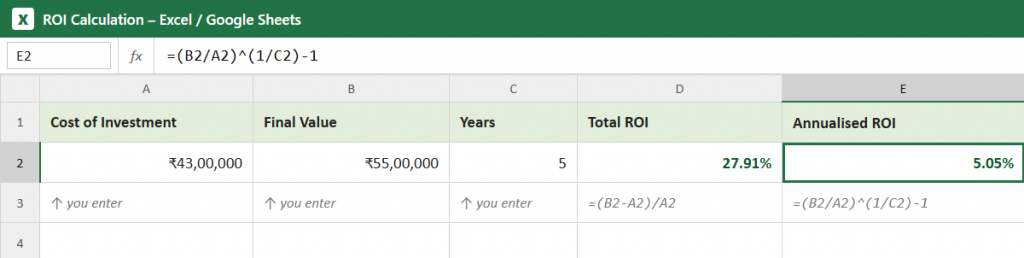
This is the total ROI over five years. It does not include rental income, ongoing maintenance, taxes or other expenses. It also does not account for time. If there was no rental income or other return, the annualised ROI would be about 5.05% per year.
Example 3: Calculating ROI on a Marketing Campaign
Suppose you spend ₹20,000 on online ads. The campaign generates ₹80,000 in sales, and the products sold cost ₹35,000.
The profit from sales before advertising is ₹80,000 − ₹35,000 = ₹45,000. After deducting the ₹20,000 ad spend, the net gain is ₹25,000.
ROI = (₹25,000 ÷ ₹20,000) × 100 = 125%
This calculation uses profit after product and advertising costs, not total sales. Using the full ₹80,000 in revenue would overstate the campaign’s return.
Example 4: Calculating ROI When an Investment Loses Value
Suppose you invest ₹30,000 in a mutual fund and its value falls to ₹25,500. Your loss is ₹25,500 − ₹30,000 = −₹4,500.
ROI = (−₹4,500 ÷ ₹30,000) × 100 = −15%
A negative ROI means the investment is worth less than its original cost. This example does not include any fees, taxes or distributions.
Example 5: Including Dividends in ROI
Suppose you buy 200 shares at ₹250 each, for a total cost of ₹50,000. While holding them, you receive ₹1,500 in dividends. You later sell the shares for ₹55,000.
The total value received is ₹55,000 + ₹1,500 = ₹56,500. Your net gain is ₹56,500 − ₹50,000 = ₹6,500.
ROI = (₹6,500 ÷ ₹50,000) × 100 = 13%
Without the dividends, the ROI would be 10%. The same principle applies to rent from a property or interest from a bond: include the income the investment generated, along with applicable costs.
Annualised ROI: How to Include Time
Basic ROI shows the total gain or loss, but it does not show how long it took. A 30% return over two years is different from a 30% return over five years. Annualised ROI converts a return into an average yearly rate, taking compounding into account.
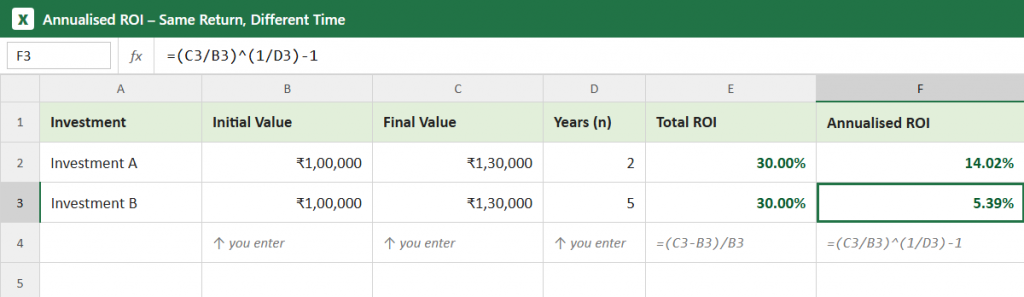
Annualised ROI = ((Final Value ÷ Initial Value)^(1 ÷ n) − 1) × 100
Here, n is the number of years. This formula assumes one initial investment and a final value that includes the return being measured. For investments with deposits or withdrawals at different times, such as a SIP, use XIRR instead.
Example: Compare Two Investments Over Different Periods
Investment A earns a total return of 50% over five years. Investment B earns 30% over two years.
| Investment | Total ROI | Period | Annualised ROI |
| A | 50% | 5 years | About 8.45% per year |
| B | 30% | 2 years | About 14.02% per year |
Investment A has the higher total ROI, but Investment B grew at a faster annual rate. The property example above follows the same principle: a 27.91% total return over five years is about 5.05% per year, assuming no other income or cash flows.
Why Dividing Total ROI by the Number of Years Can Be Misleading
A common shortcut is to divide the total ROI by the number of years. For example, dividing 27.91% by five gives 5.58% per year. This ignores compounding and overstates the annualised return. The formula above gives a more accurate comparison when the investment has one initial outlay and one final value.
The calculator above can work out annualised ROI for you. Enter the Cost of Investment , final value and time period.
How to Calculate ROI in Excel or Google Sheets
Enter the investment cost in cell A2, the final value in B2 and the number of years in C2. Make sure the final value includes any income you want to count, such as dividends, and that relevant costs have been deducted.
| Calculation | Formula |
| Total ROI | =(B2-A2)/A2 |
| Annualised ROI | =(B2/A2)^(1/C2)-1 |
Format the result cell as a percentage. The spreadsheet will display the result as a percentage automatically, so you do not need to multiply by 100 in the formula.
How Borrowed Money Changes ROI: Leverage
When you borrow money to fund an investment, the return on your own money can rise, but your losses can also become larger. This is known as leverage. Loan interest and repayment remain due even if the investment loses value.
Suppose you invest ₹1,00,000 of your own money and borrow another ₹1,00,000 at 10% interest for one year. You invest ₹2,00,000 in total. After one year, you repay ₹1,10,000, including the loan principal and interest.
| Scenario | Investment value after one year | Amount left after repaying loan and interest | ROI on your ₹1,00,000 | ROI without a loan |
| Investment rises by 15% | ₹2,30,000 | ₹1,20,000 | +20% | +15% |
| Investment falls by 10% | ₹1,80,000 | ₹70,000 | −30% | −10% |
With leverage, the 15% gain on the full investment produces a 20% return on your own money after loan interest. A 10% fall in the investment, however, creates a 30% loss on your own money. This simplified example excludes taxes, transaction fees and other charges. Consider both the potential gain and the additional risk before borrowing to invest.
Expected ROI vs Actual ROI
Expected ROI: Estimate Before Investing
Before investing, use realistic estimates of costs and potential gains to judge whether the idea may be worthwhile. Include likely fees and allow for possible delays or lower-than-expected returns.
Actual ROI: Calculate After Investing
After the investment period, use the actual costs and returns to calculate what happened. Comparing actual ROI with your estimate can show where your assumptions were accurate and what you may need to change next time.
Depending on the industry, you may come across other measures that answer related questions.
| Formula | How it is calculated | Where it is used |
| ROAS (Return on Ad Spend) | Revenue attributed to ads ÷ advertising cost | Digital marketing |
| Rental yield | (Annual rent ÷ property price) × 100 | Real estate |
| Payback period | Investment cost ÷ annual net savings or cash inflow | Business and manufacturing |
| CAGR (Compound Annual Growth Rate) | ((Final value ÷ Initial value)^(1 ÷ n) − 1) × 100 | Investment or business growth over time |
| XIRR | Annualised return calculated from dated cash flows | SIPs and investments with multiple deposits or withdrawals |
For more information, read our guide to ROI meaning and ROI in different industries.
Common Mistakes When Calculating ROI
Forgetting Additional Costs
Brokerage, taxes, stamp duty, maintenance and platform fees all affect the return. Include the costs that apply to the investment so the result reflects what you actually gained or lost.
Using Revenue Instead of Profit
Revenue is not the same as profit. In a marketing calculation, subtract the cost of the products or services sold and the advertising spend before calculating ROI.
Ignoring the Time Period
A high total ROI may have taken many years to earn. Use annualised ROI when comparing investments held for different lengths of time.
Leaving Out Taxes
Taxes can reduce the amount you keep. Include applicable taxes when you need to understand your after-tax return.
Comparing Investments With Different Risk Levels
An investment with a high potential ROI may also carry a greater chance of loss. Consider the risk and time period before comparing it with a steadier investment.
Frequently Asked Questions
What Is the Formula for Return on Investment?
ROI = (Net Gain ÷ Cost of Investment) × 100. Net gain is the total value received minus the investment cost and other relevant expenses.
How Do I Calculate ROI Quickly?
Subtract the total investment cost from the total value received. Divide the result by the investment cost and multiply by 100. You can also use the free calculator on this page.
Can ROI Be More Than 100%?
Yes. An ROI above 100% means the net gain is greater than the original investment cost. If ₹10,000 produces a net gain of ₹15,000, the ROI is 150% and the total value received is ₹25,000.
What Is the Difference Between ROI and Annualised ROI?
ROI shows the total gain or loss over the full period. Annualised ROI expresses the return as an average yearly rate, making it easier to compare investments held for different lengths of time.
Should I Include Taxes and Fees in the ROI Calculation?
Yes. Include relevant costs and taxes when calculating the return you actually keep. Leaving them out can make ROI look higher than it is.
Is ROI Always Shown as a Percentage?
ROI is usually shown as a percentage. It can also be written as a ratio, such as 0.20 instead of 20%, but the percentage is easier to read and compare.
How Do I Calculate ROI on a SIP?
Simple ROI does not account for the fact that each SIP instalment is invested for a different length of time. Use XIRR to estimate the annualised return across multiple deposits and withdrawals. Many investment platforms display XIRR, and spreadsheet programmes also have an XIRR function.
Should I Calculate ROI Before or After Investing?
Both. Estimate expected ROI before investing to assess whether the idea may be worthwhile. After the investment period, calculate actual ROI using the real costs and returns.
Conclusion
The ROI formula, (Net Gain ÷ Cost of Investment) × 100, helps you compare the gain or loss with the amount invested. To get a useful result, include relevant costs, use profit rather than revenue and consider the time taken to earn the return. Annualised ROI can help when you are comparing investments held for different periods, while XIRR is more suitable for investments with cash flows at different times.
Enter your figures in the calculator above to estimate your return. For a basic explanation of the term and how it is used, read our guide to ROI full form and meaning.