

Summary-
- 1 Summary-
- 2 Introduction-
- 3 What Is a Voice API?
- 4 What Are Traditional Voice Solutions?
- 5 Core Difference: How They’re Built
- 6 Setup and Deployment: Time Matters
- 7 Scalability: Growing Without Pain
- 8 Cost Structure: Upfront vs. Flexible
- 9 Automation and Control: Where Voice API Pulls Ahead
- 10 Integrations: Turning Calls into Business Data
- 11 Remote Work and Mobility: Built for How Teams Work Today
- 12 Reliability and Continuity: Less Dependence on One Place
- 13 Security and Compliance: Cloud Has Matured
- 14 Which One Should You Choose?
- 15 Conclusion-
Modern businesses are no longer limited to just one way of handling voice calls. Today, they usually face a clear choice to continue with traditional phone systems like PBX and fixed lines, or move to a Voice API–based setup. While both options allow businesses to make and receive calls, the similarity ends there.
Traditional systems rely heavily on physical hardware and office-bound infrastructure, which makes scaling or supporting remote teams complicated. Voice API works differently. It runs on the cloud, allowing businesses to design smarter call flows, automate repetitive tasks, integrate calling with CRMs, and support distributed teams with ease. In this blog, we’ll break down how these two approaches differ in setup, cost, automation, integrations, reliability, and security, helping cloud-based call centers choose the right path forward.
Introduction-
Voice communication has always been a big part of business. It’s how support teams solve problems, how sales teams build trust, and how operations teams keep things moving. But the technology behind business calling has changed a lot. Today, many companies are stuck between two options: a modern Voice API setup or Traditional Voice Solutions like PBX and fixed lines.
Both can handle calls, but they work very differently behind the scenes. Traditional systems are built around hardware and office-based infrastructure. A Voice API is built around software, cloud infrastructure, and integrations. With the rise of cloud contact centres and cloud call centers, this decision directly affects cost, flexibility, and customer experience. Let’s break it down in a clear, practical way.
What Is a Voice API?
A Voice API is a way to add calling features into your software like your app, website, CRM, or support platform without needing a heavy physical setup. Instead of “buying and installing” telephony hardware, you connect to voice capabilities through the cloud.
Think of it like this: a Voice API turns voice into a programmable service. You can make calls, receive calls, route calls, record calls, and even trigger actions based on what happens during a call. That means your voice system can behave like your business process, not like a fixed piece of office equipment.
This is why Voice API is becoming the backbone for modern cloud call centers. It gives teams the freedom to build smarter call flows, automate repetitive tasks, and connect voice with the rest of their tools.
What Are Traditional Voice Solutions?
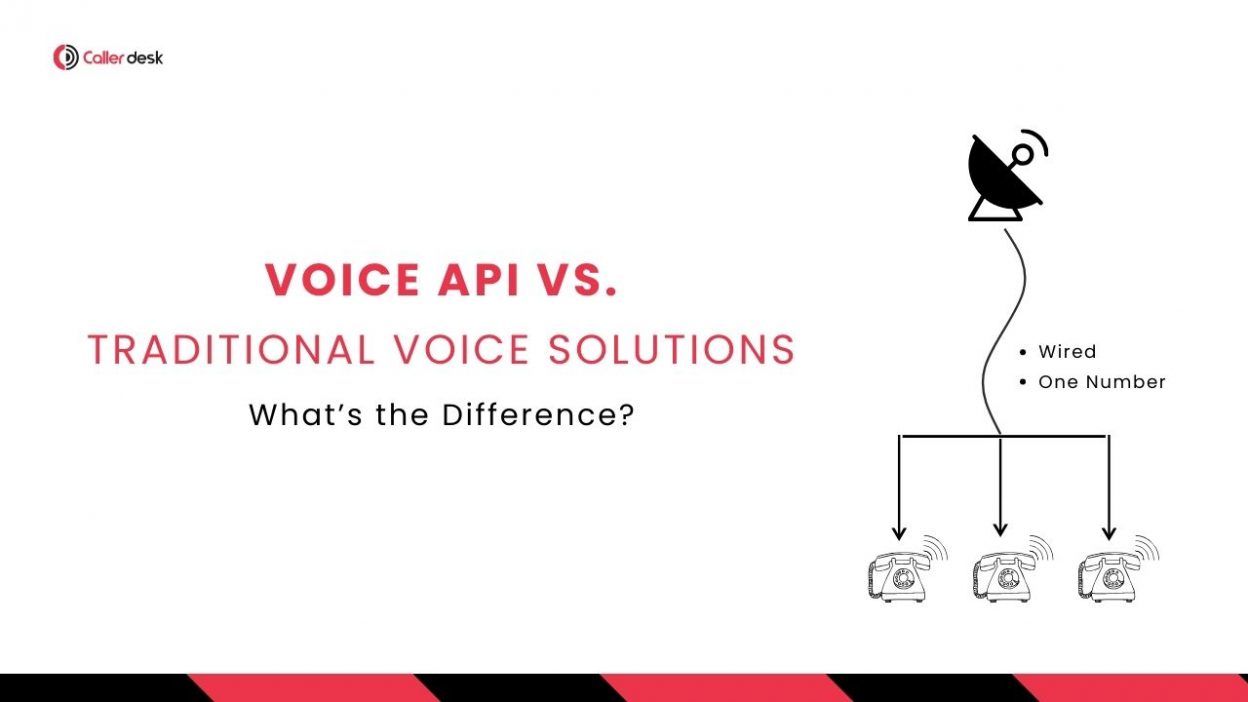
Traditional Voice Solutions are older, hardware-based telephony setups. This includes analog lines, ISDN connections, and on-premise PBX systems installed inside an office. These systems were designed in an era where teams worked from the same physical location, call flows rarely changed, and growth happened slowly.
The main limitation is that traditional voice is tied to infrastructure. If you want to add more agents, expand to another city, change your IVR flow, or integrate with modern software, you often need vendor support, physical upgrades, and time-consuming configurations.
Traditional systems can still work for some businesses. But for fast-moving teams, remote work, and modern support operations, they often feel restrictive.
Core Difference: How They’re Built
This is the real difference you should focus on.
Traditional voice is hardware-first. Voice API is software-first.
With Traditional Voice Solutions, your calling setup depends on physical devices. Calls flow through hardware installed in your office. Scaling usually means adding more equipment or lines.
With a Voice API, calling runs on cloud infrastructure. You control the logic through software. You can update call flows, add features, and integrate tools without changing physical infrastructure.
That is also why cloud contact centres and cloud call centers usually prefer Voice API-driven systems. They are easier to manage, easier to scale, and much easier to adapt as the business changes.
Setup and Deployment: Time Matters
Traditional setups often take longer than people expect. You may need procurement, wiring, installation, testing, and vendor coordination. If you’re setting up a new office or expanding to a new location, this can slow things down.
Voice API setup is usually faster because there’s less physical dependency. You can configure the system digitally, integrate with your existing workflow, and start operations without waiting for hardware work.
For many businesses, this speed is not just convenient. It’s a competitive advantage. If your team can launch a new campaign, helpline, or support line quickly, you respond to market needs faster.
Scalability: Growing Without Pain
Scaling is where Voice API feels like a modern tool, while Traditional Voice Solutions start showing their age.
Traditional systems scale in “steps.” You add new lines, upgrade hardware, or expand infrastructure. These steps often involve upfront costs and long lead times.
With a Voice API, scaling can be much smoother. If call volumes spike during a campaign, seasonal sales, or unexpected demand, you can handle it with cloud capacity and smart routing. Adding agents is typically easier too, which is especially helpful for teams running cloud call centers with fluctuating workloads.
In short: Voice API grows with your business. Traditional systems often make growth feel like a project.
Cost Structure: Upfront vs. Flexible
Traditional voice systems often come with heavy upfront costs. Hardware, maintenance contracts, office infrastructure, repairs, and upgrades can add up over time. Even small expansions can become expensive because they require physical changes.
Voice API is usually more flexible because it often follows a usage-based model. You typically pay for what you use like call minutes, channels, or specific features.
The benefit is not only cost savings. The bigger benefit is financial control. You can plan better, experiment faster, and avoid locking money into hardware that may not match your future needs.
Automation and Control: Where Voice API Pulls Ahead
Traditional Voice Solutions can handle basic IVR and routing, but deeper automation is limited. Many things still require manual effort or fixed configurations.
A Voice API allows you to automate voice in a way that matches your business logic.
For example, you can:
- Route calls based on agent skills, language, or region
- Trigger a WhatsApp or SMS follow-up automatically after a missed call
- Log call details directly into your CRM without manual entry
- Start call recording only for specific cases
- Connect calls to a ticketing workflow
This is exactly why cloud contact centres that want efficiency and consistency often move toward Voice API. It reduces repetitive work and helps teams focus on actual conversations.
Integrations: Turning Calls into Business Data
Traditional systems often struggle with integrations. You may get basic call logs, but connecting voice data to your CRM, helpdesk, analytics, or automation tools can be difficult.
Voice API is built for integrations. Calls become part of your software ecosystem. You can track outcomes, capture lead sources, analyze agent performance, and connect voice activity with the rest of your customer journey.
This is an important shift. When voice is integrated, it stops being “just calls.” It becomes measurable, trackable, and improvable.
That’s also why many modern cloud call centers use Voice API setups. They want visibility, not guesswork.
Remote Work and Mobility: Built for How Teams Work Today
Traditional voice systems are usually tied to office infrastructure. Agents often need to sit at a specific desk or use office-connected devices.
Voice API supports remote work and hybrid teams much more naturally. Agents can operate from anywhere, as long as they have secure access and the right tools. Supervisors can monitor performance through cloud dashboards. Teams can stay distributed without losing control of call operations.
For businesses running cloud contact centres, this flexibility is now a necessity, not a nice-to-have.
Reliability and Continuity: Less Dependence on One Place
Traditional systems can face downtime due to hardware failures, line issues, or office-level disruptions. If something breaks on-site, call operations can suffer immediately.
Voice API systems usually run with cloud redundancy, backup routing, and scalable infrastructure. That means fewer single points of failure and better continuity during unexpected disruptions.
For customer-facing teams, reliability is not only about technology. It’s about protecting trust. A system that stays available helps you avoid missed calls, lost leads, and unhappy customers.
Security and Compliance: Cloud Has Matured
Some businesses still assume cloud voice is less secure, but the reality has changed. Most Voice API platforms today offer encryption, secure access controls, audit logs, and compliance-ready environments.
Traditional Voice Solutions rely heavily on physical security and on-site controls. That may work in some setups, but it does not automatically make the system safer. Security also depends on updates, monitoring, and access control areas where cloud systems can actually be stronger because updates are consistent and centrally managed.
Which One Should You Choose?
If your business is small, office-based, and your call setup rarely changes, Traditional Voice Solutions can still work. It may be enough for basic calling needs.
But if you want flexibility, automation, integrations, remote readiness, and smoother scaling, Voice API is usually the smarter choice. It fits modern business operations, especially teams running cloud call centers and cloud contact centres where speed and customer experience matter.
Conclusion-
The difference between Voice API and Traditional Voice Solutions is not just about “new vs old.” It’s about how your business wants to operate going forward. Traditional systems are built around fixed infrastructure and slower change. Voice API is built around software, automation, integration, and growth.
If you want a voice setup that scales easily, supports remote teams, and gives you better control over call flows and data, Voice API is a strong foundation. That’s why modern cloud call centers and cloud contact centres are moving in this direction.
If you’re exploring Voice API-led calling for your business, you can check practical, scalable options at callerdesk.io.