
Businesses no longer need phone lines to sound professional on a call. Startups, SMEs, healthcare providers, and educational institutes across India are moving calling systems to the internet, cutting out copper wiring and EPABX boxes.
- 1 What Is Voice Over Internet Protocol VoIP?
- 2 How Does VoIP Technology Work?
- 3 Why Are Indian Businesses Switching to VoIP?
- 4 Traditional Phone Systems vs Voice Over Internet Protocol VoIP
- 5 Features, Who It’s For, and Choosing an Indian Provider
- 6 Can You Check Whether a Number Is VoIP?
- 7 Is VoIP Right for Every Business?
- 8 Why Choose CallerDesk
- 9 Conclusion
- 10 FAQs
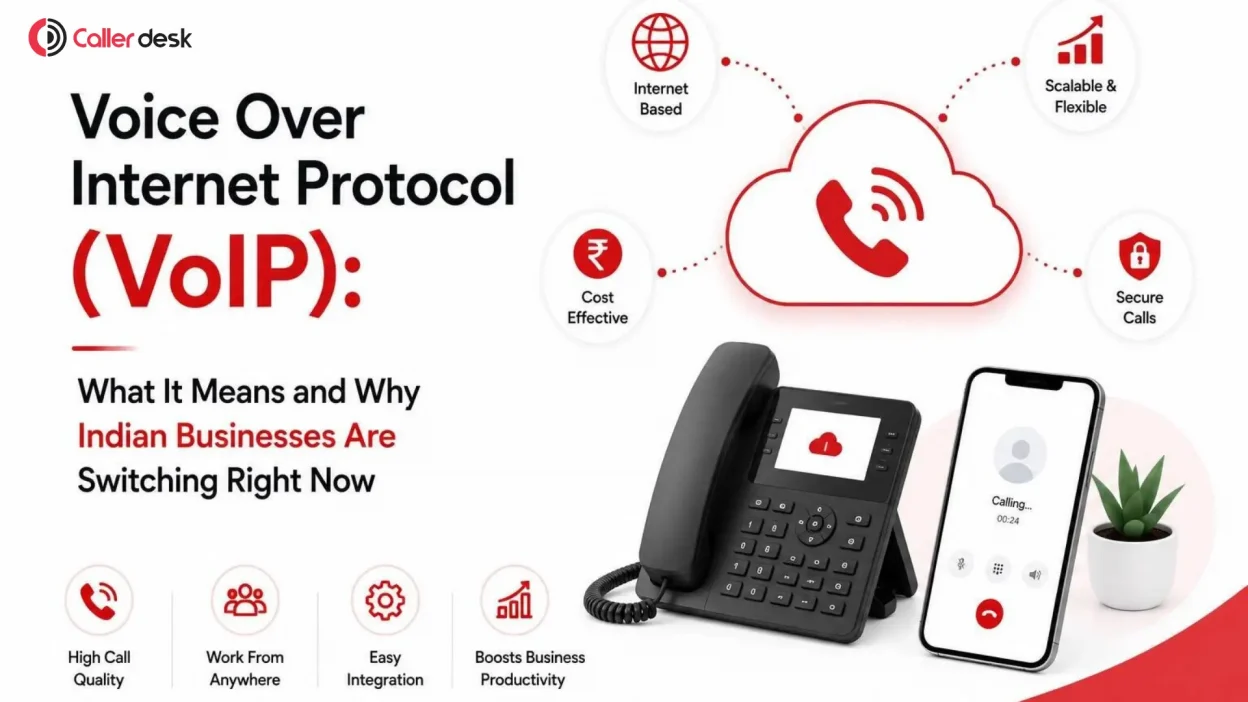
Voip full form of Voice over Internet Protocol, lets businesses make and receive calls over the internet instead of traditional phone lines. By converting voice into digital data, it reduces communication costs, improves flexibility, and offers advanced features that conventional telephone systems cannot provide.
What Is Voice Over Internet Protocol VoIP?
Voice over internet protocol VoIP converts your voice into digital packets and transmits them over the Internet instead of copper phone lines. It lets you call from any internet-connected device, such as a laptop, smartphone, or IP phone, without physical wiring. Unlike traditional calling, which needs a dedicated circuit between two phones, protocol VoIP breaks speech into data packets, routes them through the internet, and reassembles them on the other end in real time.
How Does VoIP Technology Work?
The mechanics behind voip technology are straightforward once broken into steps:
- Internet connection — Your device connects through a stable broadband or mobile data connection.
- Voice converted into digital packets — Speech is captured and compressed into small data packets using a protocol such as SIP (Session Initiation Protocol).
- Packets travel securely — These packets move through cloud servers that manage routing, encryption, and call quality.
- Receiver hears normal voice — The packets reassemble on the other end and play back as a normal-sounding call.
Call clarity depends on internet bandwidth and connection stability. This is why businesses running voip technology at scale are advised to maintain a dedicated, redundant internet line rather than relying on a single connection.
Why Are Indian Businesses Switching to VoIP?
The shift is measurable, not anecdotal. India’s combined PSTN and VoIP subscriptions grew by about 23% in 2024, crossing 39 million connections, according to TeleGeography. That growth traces back to a few clear, India-specific pressures:
- Lower calling costs — Businesses making frequent interstate or international calls save significantly compared to STD/ISD billing on traditional lines.
- Remote and hybrid teams — Employees can answer a company number from home or a different city without call-forwarding workarounds.
- Easy scalability — Adding ten agents to a cloud PBX takes minutes, not a technician visit.
- No bulky hardware — Cloud-based communication removes the need for on-site EPABX equipment.
- Better customer experience — IVR, automatic call routing, recording, and CRM integration turn a basic line into a structured support system.
In 2020, Acmatel, an NBFC handling high-volume collections, adopted cloud telephony to manage increased call volumes during peak collection periods. The transition allowed the company to scale its agent capacity without investing in additional hardware while maintaining detailed call records to support operational and compliance requirements, something its traditional PBX system struggled to deliver efficiently at scale.
Traditional Phone Systems vs Voice Over Internet Protocol VoIP
| Factor | Traditional PBX | VoIP |
| Installation | Physical wiring, technician visits | Cloud setup, same-day activation |
| Hardware | EPABX box, handsets required | Works on existing devices |
| Monthly cost | High, fixed line rentals | Lower, usage-based plans |
| Maintenance | On-site technician support | Managed by the provider |
| Remote work | Limited or impossible | Fully supported |
| Scalability | Slow, hardware-dependent | Add users in minutes |
Features, Who It’s For, and Choosing an Indian Provider
Modern voice over internet protocol voip systems go well beyond calling. Most business plans bundle:
- IVR and auto attendants
- Call recording and analytics
- CRM integration
- Virtual numbers and number porting
- Multi-location support
Different teams pull different values from these features. Small businesses get affordable, no-hardware communication from day one. Growing companies scale headcount without re-architecting their phone setup. Sales teams get mobility paired with CRM-linked call logs; MyOperator’s AIBM (AI-based business messaging) is a useful example here, combining voice calling with automated follow-up messaging so sales reps don’t lose leads between calls.
When comparing Indian VoIP providers, look beyond pricing. Check whether the provider complies with TRAI regulations, offers reliable local support, follows strong data security practices, provides transparent pricing without hidden charges, guarantees high uptime, and supports easy number portability. A clear Service Level Agreement (SLA) is also important, as unclear uptime commitments can lead to service issues over time.
Can You Check Whether a Number Is VoIP?
Some businesses use a voip number checker to verify whether a phone number is linked to VoIP services, often for fraud detection or identity verification workflows. These tools are useful but not always conclusive; number portability and hybrid telecom networks mean a lookup result isn’t always a clear yes-or-no answer.
Is VoIP Right for Every Business?
Not automatically. Voice over internet protocol voip call quality depends on internet stability, and businesses in areas with poor broadband, frequent power outages, or unreliable connectivity may experience dropped calls or lag. This is a genuine limitation, not a hypothetical one. Rural offices or businesses without backup power should plan for a secondary internet connection and a UPS for networking equipment before making the switch. Without that redundancy, VoIP can be less reliable than a traditional line, not more.
Why Choose CallerDesk
CallerDesk builds cloud telephony for exactly these India-specific realities: TRAI-compliant infrastructure, local support teams that understand regional connectivity gaps, and pricing that stays transparent as call volumes scale. Whether you’re a startup setting up a support line for the first time or an enterprise managing multi-location call centers, the platform is built to handle the switch from traditional PBX without the usual hardware headaches.
Conclusion
Voice over internet protocol VoIP replaces physical phone lines with internet-based calling, and Indian businesses are adopting it because it lowers costs while adding features traditional systems can’t match. The technology itself is mature and dependable; the real work is choosing a compliant, transparent provider and making sure your internet connection can support it. Get both right, and VoIP becomes infrastructure you stop thinking about.
FAQs
What is Voice over Internet Protocol VoIP?
VoIP stands for Voice over Internet Protocol. It is a technology that converts voice into digital packets and sends them over the internet instead of traditional phone lines. It allows calls from any internet-connected device, a computer, smartphone, or IP phone, without needing physical telephone wiring or dedicated circuits.
How is VoIP different from traditional phone systems?
Traditional phone systems use dedicated physical circuits and on-premise hardware. VoIP transmits calls as internet data, needing no wiring or bulky equipment. This makes it more flexible, easier to scale, and generally cheaper to run than legacy PBX-based phone infrastructure.
Is VoIP legal in India?
Yes, voice over internet protocol voip is legal in India when used through licensed, TRAI-compliant service providers. Businesses should confirm their chosen provider holds the necessary telecom authorizations, since using unauthorized VoIP services or bypassing regulatory frameworks can create compliance issues.
Can I use VoIP with my existing business number?
Many voice over internet protocol voip providers support number porting, letting you keep your existing business number when switching. Eligibility depends on your current provider and number type, so confirm porting timelines and requirements with your new provider before committing to the switch.
Does VoIP require special hardware?
Not necessarily. Most cloud VoIP solutions work on smartphones, computers, and standard headsets. Dedicated IP phones are optional and mainly used by businesses wanting a traditional desk-phone experience alongside the flexibility of cloud-based calling.
Sources: TeleGeography (2024) / TRAI / IMARC Group India VoIP Market Report