
Summary-
- 1 Summary-
- 2 Introduction-
- 3 Why Call Monitoring Is More Than Just Listening
- 4 What Call Whispering Really Is
- 5 Why Call Whispering Works So Well
- 6 What Call Barging Is Used For
- 7 When Call Barging Makes Sense
- 8 Call Whispering vs. Call Barging: The Real Difference
- 9 When Call Whispering Is the Better Choice
- 10 When Call Barging Should Be Used Carefully
- 11 Impact on Customer Experience
- 12 Role of Cloud Telephony in Smarter Call Monitoring
- 13 How CallerDesk Supports Call Whispering and Call Barging
- 14 Building a Balanced Call Monitoring Approach
- 15 Conclusion–
If you’ve ever listened to a live customer call and felt, “The agent just needs a little help right now,” this article is for you. It explains how Call Whispering and Call Barging are used in real call-center situations, not just as features, but as decision tools. You’ll learn when silent guidance keeps a call on track and when stepping in openly is the smarter move.
The blog focuses on agent confidence, customer emotions, and timing because choosing the wrong approach can change the entire call outcome. It also shows how cloud telephony platforms like CallerDesk make live call monitoring practical, flexible, and effective for growing teams.
Introduction-
Every call center eventually reaches a point where listening is not enough. An agent hesitates mid-sentence. A customer’s tone changes. A simple question starts turning into an argument. These moments decide whether a call ends smoothly or goes off track. This is why call monitoring matters. Not to control agents, but to support them when it counts.
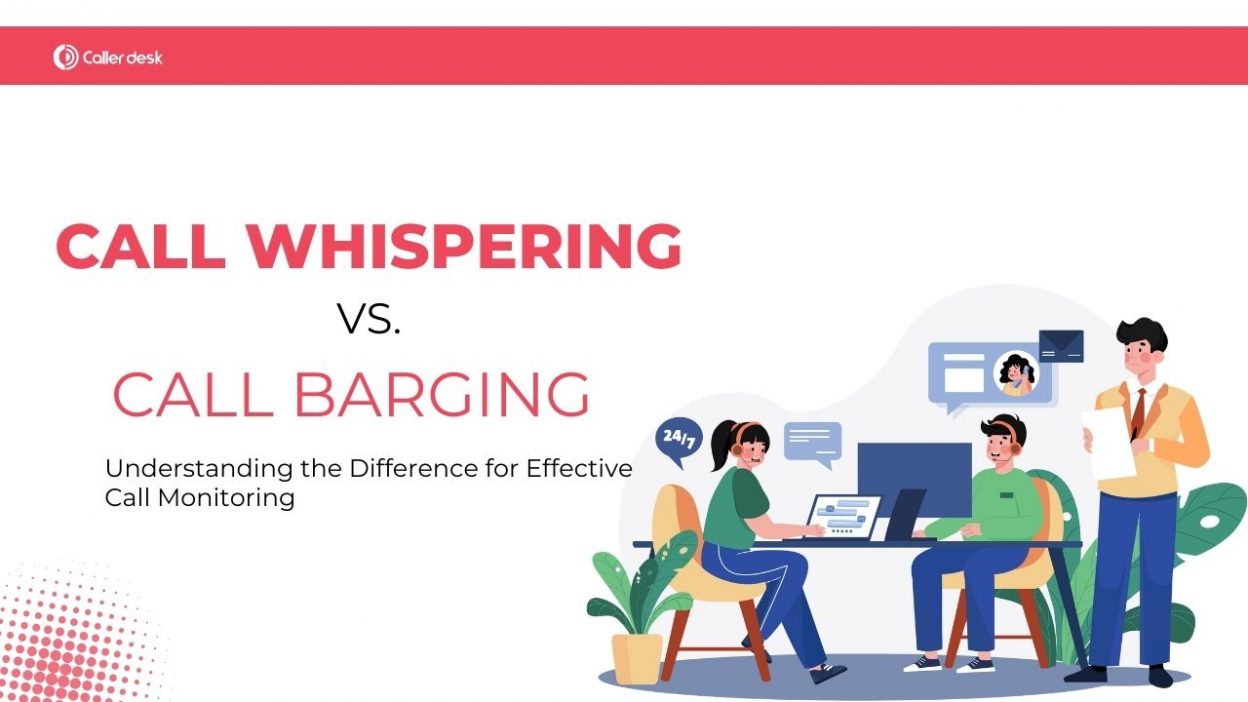
Modern Cloud Telephony systems give supervisors the ability to step into live calls in two very different ways: Call Whispering and Call Barging. While both are designed to help agents during live conversations, they are not interchangeable. Each serves a specific purpose and has a different impact on the call. This blog explains how Call Whispering and Call Barging actually work in real call center situations, when to use each one, and how to apply them correctly for effective call monitoring.
Why Call Monitoring Is More Than Just Listening
Call monitoring used to mean reviewing recordings after the call was already over. By then, mistakes were already made and customers were already frustrated.
With Cloud Telephony, monitoring happens live. Supervisors can hear what is going on, understand the situation instantly, and decide whether guidance or intervention is needed.
Effective call monitoring helps:
- Agents handle pressure situations better
- Teams stay aligned with processes and policies
- Customers get clearer, faster resolutions
- Managers reduce repeated errors
The real value lies in how the supervisor steps in.
What Call Whispering Really Is
Call Whispering allows a supervisor to speak to an agent during a live call without the customer hearing anything. The agent gets guidance in real time, while the customer continues the conversation as usual.
There is no interruption. No change in voice on the customer side. The agent remains the face of the conversation.
How Call Whispering Works in Practice
- An agent is talking to a customer
- The supervisor joins the call in whisper mode
- The supervisor’s voice reaches only the agent
- The customer stays completely unaware
From the customer’s perspective, nothing changes.
Why Call Whispering Works So Well
Call Whispering feels natural because it mirrors how people learn best. Quiet guidance, delivered at the right moment, without pressure.
Practical Benefits of Call Whispering
- New agents gain confidence faster
- Agents avoid panic during objections
- Conversations stay smooth and uninterrupted
- Call quality improves without escalation
- Learning happens during real situations
This is why Call Whispering is commonly used during onboarding, training periods, and performance improvement phases.
What Call Barging Is Used For
Call Barging is different by design. It allows a supervisor to join a live call and speak directly to both the agent and the customer.
Here, the supervisor becomes visible. The customer knows someone senior has stepped in.
How Call Barging Works
- An agent is on a live call
- The supervisor joins openly
- Both agent and customer hear the supervisor
- The supervisor may guide or take control
Call Barging changes the dynamic of the call instantly.
When Call Barging Makes Sense
Call Barging should never be the default option. It is meant for moments where silent guidance is no longer enough.
Situations Where Call Barging Is Useful
- A customer is clearly upset or angry
- The issue involves billing, policy, or compliance
- The agent lacks authority to resolve the concern
- The risk of customer loss is high
- The call needs immediate resolution
Used correctly, Call Barging can calm a situation instead of escalating it.
Call Whispering vs. Call Barging: The Real Difference
The difference between Call Whispering and Call Barging is not technical. It is emotional and situational.
Customer Awareness
Call Whispering keeps the supervisor invisible. Call Barging makes the supervisor part of the conversation.
Agent Experience
Call Whispering feels like support. Call Barging feels like a backup.
Conversation Flow
Call Whispering preserves continuity. Call Barging resets the flow.
Purpose
Call Whispering improves skills. Call Barging resolves problems.
Understanding this difference is key to effective call monitoring.
When Call Whispering Is the Better Choice
Call Whispering should be used whenever the goal is improvement without disruption.
Ideal Use Cases for Call Whispering
- Training new agents on live calls
- Helping agents stick to scripts
- Guiding responses during negotiations
- Supporting sales calls quietly
- Reducing call transfers
In most call centers, Call Whispering becomes part of daily operations because it strengthens agents without undermining them.
When Call Barging Should Be Used Carefully
Call Barging should be intentional, not reactive.
Ideal Use Cases for Call Barging
- Customer escalations
- Sensitive compliance discussions
- Policy disputes
- High-value customer complaints
- Situations beyond agent authority
Overusing Call Barging can make agents dependent. Using it wisely builds trust on both sides.
Impact on Customer Experience
Customers usually prefer seamless conversations. This is why Call Whispering often leads to better experiences. Problems get resolved quietly, without interruptions or confusion.
Call Barging, when used at the right time, reassures customers that their concern is being taken seriously by someone senior.
Success lies in choosing the right tool at the right moment.
Role of Cloud Telephony in Smarter Call Monitoring
Without Cloud Telephony, real-time call monitoring is limited. Cloud-based systems allow supervisors to monitor, whisper, or barge from anywhere.
Cloud Telephony enables:
- Live access to calls
- Remote supervision
- Easy switching between monitoring modes
- Scalable call monitoring across teams
This flexibility is essential for modern call centers.
How CallerDesk Supports Call Whispering and Call Barging
CallerDesk offers both Call Whispering and Call Barging within its Cloud Telephony platform, designed for practical, real-world use.
With callerdesk, supervisors can:
- Coach agents live using Call Whispering
- Step in during escalations using Call Barging
- Improve call quality without disrupting workflows
- Support agents without micromanagement
The focus stays on better conversations, not control.
Building a Balanced Call Monitoring Approach
Effective call monitoring is about restraint as much as action.
A balanced approach includes:
- Using Call Whispering for everyday coaching
- Using Call Barging only when needed
- Trusting agents to handle conversations
- Letting Cloud Telephony tools do the heavy lifting
This creates confident agents and consistent customer experiences.
Conclusion–
Call Whispering and Call Barging serve different but equally important roles in call monitoring. Call Whispering helps agents think clearly, respond better, and grow through real conversations. Call Barging provides direct support when a call reaches a critical point.
Modern call centers need both, supported by a reliable Cloud Telephony platform. When applied thoughtfully, these tools strengthen teams, protect customer relationships, and improve service quality.
If your goal is smarter call monitoring and better live support for agents, explore how callerdesk brings Call Whispering and Call Barging together in one platform. Visit callerdesk.io to see how the right tools can help your team manage every call with confidence and clarity.