
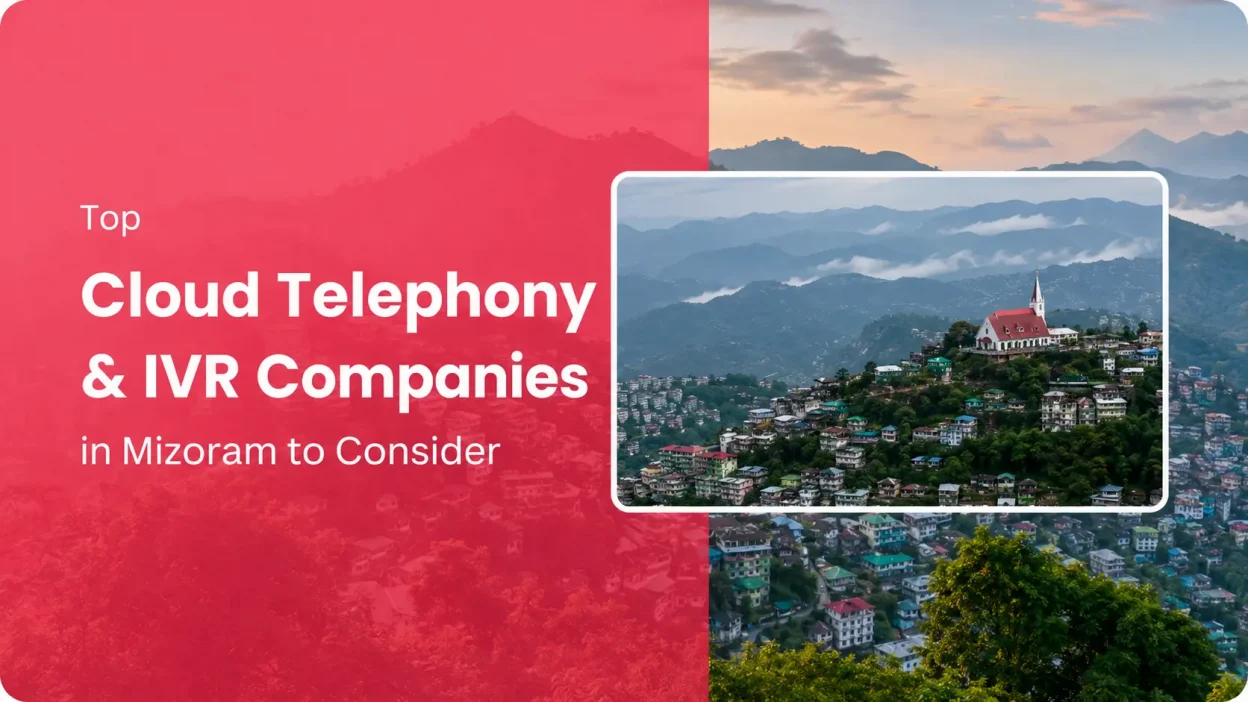
A customer calling a business in Mizoram usually does not know who handles bookings, sales, support, or accounts.
They only know the business number.
When calls increase, one number can quickly become difficult to manage. A hotel may miss a room enquiry, a travel company may struggle with booking calls, or a clinic may send patients from one employee to another.
Cloud telephony gives businesses a better way to manage these conversations.
With one business number, IVR, call routing, recordings, and analytics, companies can decide where calls go and what happens when nobody answers.
In this guide, we compare CallerDesk and other cloud telephony and IVR providers for businesses in Mizoram, so you can choose a solution based on your actual calling needs.
Why Growing Businesses in Mizoram Need Better Call Management
A small business can often manage calls through one phone.
But as the business grows, different teams start handling different types of enquiries.
For example:
Customer → Business Number → Employee → Missed Call
can become:
Customer → Business Number → IVR → Department → Agent → Follow-up
A hotel can send booking calls to reservations.
A healthcare business can direct appointment calls to reception.
A travel company can separate new enquiries from existing bookings.
The goal is simple: make sure customers reach the right person without having to call multiple numbers.
Top 6 Cloud Telephony & IVR Providers in Mizoram
1. CallerDesk
Best for: Growing businesses that want IVR, call routing, recordings, analytics, and organized team calling
Customers do not need to know which employee handles their enquiry.
They just need one number that works.
CallerDesk helps businesses create a central business number and build call flows around their teams.
A typical setup can look like:
Business Number → IVR → Department → Agent → Recording → Analytics
Businesses can use features such as IVR journeys, multi-level IVR, multilingual IVR, time-based routing, call routing, call recording, monitoring, analytics, CRM/API integrations, and team management.
CallerDesk can be considered by:
- Hotels and resorts
- Travel businesses
- Healthcare organizations
- Schools and coaching centres
- Retail businesses
- Sales teams
- Customer support teams
- Startups
- Software companies
- Growing businesses with multiple departments
The bigger advantage is how these features work together.
IVR → Routing → Agent → Recording → Analytics → CRM
Instead of treating the phone as just a way to receive calls, businesses can use it as part of their customer-management process.
2. Knowlarity
Best for: Businesses looking for cloud communication and business calling solutions
As a company grows, its communication needs can become more complex.
Different teams may need to handle sales, customer support, service requests, and other enquiries.
Knowlarity can be considered by businesses looking for capabilities around cloud telephony, IVR, business numbers, call routing, and customer communication.
It may be useful for:
- Growing businesses
- Sales teams
- Customer support teams
- Service businesses
- Organizations managing multiple customer calls
The right choice depends on how many calls the business receives and how much control it needs over its calling process.
3. Servetel
Best for: Businesses that want cloud-based calling with IVR and call management
A business does not always need a complicated contact centre.
Sometimes it simply needs to make sure incoming calls reach the right employee.
A basic flow could be:
Customer → IVR → Sales / Support / Accounts → Agent
Servetel can be evaluated by businesses looking for cloud telephony, IVR, call routing, call recording, and related business communication capabilities.
It may fit:
- Small and mid-sized businesses
- Sales teams
- Customer support teams
- Education businesses
- Service companies
For a growing company, the important question is whether the platform can continue supporting the business as call volumes and teams increase.
4. CloudTalk
Best for: Businesses that need cloud-based calling and customer communication
Some businesses have teams working from different locations.
In such cases, relying on individual phone numbers can make customer communication harder to manage.
CloudTalk can be considered by businesses looking for cloud-based calling, call management, analytics, and integrations.
It can be relevant for:
- Sales teams
- Customer support teams
- Remote teams
- Growing companies
- Businesses managing customer conversations across different channels
For businesses in Mizoram with distributed teams, the key consideration is whether the platform fits their calling workflow and integration requirements.
5. JustCall
Best for: Sales and support teams that want calling connected with their business tools
For a sales team, a phone call is often only the beginning.
The team may also need to record the conversation, update the customer record, and schedule a follow-up.
That creates a workflow like:
Lead → Call → Conversation → CRM Update → Follow-up
JustCall can be evaluated by businesses that want cloud calling combined with sales and customer-support workflows.
It may be relevant for:
- Sales teams
- Customer support teams
- Startups
- Remote teams
- Businesses already using CRM tools
The main consideration is whether the platform’s calling and integration capabilities match the tools the business already uses.
6. RingCentral
Best for: Businesses looking for a broader business communication platform
Some organizations need more than a basic business number.
They may have teams spread across locations and need a broader communication setup.
RingCentral can be considered by businesses looking at cloud communications, business calling, team communication, integrations, and scalable communication workflows.
It may be more relevant for:
- Larger businesses
- Distributed teams
- Organizations with multiple departments
- Companies with broader communication requirements
For smaller businesses, a simpler cloud telephony solution may be enough.
How Businesses in Mizoram Can Use Cloud Telephony
Cloud telephony is not only useful for large companies.
It can solve everyday calling problems for businesses across different industries.
1. Hotels and Hospitality
Hotels in Mizoram may receive calls about:
- Room availability
- Reservations
- Check-in information
- Transport
- Amenities
- Existing bookings
Instead of sending every caller to reception, a hotel can create:
Business Number → IVR → Reservations / Reception / Guest Support
This lets the front desk focus on guests while callers are directed to the right team.
2. Travel and Tourism
Travel businesses can receive calls from customers looking for packages, transport, accommodation, and booking information.
A simple IVR can organize calls like this:
Press 1 → New Booking
Press 2 → Existing Booking
Press 3 → Transport
Press 4 → General Enquiries
This becomes especially useful when several customers call at the same time.
3. Healthcare
A clinic or healthcare organization may receive different types of calls throughout the day.
One patient may want an appointment.
Another may need information about reports.
Someone else may have a billing question.
The business can create:
Press 1 → Appointments
Press 2 → Doctor Information
Press 3 → Reports
Press 4 → Billing
The goal is not to create a long IVR menu.
It is to help customers reach the right team faster.
4. Education
Schools, colleges, training centres, and coaching institutes can receive more enquiries during admission periods.
A central business number can organize calls around:
Admissions → Courses → Fees → Student Support
This means the organization does not need to give customers a different number for every department.
5. Retail and Local Service Businesses
Retailers and service businesses can receive calls about:
- Product availability
- Orders
- Delivery
- Sales
- Service requests
- Complaints
A central number can route these calls to the right team instead of making customers search for individual employee numbers.
What Should Businesses in Mizoram Compare Before Choosing a Provider?
Choosing a cloud telephony provider should not start with the cheapest plan.
Start with how your business actually handles calls.
1. Daily Call Volume
Look at:
- Average daily calls
- Peak-hour calls
- Missed calls
- Concurrent calls
- Inbound calls
- Outbound calls
A system that works for a small team may not work the same way when the business starts handling hundreds of calls.
2. Department Structure
Think about the teams that need to receive calls.
For example:
Sales → Support → Accounts → Operations
Your IVR should match your actual business structure.
3. Call Routing and Fallback
Ask a simple question:
What happens if nobody answers?
The system should be able to follow a predefined rule, such as:
Agent 1 → Agent 2 → Queue → Backup Number
This helps reduce missed opportunities.
4. Call Recording and Monitoring
Call recording can help with:
- Employee training
- Quality checks
- Customer-service reviews
- Dispute resolution
- Sales analysis
Managers can also use call analytics to understand how their teams are handling customer conversations.
5. CRM and Other Integrations
If your sales or support team already uses a CRM, check whether the telephony system can connect with it.
A useful workflow could be:
Customer Call → Caller Identification → CRM → Agent → Call Record → Follow-up
This reduces the need for employees to enter information manually.
6. IVR and Number Requirements
Before choosing a provider, check whether it supports the calling setup your business needs.
Look at:
- Business numbers
- IVR levels
- Department routing
- Time-based routing
- Multiple teams
- Call queues
- Call forwarding
- Fallback routing
7. Pricing
Do not compare providers only by their starting price.
Look at the complete cost.
This may include:
- Number charges
- Call charges
- Users or agents
- IVR usage
- Recording and storage
- Integrations
- Additional usage
- Setup requirements
A low starting price may become expensive when your business adds more users and features.
8. Scalability
Your business may start with:
1 Number → 3 Employees
Later, it could become:
1 Number → 5 Departments → 30 Agents → CRM → Analytics
Choose a platform that can support where your business is going, not just where it is today.
Frequently Asked Questions
What is cloud telephony?
Cloud telephony allows businesses to manage calls through internet-based communication systems instead of depending only on traditional phone infrastructure.
Businesses can use features such as business numbers, IVR, call routing, recording, analytics, and integrations.
Is IVR useful for small businesses in Mizoram?
Yes. Even a small business can use IVR to separate calls between sales, support, bookings, or other teams.
The key is to keep the menu simple.
Can hotels in Mizoram use cloud telephony?
Yes. Hotels can use a central number to route calls for reservations, reception, guest support, transport, and other enquiries.
Can cloud telephony connect with CRM software?
Many cloud telephony platforms support CRM and API integrations. Businesses should check whether the provider supports the specific CRM or software they already use.
How much does cloud telephony cost?
The total cost depends on factors such as the business number, call usage, number of users, IVR requirements, recordings, integrations, and additional features.
It is better to compare the complete cost rather than only the starting plan.
Which cloud telephony provider is right for my business?
There is no single provider that fits every business.
A small company may need a simple business number and IVR, while a larger organization may need advanced routing, analytics, integrations, and contact-centre capabilities.
Conclusion
The best cloud telephony provider for a business in Mizoram is not necessarily the one with the longest feature list.
It is the one that fits the way your team handles customer calls.
A hotel may need:
Booking → Reservations → Reception
A travel business may need:
Enquiry → Sales → Booking → Operations
A healthcare organization may need:
Appointments → Reception → Reports → Billing
A growing company may need:
IVR → Routing → Queue → Agent → Recording → Analytics → CRM
For businesses looking for a structured way to manage customer calls, CallerDesk is worth evaluating alongside providers such as Knowlarity, Servetel, CloudTalk, JustCall, and RingCentral.
The goal is simple:
One business number. The right team. Fewer missed conversations.