
Have you ever hesitated to answer an unknown number because you did not know who was calling?
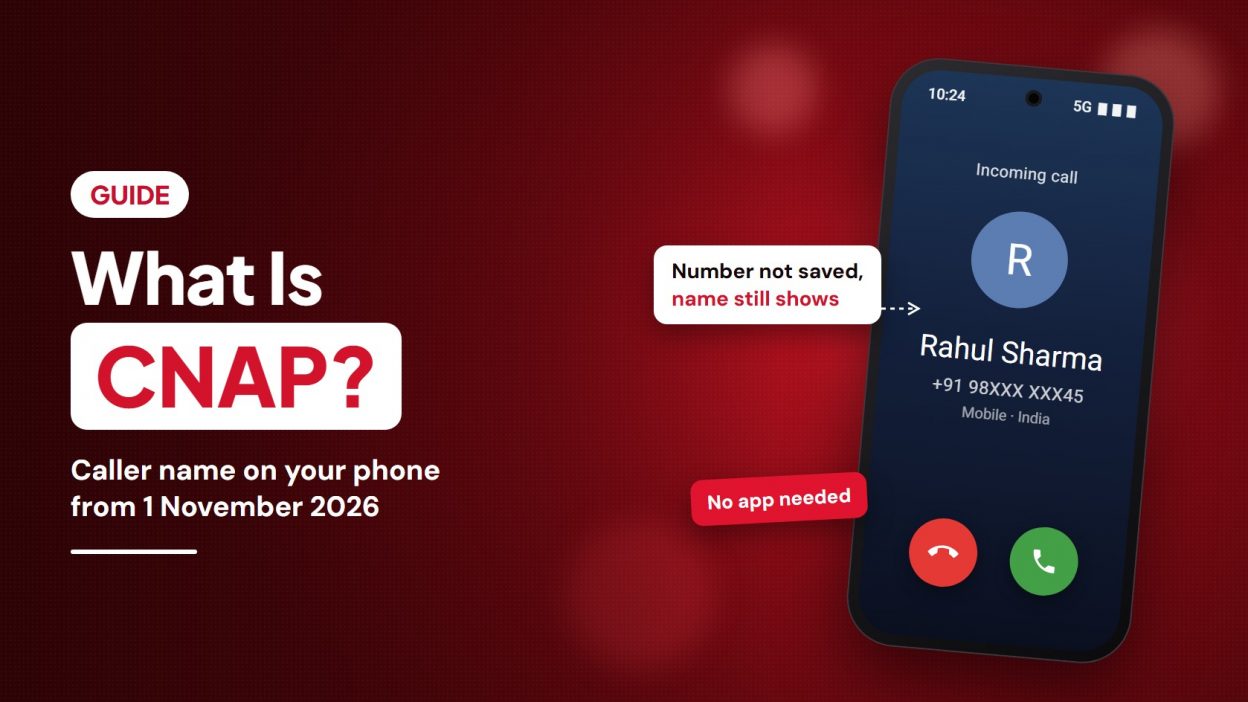
From 1 November 2026, mobile operators are directed to introduce Calling Name Presentation (CNAP) across 4G and higher-generation wireless networks. When you receive a call from a number that is not saved in your contacts, your phone may display the caller’s name along with their number.
CNAP works through the telecom network, so you do not need to install an app or make a separate request to activate it. The name shown comes from the caller’s subscriber records held by their mobile operator.
This guide explains how CNAP works, what information appears on your screen, how it differs from caller ID apps and what businesses need to know.
What is CNAP?
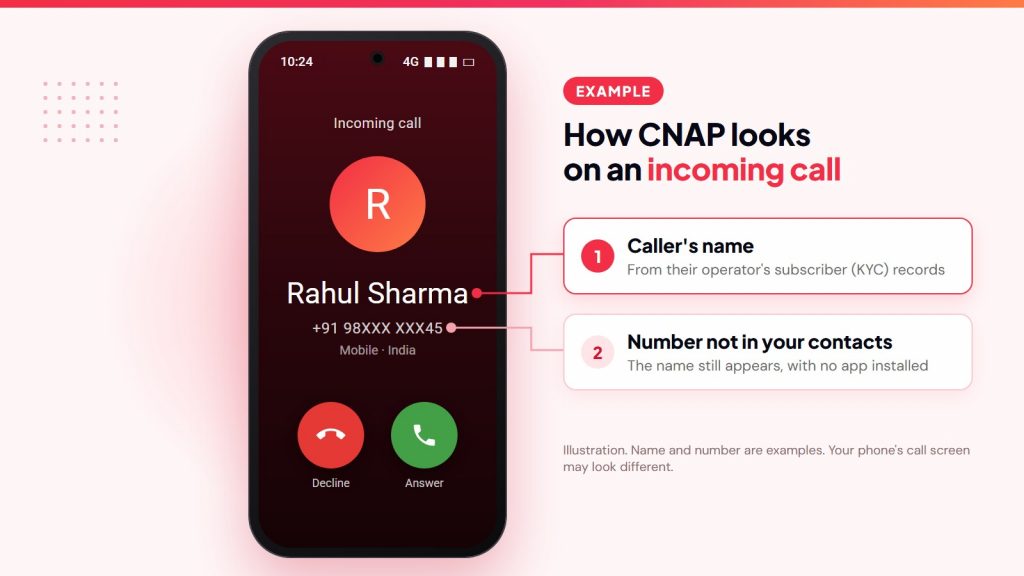
CNAP Full form is Calling Name Presentation. It is a telecom network service that displays the caller’s name on the receiver’s phone during an incoming call.
The name is taken from the caller’s subscriber records maintained by their mobile operator. If the number is already saved in your contacts, your phone will show the name you saved. If it is not saved, the network can display the caller’s name recorded by their operator.
DoT has directed operators to provide CNAP without requiring users to submit a separate request.
Initially, it will be available on 4G and higher-generation wireless networks, including 5G. DoT will consider support for 2G, 3G and landline networks separately.
Users will not need to request activation or install an app. CNAP is designed to work through the telecom network.
How does CNAP work?
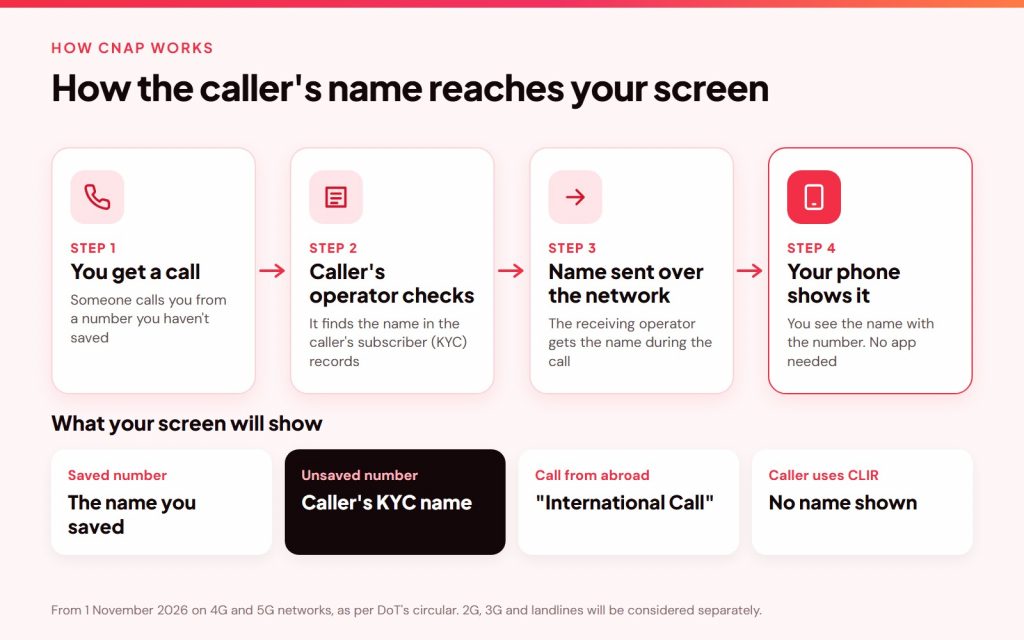
When a call is made, the caller’s mobile operator checks the subscriber record linked to that number. The caller’s operator makes the name available through the telecom network, and the receiving operator retrieves it for display on the receiver’s phone.
The name shown for an unsaved number is called the calling name identity. It is based on the name in the caller’s subscriber records, which are generally linked to the details provided when the SIM connection was registered.
Here is what you may see on your phone:
| Call type | What may appear on your screen |
| A number saved in your contacts | The name you saved |
| A domestic number not saved in your contacts | The caller’s name from their operator’s subscriber records |
| A call from outside India | “International Call” |
| A caller using CLIR | The caller’s name will not be displayed |
CLIR, or Calling Line Identification Restriction, is a facility used to restrict the display of a caller’s identity. DoT’s circular says that the calling name identity of a user who has activated CLIR will not be presented.
What does CNAP mean for privacy?
To show a caller’s name, the mobile network checks the subscriber records linked to that phone number and sends the matching name to the receiver’s network. DoT requires this lookup system to be designed so that the name used for the CNAP response is not retained after the call ends.
This requirement applies to the CNAP lookup process. It does not say that the subscriber record used to identify the caller is deleted. The circular also requires operators to maintain records linking users’ names with their phone numbers.
CNAP in India: Rollout Timeline and Key Dates
Telecom authorities have discussed CNAP since 2022. Its rollout plan has developed over time—from TRAI’s initial recommendation to provide it on request to DoT’s direction to make it available by default.
On 23 February 2024, TRAI recommended that users should be able to request CNAP. On 26 September 2025, DoT asked TRAI to reconsider this approach and make the service a default feature. The following month, TRAI agreed to a default service with an opt-out option.
Trials began in November 2025. Jio, Vodafone Idea and BSNL conducted trials in Haryana, while Airtel conducted trials in Himachal Pradesh. An earlier nationwide deadline passed in March 2026 without full coverage.
On 23 June 2026, telecom authorisation rules were notified under the Telecommunications Act, 2023. Rule 48 requires caller identification to be protected from tampering. Then, on 13 October 2026, DoT issued a circular directing operators to introduce CNAP on 4G and higher-generation wireless networks from 1 November 2026.
Can users opt out of CNAP?
In October 2025, TRAI agreed to a default service with an opt-out option. However, DoT’s final circular requires operators to provide CNAP without a separate request and does not explain how users can switch it off. Contact your mobile operator for its latest instructions.
CNAP vs caller ID apps
CNAP and caller ID apps can both display a name for an incoming number, but they use different sources.
CNAP gets the name from the caller’s subscriber records held by their operator. Caller ID apps usually use their own databases, which may include information shared by app users. Caller ID apps may also provide features such as spam labels.
| Feature | CNAP | Caller ID apps |
| Who provides it? | Your mobile operator | A third-party app |
| Where does the name come from? | The caller’s subscriber records with their operator | The app’s own database, which may include information shared by users |
| Do you need an app? | No | Yes |
| Does it depend on an internet connection? | The name is delivered through the telecom network | Usually requires an internet connection |
| Is it provided by default? | Operators must provide it from 1 November 2026 without a separate request | Only if you install and use the app |
What businesses need to know about CNAP
For business or bulk connections, the name displayed by default is the name recorded in the connection’s subscriber details. This may be a company’s legal name rather than the brand name customers recognise.
DoT’s circular allows an operator to offer a preferred name for a business or bulk connection. The preferred name must be either:
- A trademark registered in the user’s name with the Trade Marks Registry
- A trade name registered on the GST portal
The operator must verify the preferred name before displaying it. The circular says an operator may offer this facility, so businesses should check with their operator about availability and the application process.
| Connection type | What the business needs to do |
| New business connection | Submit original documents that support the preferred name when applying. |
| Existing business connection | Apply through the process provided by the operator. |
A verified brand name can help customers identify a business when it calls them. Businesses should check that their subscriber records and supporting registration documents are accurate.
DoT has also directed operators to set up a process for receiving, recording and resolving CNAP-related complaints within a defined time.
CNAP’s Scope and Limitations
CNAP displays the name linked to a phone number in the caller’s subscriber records. It can help you identify an incoming call, but it has some limitations.
1. The displayed name depends on subscriber records
If a SIM is registered in another person’s name, that person’s name may appear on your screen.
2. CNAP does not block spam calls
CNAP displays a caller’s name; it does not filter or block unwanted calls. You can use DND or block a number to manage unwanted calls.
3. The initial rollout does not include every network
The first rollout covers 4G and higher-generation wireless networks. DoT will consider CNAP for 2G, 3G and landline networks separately.
4. International calls may not show a caller’s name
If an international number is not saved in your contacts, your phone will show “International Call” instead of the caller’s name.
5. Callers using CLIR will not have their name displayed
If a caller has activated Calling Line Identification Restriction (CLIR), CNAP will not display their name.
6. A displayed name does not guarantee that a call is safe
CNAP does not assess a caller’s intentions or verify whether their request is genuine. Do not share your OTP, PIN or bank details with an unknown caller.
Related reading
Learn more about caller ID and unwanted calls
Frequently asked questions
What is the full form of CNAP?
CNAP stands for Calling Name Presentation.
When will CNAP start in India?
DoT has directed mobile operators to introduce CNAP from 1 November 2026 on 4G and higher-generation wireless networks.
Do I need to activate CNAP?
No. Operators must provide the service without requiring you to make a separate request.
Which name will appear on my screen?
If the number is saved in your contacts, your phone will show the name you saved. If it is not saved, the phone may show the caller’s name from their operator’s subscriber records.
Will CNAP work on 2G, 3G or landline networks?
These networks are not part of the initial rollout. DoT will consider them separately.
Can a business display its brand name?
An operator may offer this option for business or bulk connections. The preferred name must be a registered trademark or a trade name registered on the GST portal, and the operator must verify it.
Does CNAP store my name after a call?
DoT requires the CNAP lookup process to be designed so that the caller’s name is not retained after the incoming call is completed.
Can I hide my name on CNAP?
DoT’s circular says that a caller using CLIR will not have their name displayed. It does not describe a separate CNAP opt-out process. Contact your operator for its latest instructions.