
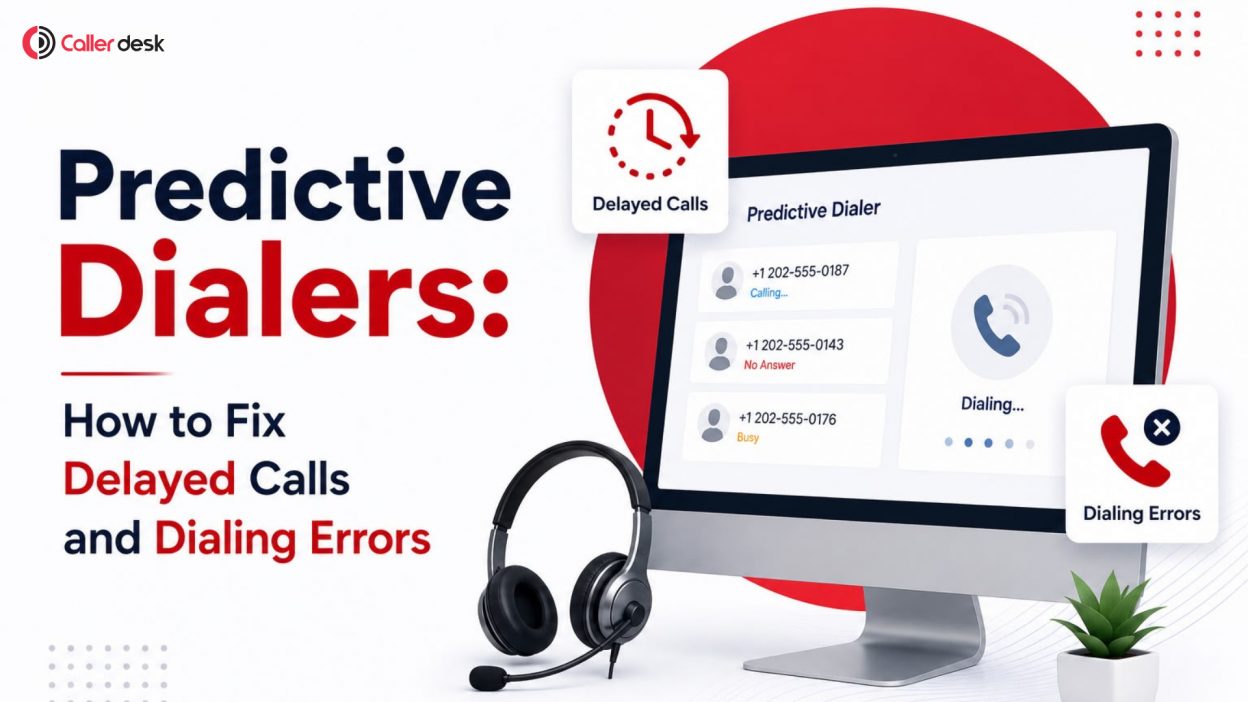
You invested in Predictive Dialers expecting a real jump in agent efficiency and connection rates. Instead, you are seeing delayed calls, “no response” errors, and dialing failures, along with that nagging feeling that something is off.
- 1 Predictive Dialer Issues at a Glance
- 2 Predictive Dialers: Delayed Calls, Causes, and Fixes
- 3 Dialer Shows No Response or No Voicemail Detected
- 4 Fixing Dialer Delivery Failed Errors
- 5 The Number You Dialed Does Not Exist, and Wrong Dial Errors
- 6 Other Common Predictive Dialer Issues
- 7 Best Practices to Prevent Predictive Dialer Issues
- 8 Why Choose CallerDesk’s Predictive Dialers?
- 9 Conclusion
- 10 Sources and Further Reading
- 11 FAQs
Here is the reassuring part. It almost never means the system is broken. Predictive Dialers work like a finely tuned engine. When one setting is off, the whole thing feels sluggish even though every part is technically working. Most predictive dialer issues come down to configuration, network conditions, or data quality, not a faulty platform. Once you know where to look, most of them take minutes to fix.
In this guide, you will learn how to fix:
- Delayed calls in your Predictive Dialers setup
- “No response” or missing voicemail errors
- Dialer delivery failures
- “The number you dialed does not exist” errors and wrong dial issues
- The other common call center dialer problems that affect performance
Predictive Dialer Issues at a Glance
| Issue | Most Likely Cause | Fastest Fix |
|---|---|---|
| Delayed calls | Overly conservative pacing ratio or network latency | Recalibrate pacing, run a bandwidth test |
| No response or missing voicemail | Answering machine detection sensitivity or timeout is misconfigured | Adjust detection sensitivity, test with known numbers |
| Delivery failed | Invalid number format, carrier blocking, or account limits | Validate numbers, check caller ID reputation, review account status |
| Number does not exist / wrong dial | Disconnected number or list import error | Run list validation before every campaign |
| Dropped calls | Aggressive dialing ratio or weak internet | Lower the ratio, monitor abandonment rate |
| High agent idle time | Pacing too conservatively or poor forecasting | Adjust pacing to match real agent availability |
| Calls marked as spam | Weak caller ID reputation or excessive retries | Use verified numbers, reduce retry frequency |
Predictive Dialers: Delayed Calls, Causes, and Fixes
One of the most common complaints with Predictive Dialers is a noticeable delay before a call connects to an agent, or calls going out later than scheduled.
Think of your dialer’s pacing setting like a thermostat. Set it too conservatively, and it holds back, dialing fewer calls than your agents can actually handle. That is the delay you feel. Set it too aggressively, and you swing straight into dropped calls and abandonment. The goal is finding the setting that keeps pace with how quickly your agents actually finish calls, not a static number you set once and forget.
Why this happens:
- Incorrect pacing or ratio settings that hold calls back
- Network latency that adds lag between dialing and connection
- Server or carrier-side congestion during peak hours
- Outdated lead lists that slow the system down while processing invalid numbers
How to fix delayed calls:
- Recalibrate the dialing ratio, lowering it slightly if delays coincide with high abandonment
- Check your bandwidth with a speed test during business hours
- Clean your lead list before every campaign to remove duplicate or disconnected numbers
- Review carrier or server status if delays cluster around specific times
- Monitor pacing in real time using your dialer’s live dashboard
This is one of the most common outbound calling software issues teams run into, and it is almost always fixable through pacing and list hygiene rather than a platform switch.
Dialer Shows No Response or No Voicemail Detected
If your dialer logs a call as “no response” or fails to detect voicemail, the issue is almost always in answering machine detection settings or call signaling.
Answering machine detection works by analyzing a short window of audio right after the call connects, reading silence patterns, tone, and speech cadence to decide whether it is a live person or a machine. When that window is too short or too long, the system misreads the signal, and you get exactly the symptom you are seeing. Real answers get logged as no response, or voicemails get skipped entirely.
Common causes:
- Detection sensitivity is set too high or too low
- Carrier delays in sending call progress signals
- SIP or VoIP configuration issues that disrupt the detection window
- Poor line quality that prevents accurate tone reading
How to fix it:
- Adjust detection sensitivity and test with a small batch of known numbers
- Increase the detection timeout slightly if live answers are being misjudged
- Check the SIP trunk configuration to confirm call progress signaling is mapped correctly
- Test with a controlled mix of live answers, voicemail, and no answer numbers to isolate the cause
This is a frequent source of auto dialer troubleshooting requests, since the fix usually sits in a setting most teams never touch after initial setup.
Fixing Dialer Delivery Failed Errors
A delivery failure means the dialer attempted the call, but it never reached the carrier network or the recipient.
Common causes:
- Invalid or malformed number formatting
- Carrier-level call blocking or spam filtering
- SIP trunk or gateway misconfiguration
- Account-level restrictions such as balance limits or number blacklisting
How to fix it:
- Validate number formatting, including correct country and area codes, before upload
- Check your caller ID reputation, since carriers increasingly block numbers flagged as spam
- Review account limits to confirm you have not hit a rate or balance threshold
- Check SIP or gateway logs, which usually show a specific error code pointing to the exact cause
A few SIP response codes are worth knowing when you’re reading these logs. A 404 typically means the number does not exist on the network. A 480 means the destination is temporarily unavailable. A 503 usually points to a carrier or gateway capacity issue rather than a problem with the number itself. Knowing which code you are seeing saves time, since a 404 sends you back to list quality while a 503 sends you to your carrier’s status page instead.
Reliable cloud dialer solutions typically surface these error codes directly in the dashboard, which makes this one of the faster fixes on this list once you know where to look.
The Number You Dialed Does Not Exist, and Wrong Dial Errors
This error is usually not a dialer problem at all. It is a data quality issue upstream of the dialer.
Common causes:
- The number in your lead list is disconnected or was never active
- A digit was dropped or duplicated during the list import
- The number was ported to a different carrier, and the routing has not been updated
- An incorrect country code causes the dialer to misroute the call
How to fix it:
- Run list validation before every campaign using a number verification tool
- Check import formatting, since CRM and CSV exports sometimes truncate or alter digits
- Suppress numbers that consistently return this error rather than retrying them
Other Common Predictive Dialer Issues
Beyond the errors above, a few other call center dialer problems commonly affect performance.
Dropped calls are often caused by an aggressive dialing ratio or weak internet. Lower the ratio, monitor abandonment, and improve bandwidth stability.
Low answer rates are usually linked to poor lead quality or bad call timing. Clean contact lists regularly and schedule calls during optimal windows.
Poor call quality, including echo or jitter, typically points to network configuration. Configure quality of service settings properly and use wired connections where possible.
High agent idle time usually comes from incorrect pacing or poor forecasting. Adjust pacing and review campaign settings regularly.
CRM integration problems, including failed syncs or duplicate contacts, usually point to broken API connections. Reconnect and test APIs regularly and monitor sync logs.
Compliance and abandoned call risk rise when Do Not Call checks are skipped or abandonment thresholds are exceeded. Under the FTC’s Telemarketing Sales Rule, predictive dialers must not abandon more than 3 percent of answered calls over a rolling 30-day period, and unanswered calls must ring for at least 15 seconds or four rings before disconnecting. A single aggressive afternoon of dialing can push a campaign average over that 3 percent line, so abandonment should be checked daily, not just at the end of a campaign. Note that the FCC proposed loosening some of these specific requirements in late 2025, so confirm the current rule with your compliance team or legal counsel before adjusting pacing based on this threshold. Keep compliance filters enabled and monitor abandonment rates closely regardless of where the rule lands.
Calls marked as spam often result from a weak caller reputation or excessive retries. Use verified business numbers and keep abandonment rates low.
Best Practices to Prevent Predictive Dialer Issues
Most predictive dialer issues can be avoided with regular maintenance:
- Monitor calls and system performance daily
- Keep CRM data clean and updated
- Test network performance regularly
- Train agents on dialer workflows
- Review campaign and compliance settings often
Change one variable at a time when troubleshooting. Adjusting pacing, your lead list, and your caller ID reputation all in the same week makes it nearly impossible to tell which fix actually worked.
Why Choose CallerDesk’s Predictive Dialers?
CallerDesk’s cloud dialer solutions are built to minimize the issues covered in this guide, with intelligent call pacing, accurate answering machine detection, real-time CRM sync, and built-in compliance controls. The goal is to keep delayed calls, delivery failures, and misdials to a minimum, so your team spends less time troubleshooting and more time talking to customers.
Conclusion
Predictive dialer issues, whether delayed calls, no response errors, delivery failures, or misdials, are almost always fixable with the right configuration and clean data, not a sign your system is broken. Regular monitoring, list hygiene, and network checks prevent most of these problems before they start. If you are consistently running into these issues despite following the fixes above, it may be time to evaluate whether your current platform, not just your settings, is holding your team back.
Sources and Further Reading
- Federal Communications Commission, Telephone Consumer Protection Act, 47 U.S.C. § 227: https://www.fcc.gov/sites/default/files/tcpa-rules.pdf
- FDIC Consumer Compliance Examination Manual, Telephone Consumer Protection Act overview: https://www.fdic.gov/consumer-compliance-examination-manual/viii-5-telephone-consumer-protection-act
These sources cover the abandonment rate cap, ring time requirements, and consent rules referenced in the compliance section above. Regulations in this area continue to evolve, so confirm current requirements with legal counsel before making compliance-related configuration changes.
FAQs
1. Why is my predictive dialer delaying calls? Delayed calls are usually caused by incorrect pacing settings, network latency, or outdated lead lists. Recalibrating your dialing ratio and checking bandwidth typically resolves this.
2. Why does my dialer show no response for calls that were actually answered? This is usually an answering machine detection or carrier signaling issue. Adjusting detection sensitivity or increasing the timeout often fixes it.
3. What does dialer delivery failed mean? It means the call never reached the carrier or recipient, commonly due to invalid number formatting, carrier-level blocking, or account restrictions.
4. Why does my dialer say the number you dialed does not exist? This is typically a data quality issue, such as a disconnected or incorrectly formatted number in your lead list, not a dialer malfunction.
5. What are Predictive Dialers and how do they improve outbound calls? Predictive Dialers are automated systems that dial multiple numbers, filter unanswered calls and voicemails, and connect only live answers to available agents, improving talk time and reducing manual dialing effort.