
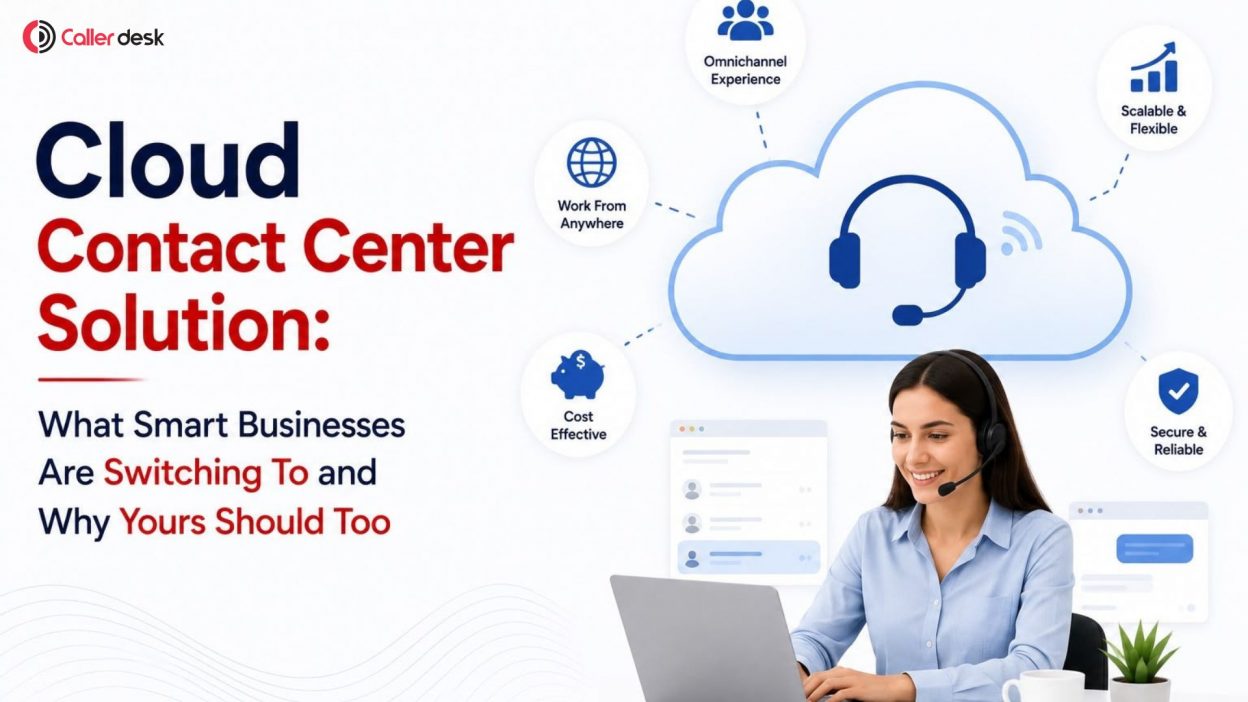
Every growing business hits the same wall eventually: agents juggling three different tools just to answer one call, customers stuck on hold with no idea when they’ll be helped, and managers with zero visibility into what’s actually happening on the floor. The result is dropped calls, frustrated teams, and lost business. A cloud contact center solution fixes this by bringing calls, data, and reporting onto one connected platform- no extra hardware, no guesswork.
- 1 What is a Cloud Contact Center Solution?
- 2 Why Smart Businesses Are Switching
- 3 Key Features to Look For
- 4 Cloud vs On-Premise Contact Center
- 5 Cloud Contact Center Solution vs Cloud PBX Phone System
- 6 How to Choose the Right Solution
- 7 Real-World Case Study: NBFC Toll-Free Transformation
- 8 Why CallerDesk
- 9 FAQs
- 10 Sources
What is a Cloud Contact Center Solution?
A cloud contact center solution is customer service cloud software that lets businesses manage all customer interactions, calls, WhatsApp, chat, and email, from a single online platform, without installing hardware on-site. It routes incoming calls to the right agent automatically, tracks performance in real time, and lets teams work from any location with just an internet connection. Because everything runs on the cloud, businesses can add agents, numbers, or channels within minutes instead of weeks.
Why Smart Businesses Are Switching
More Indian businesses are moving away from traditional phone setups every year, and the reasons go beyond just cost. A cloud based contact center solution frees teams from physical infrastructure, adapts to changing team sizes, and gives managers visibility they never had with landlines. According to MarketsandMarkets, the global cloud based contact center market grew from USD 20.9 billion in 2023 to an estimated USD 26.2 billion in 2024, showing how fast businesses worldwide are making this shift.
Here’s what’s driving the move:
- Lower cost: no hardware to buy, no annual maintenance contracts (AMC), and no dedicated IT team needed just to keep phones running.
- Supports remote and hybrid teams: agents can log in and take calls from home, a branch office, or while travelling, using just a laptop and internet.
- Easy to scale up or down: add ten agents during a sale season or scale back after, without waiting on hardware procurement.
- Better customer experience through smart routing: calls reach the right agent instantly instead of being transferred multiple times, cutting wait time and frustration.
Key Features to Look For
Not every cloud contact center solution offers the same depth of features. Before choosing one, check whether it covers these essentials:
- Call routing / IVR: Automatically directs callers to the right department or agent based on their input, cutting hold times and manual transfers.
- CRM integration: Syncs call data directly with your existing CRM, so agents see customer history before they even pick up.
- Real-time reporting and analytics: show live call volumes, agent availability, and wait times, helping managers make quick, informed decisions.
- Omnichannel support (WhatsApp, calls, etc.): Let’s customers reach you through their preferred channel while agents manage everything from one dashboard.
- Call recording and quality monitoring: Records conversations for training, dispute resolution, and quality checks, and flags calls that need review.
Cloud vs On-Premise Contact Center
Businesses evaluating both models often find the difference comes down to control versus convenience. Here’s how they compare on the factors that matter most:
| Factor | Cloud Contact Center | On-Premise Contact Center |
| Setup cost | Low – pay-as-you-go, no hardware | High – servers, phone lines, equipment |
| Setup time | Days | Weeks to months |
| Maintenance | Handled by the provider | Managed in-house, needs dedicated IT staff |
| Scalability | Add or remove agents instantly | Requires new hardware and licenses |
| Remote access | Works from anywhere with internet | Typically tied to office premises |
That said, on-premises setups can still make sense for organizations with strict data residency rules or legacy systems that aren’t ready for cloud migration; it isn’t a one-size-fits-all decision.
Cloud Contact Center Solution vs Cloud PBX Phone System
These two terms get mixed up often, but they solve different problems.
A cloud based contact center is a full customer service setup; it includes call routing, CRM integration, analytics, and omnichannel support, built for teams handling high interaction volumes. A cloud PBX phone system, on the other hand, is a business phone infrastructure that includes calling, extensions, and basic IVR. It can sit underneath a larger contact center or work as a standalone system for simpler business calling needs.
If your business only needs to manage internal calling and extensions rather than run full support operations, a cloud PBX phone system alone might be all you need.
How to Choose the Right Solution
Choosing a cloud contact center solution isn’t about picking the most popular name; it’s about matching features to your actual business needs. Before signing up, run through this checklist:
- TRAI compliance: Confirm the provider follows Telecom Regulatory Authority of India (TRAI) guidelines for call routing, DND, and number provisioning.
- CRM/tool integration: Check that it connects with the CRM, helpdesk, or sales tools your team already uses.
- Uptime guarantees: Look for a documented uptime SLA, since even short downtime can mean missed customer calls.
- Support quality: Test their support responsiveness before you commit; a slow support team becomes your problem during outages.
- Transparent pricing: Ask for a full breakdown of costs, including per-agent fees, call charges, and any hidden add-ons.
Running through this checklist before signing a contract saves businesses from switching providers within the first year, a common and costly mistake.
Real-World Case Study: NBFC Toll-Free Transformation
An NBFC managing 350 agents and 72 separate landline numbers was struggling with 2–3 lakh monthly calls, frequent call drops, and no way to track performance, a problem that worsened when the pandemic pushed most staff to work from home.
The company switched to a toll-free number setup with multi-level IVR, call recording, and analytics, replacing its scattered landline system with one unified number.
The results were significant: call flow capacity increased by 300%, call drops fell by 45%, and overall customer satisfaction rose by 100%, according to the AcmaTel Communications case study. The shift also gave managers real-time visibility into call routing and agent performance for the first time.
Why CallerDesk
CallerDesk builds cloud contact centre solutions specifically for Indian businesses, from growing startups to established BFSI and NBFC teams handling high call volumes daily.
Every setup runs on TRAI-compliant infrastructure with guaranteed uptime, giving businesses the reliability they need for customer-facing operations. CallerDesk’s platform brings together call routing, real-time analytics, CRM integrations, and omnichannel support (including WhatsApp) into a single dashboard, so teams aren’t juggling separate tools.
With a growing base of Indian businesses already running their support and sales operations on CallerDesk, the platform is built around what local teams actually need: simple onboarding, transparent pricing, and support that understands Indian business hours and language needs.
If you’re evaluating a cloud based contact center solution for your team, it’s worth seeing how CallerDesk fits your specific call volume and workflow.
FAQs
1. What is a cloud contact center solution?
A cloud contact center solution is a cloud based platform that manages customer calls, chats, and messages from one system, without on-site hardware. It handles call routing, reporting, and omnichannel support, letting agents work from anywhere with an internet connection.
2. How much does it cost in India?
Pricing typically depends on the number of agents, call volume, and features needed. Most Indian providers offer per-agent monthly plans, with costs scaling based on additional features like CRM integration, call recording, and omnichannel support.
3. Is it secure and TRAI-compliant?
Reputable providers follow TRAI guidelines for call routing, number provisioning, and DND compliance, alongside data encryption and secure call storage. Always confirm compliance certifications directly with your chosen provider before signing up.
4. Does it integrate with existing CRMs?
Most modern cloud contact centre solutions integrate with popular CRMs like Zoho, Salesforce, and HubSpot, syncing call data and customer history automatically. Check integration compatibility with your specific CRM before choosing a provider.
Sources
- MarketsandMarkets, “Cloud-Based Contact Center Market” Report, 2024
- AcmaTel Communications, NBFC Toll-Free Number Case Study
- TRAI (Telecom Regulatory Authority of India), Unsolicited Commercial Communications (UCC) – Official Guidelines