
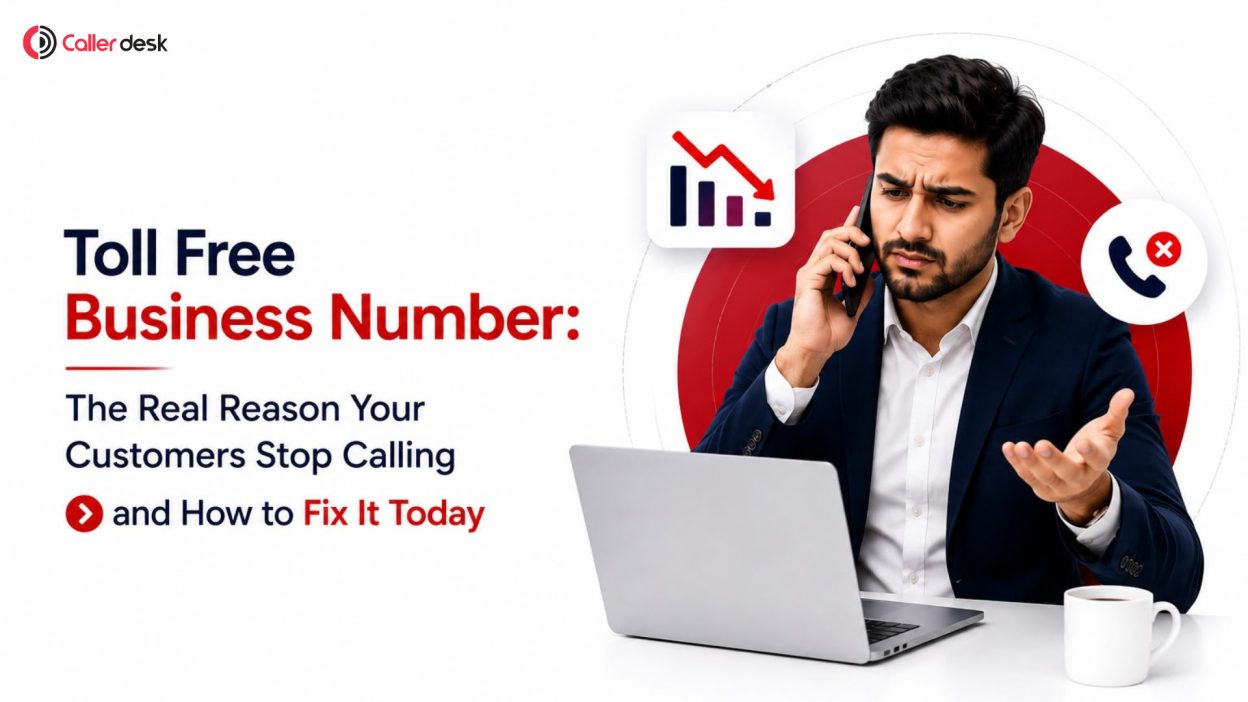
Customers stop calling a business when they face friction, long wait times, no visible support number, or an IVR that leads nowhere. A toll free business number (1800 prefix, regulated by TRAI) removes the cost barrier for callers, signals legitimacy, and, when paired with smart IVR routing, directly reduces call drop-off. For Indian businesses, it is both a trust signal and a measurable fix for lost inbound volume.
- 1 The Real Reason Customers Stop Calling Your Business
- 2 What Is a Toll Free Business Number and Why Does It Matter?
- 3 Key Data: What the Numbers Say About Toll-Free and Customer Retention
- 4 How a Toll Free Business Phone Number Fixes the Drop-Off Problem
- 5 Toll-Free Number for Customer Service: Which Businesses Need It Most?
- 6 What to Look For in Toll-Free Providers
- 7 Real-World Example
- 8 How to Get a Toll-Free Business Phone Number: Step-by-Step
- 9 Frequently Asked Questions
- 10 Why Choose CallerDesk as Your Toll Free Customer Service Provider
- 11 Sources & References
The Real Reason Customers Stop Calling Your Business
Most businesses assume customers stop calling because of a bad product or a slow agent. The real reason is simpler: friction. When calling feels costly, confusing, or pointless, customers quietly stop trying.
The numbers confirm this. Contact centers lose up to 27% of inbound calls to abandonment, and nearly 60% of customers who hang up never call back. 32% never return to that business at all (Voiso, 2025). For small and mid-sized businesses, missed calls cost an average of $126,000 annually, with each unanswered call worth anywhere between $200 and $1,200 depending on the industry (Ringly.io, 2026).
The common causes behind this drop-off are:
- Customers abandon calls after waiting 60–90 seconds with no answer or queue update
- A local or personal-looking number signals an informal, unverified business, especially in healthcare, BFSI, and D2C, where trust matters before the first word is spoken
- No visible support number on a website is read as unavailability, not just an oversight
- Poorly structured IVR menus and repeated transfers frustrate callers into hanging up
A customer service toll free number removes the first barrier, caller cost, and creates the foundation to fix the rest.
What Is a Toll Free Business Number and Why Does It Matter?
A toll free business number is a dedicated phone line where the caller pays nothing. The business absorbs the call cost through a monthly rental and per-minute inbound charge, managed through a TRAI-licensed cloud telephony provider. In India, these numbers carry the 1800 prefix and are issued under the Telecom Regulatory Authority of India’s regulatory framework.
Beyond the mechanics, what matters is the signal it sends. In India’s tier 2 and tier 3 cities, an 1800 number is still closely associated with established, accountable companies, banks, insurers, large e-commerce brands, and government helplines, all of which use them. A local mobile number, by contrast, feels unverified, especially for a first-time customer filing a complaint or making a significant purchase. The difference between a toll free business number and a regular mobile line isn’t just technical; it’s the message it sends before the call is even answered.
Key Data: What the Numbers Say About Toll-Free and Customer Retention
The toll free business number case is well-documented:
- “Businesses that buy a toll free number report a 40% increase in inbound call volume compared to those without one (CallerDesk, 2025).”
- Displaying a toll-free number on a landing page can lift conversion rates by 9–25% depending on the industry (Callin, 2025)
- 75.5% of consumers have switched to a competitor after a poor customer service experience, and the phone is usually where that decision is made (Ringover, 2025)
- 71% of Gen Z consumers say live phone calls rank highly as a preferred customer service channel (McKinsey, 2024), disproving the assumption that younger customers only want digital support
- 74.8% of Fortune 500 companies use a toll-free number (UnitelVoice, 2026), confirming it remains a default credibility marker even among the largest, most digitally advanced organizations
For Indian BFSI businesses, there is also a regulatory shift to be aware of. As of January 1, 2026, RBI has mandated that banks, NBFCs, and insurers use the separate 1600 series specifically for transactional calls such as OTPs and fraud alerts. The 1800 number remains valid for general customer service, but any business in this sector must now run two separate number systems for different call types.
How a Toll Free Business Phone Number Fixes the Drop-Off Problem
Getting the number is step one. What actually reduces drop-off is how the system behind it is configured.
Removing the cost barrier increases the number of customers who attempt to call in the first place; this matters most in price-sensitive tier 2 and tier 3 markets where even a small STD charge can discourage a call. A well-structured IVR then routes callers to the right department without unnecessary transfers, eliminating the mid-call frustration that causes hang-ups. Call recording and analytics reveal exactly where in the IVR flow customers are dropping, which level, at what wait time, and during which hours, turning drop-off from a vague problem into a specific one that can be fixed. Business-hours routing with missed-call alerts ensures no inquiry disappears after working hours, and a 24×7 IVR fallback for common queries keeps the number useful around the clock even when no agents are online.
Toll-Free Number for Customer Service: Which Businesses Need It Most?
A customer service toll free number delivers the highest return in industries where a missed call has a direct cost:
- E-commerce and D2C: order queries, delivery complaints, and return requests spike during festive sales; unanswered calls convert into refund requests and negative reviews
- BFSI: loan queries, account issues, and KYC follow-ups require a credible, accessible number; with the 1600-series rule now active for transactional calls, the 1800 number handles general service queries
- Healthcare: appointment bookings and report-related calls are time-sensitive; an abandoned call in this segment affects patient outcomes, not just satisfaction scores
- EdTech: admission helplines run at high volume during enrollment windows; one missed call can mean one lost student
- Real estate and B2B: lead qualification and post-sale support require a number that signals the business is reachable and accountable at scale
What to Look For in Toll-Free Providers
Before you buy a toll free business number, verify these six things with any provider:
- TRAI licensing and KYC support: the provider must be licensed and must guide you through the documentation without creating delays
- IVR depth and multi-level routing: confirm how many IVR levels are supported and whether regional language options are available
- Call recording and analytics: these should be part of the core plan, not a paid add-on
- CRM and helpdesk integration: call data must sync into your existing systems, not sit in a separate dashboard
- Uptime and Indian carrier compatibility: ask specifically about routing reliability on regional networks and during peak call periods
- Transparent post-activation pricing: get the exact monthly rental and per-minute rate in writing before signing, not after the trial period ends
Real-World Example
A Bengaluru-based EdTech company was losing 35% of inbound admission calls at its peak enrollment period. Most callers dropped off at the second IVR level or abandoned after 90 seconds on hold. After switching to a toll free phone number for business with a restructured three-level IVR, course type, then city, then counsellor, missed calls dropped by 40% within the first billing cycle. Callers reached the right person without being transferred, first-call resolution improved, and the enrollment-to-call ratio rose by 18% compared to the same period the previous year.
How to Get a Toll-Free Business Phone Number: Step-by-Step
- Choose a TRAI-licensed provider: compare IVR depth, analytics availability, and post-trial pricing before committing
- Complete KYC: submit your business registration certificate, GST certificate, and address proof
- Configure IVR and routing: set department routing, business hours, language options, and after-hours fallback rules
- Integrate with CRM or helpdesk: connect your call data to existing customer management systems
- Test across networks: make test calls from mobile, landline, and VoIP to catch any carrier-specific blocks before going live
- Monitor analytics for the first 30 days: track abandonment by IVR level and time of day, then adjust routing based on what the data shows
A toll free service provider completes activation within 24–72 hours of document verification.
Frequently Asked Questions
What is a toll free business number?
A phone line with an 1800 prefix, regulated by TRAI, where the caller pays nothing. The business covers the cost through monthly rental and per-minute inbound charges.
How does a customer care toll free number benefit customer service?
Toll free number for customer service removes the cost barrier for callers, increases call volume, and enables IVR routing and analytics that reduce abandonment and pinpoint exactly where customers are dropping off.
Can small businesses afford a toll-free phone number?
Yes. A toll free number service provider offers trial-based plans with per-minute billing that scales with call volume, so costs stay proportional to usage.
What is the difference between a toll-free number and a customer care number?
A toll-free number is a technical designation,1800 prefix, free for the caller. A customer care number simply means any number used for support. Only an 1800 number is genuinely toll-free.
How do I buy a toll-free number for my business in India?
Select a TRAI-licensed cloud telephony provider, complete KYC, configure IVR routing, and go live, typically within 24–72 hours of document verification.
Which industries benefit most from a toll-free customer service number?
E-commerce, BFSI, healthcare, EdTech, and real estate, industries where a missed inbound call means lost revenue, a lost enrollment, or a compliance risk.
Why Choose CallerDesk as Your Toll Free Customer Service Provider
The provider you choose matters as much as the number itself. A toll-free number with a poorly built IVR, no analytics, or unclear billing doesn’t reduce drop-off, it just relocates the problem. CallerDesk is built for Indian businesses that need the number and the infrastructure to back it up.
Here is what CallerDesk brings to the table:
- Transparent pricing from day one: no hidden costs or billing surprises after the trial ends
- TRAI-compliant KYC, handled end-to-end: documentation guided and managed, so activation is not delayed by paperwork
- Multi-level IVR with regional language support: designed for India’s linguistic diversity, not adapted from a global product
- Call recording, analytics, and missed-call alerts included: not charged as extras
- CRM and ERP integration — call data flows directly into your existing business systems
- Support from a team that understands TRAI regulations: not a generic global helpdesk
Whether you are an SMB noticing early call drop-off or a startup building a credible inbound system before your next growth phase, CallerDesk’s free trial gives you a clear read on your call volume and system performance before you make any financial commitment.
Sources & References
TRAI / RBI 1600-series BFSI directive, November 2025 / CallerDesk, Indian Business Communication Trends, 2025 / Callin, “Toll Free Business Numbers in 2025” / UnitelVoice, Fortune 500 Business Number Study, 2026 / Voiso, “Call Abandonment Rate: A Strategic Guide,” July 2025 / Ringly.io, “47 Call Abandonment Rate Statistics,” 2026 / Ringover, Customer Service Switching Study, 2025 / McKinsey, Gen Z Customer Service Survey, 2024