
The way of communication in business has evolved dramatically. Landlines are being replaced with intelligent internet connections. People often mistake VoIP and cloud telephony as the same because they both allow businesses to make and receive calls via the internet. A VoIP phone system is a typical method of internet calling. But they are not the same, and they have different advantages. It is crucial to know this difference when setting up a phone system for your business. It can help you save money, boost productivity, and fuel growth. Here, we’ll explore how they work and which type is right for your business.
- 1 What is a VoIP Phone System?
- 2 What is Cloud Telephony?
- 3 VoIP vs Cloud Telephony
- 4 How a VoIP Cloud Phone System Works
- 5 Benefits of a VoIP Phone System for Businesses
- 6 Benefits of Cloud Telephony for Businesses
- 7 When Should You Choose a VoIP Phone System?
- 8 When Should You Choose Cloud Telephony?
- 9 How to Choose the Right Cloud Phone Service Providers
- 10 Common Challenges and Solutions
- 11 Future of Business Calling in India
- 12 Frequently Asked Questions
- 13 Conclusion
What is a VoIP Phone System?
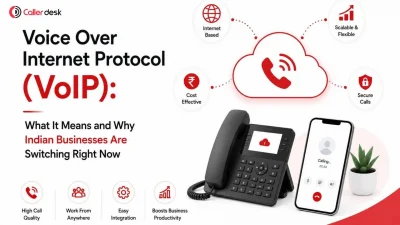
A VoIP phone system is a new way to make and receive calls over the internet, rather than using old-fashioned telephone cables. It does this by turning your voice into digital data and transmitting it over the internet. This allows for faster, intelligent, and cost-effective communication. IP desk phones, mobile apps, and softphones (computer-based phones) are generally used by businesses. It is often used for team calls, customer service, and office communication. Many companies choose it for lower costs and better flexibility.
What is Cloud Telephony?
Cloud telephony is a business phone system that runs completely online through cloud servers. So there is no need for businesses to set up their own PBX system or expensive equipment. Users can manage calls on mobile devices, laptops, or web portals. It typically includes features such as IVR, call routing, call recording, and reporting. It’s popular with businesses because it’s easy to set up and the provider takes care of maintenance. A Cloud phone system in India is becoming a popular choice for growing businesses that need flexible communication.
VoIP vs Cloud Telephony
| Feature | VoIP | Cloud Telephony |
| Meaning | Internet calling system | Cloud-based business phone system |
| Hardware Need | May need devices | No major hardware needed |
| Setup Control | Managed by the business | Managed by the provider |
| Scalability | Medium growth support | Easy high growth support |
| Remote Access | Available | Very easy access |
| IVR Features | Optional | Usually included |
| Analytics | Basic reports | Advanced reports |
| Maintenance | Internal team needed | Provider handles it |
| Best For | Budget-focused businesses | Fast-growing businesses |
How a VoIP Cloud Phone System Works
A VoIP cloud phone system combines internet calling with smart business phone features. When a customer calls your business, the call is received by secure servers in the cloud. Then, greetings, IVR flows, and call rules are applied. Finally, the call is routed to the appropriate employee via a mobile app, softphone, laptop, or desk phone. Call recordings, reports, and call logs are also stored in the cloud. This system helps businesses manage calls smoothly without expensive hardware or heavy maintenance. It is flexible, efficient, and ideal for modern businesses.
Benefits of a VoIP Phone System for Businesses
- Saves money on local, long-distance, and international calls.
- Let your team take calls from any device, anywhere.
- Makes internal communication faster and easier.
- Keeps remote employees connected at all times.
- Makes global customer calling simple and affordable.
- Keeps business calls running during shutdowns or emergencies.
Benefits of Cloud Telephony for Businesses
- No need to spend money on costly hardware setup.
- Gets started quickly with fast and easy deployment.
- Routes calls smartly with IVR menus and automation.
- Records calls and helps monitor team performance.
- Connects easily with CRM and business tools.
- Shows useful reports through a live analytics dashboard.
- Manages teams across multiple locations from one system.
When Should You Choose a VoIP Phone System?
A VoIP phone system is ideal if you need low-cost business communication. It allows businesses to cut call expenses while ensuring efficient communication.
It’s perfect for startups, small offices, and expanding businesses that require basic telephony. It is suitable if your team needs to call within the office, talk to customers, and connect multiple branches.
Businesses with basic IT support can manage it easily. It’s also ideal if you want to manage your phone system and user settings.
This system may also work well if you need desktop phones, mobile apps, and low cost. If your company wants affordability, flexibility, and simplicity, a VoIP phone system can be a great choice.
When Should You Choose Cloud Telephony?
This system is ideal if your company is expanding, automating workflows, and is interested in enhancing the customer experience. It’s an excellent choice for businesses that receive a large number of calls each day and require an organised approach to manage them.
If you need IVR, call recording, intelligent call routing, and live dashboards, then this is a good fit. It allows you to handle customers more efficiently.
It is also ideal for remote or hybrid teams because everything is controlled from a single cloud dashboard. Many fast-growing startups prefer it since there is no hardware burden and maintenance is handled by the provider.
If you are looking for the Best cloud phone system with strong analytics and long-term scalability, cloud telephony is the smarter option for serious business growth.
How to Choose the Right Cloud Phone Service Providers
Choosing the right cloud phone partner is really important for smooth business communication. First, look at uptime, quality of calls, and the responsiveness of their support service. They should have transparent pricing with no hidden fees. The best cloud phone system will always ensure stable performance and reliable connectivity.
You should check if the system integrates with your CRM and other software. This allows for smoother workflows without navigating different systems. It’s a good idea to request a demonstration before deciding to ensure you get a good feel for the features.
Security and data protection should never be ignored, especially for customer calls and recordings. Good Cloud phone service providers will also help with onboarding and setup support. Tools such as Callerdesk provide easy-to-use and scalable solutions for business communications.
Common Challenges and Solutions
- Poor internet quality can be fixed by using a stable broadband connection.
- Audio delay can be reduced with low-latency internet and a better network setup.
- Number porting confusion can be solved by proper documentation and provider guidance.
- Team adoption issues can be handled with simple training and onboarding sessions.
- Wrong provider selection can be avoided by checking reviews, demos, and features carefully.
Future of Business Calling in India
We’re rapidly shifting to digital communication. Companies are no longer sticking with traditional phone solutions. Instead, they want more efficient systems that can automate, analyse, and be accessed remotely.
Customer expectations are also increasing every year. Customers expect quicker answers and improved service, and businesses are adapting to this by modernising their telephone systems. New features such as AI-powered call routing, voice-based bots, and intelligent dashboards are emerging in the new systems.
A Cloud phone system in India will soon become the default choice for many businesses. Businesses that want to remain competitive are embracing these technologies. Online communications are not an option anymore. It’s becoming an essential requirement for seamless communication, improved customer satisfaction and sustained growth.
Frequently Asked Questions
Is cloud telephony the same as VoIP?
No, VoIP is the basic internet calling technology. Cloud telephony is a hosted business communication system that runs on it with additional features such as IVR, routing, analytics, and management.
Is a VoIP phone system good for startups?
Yes, using a VoIP phone system is good for startups as it is cost-effective, easy to set up and use without high capital costs, and simple to manage.
Can existing numbers be ported?
Yes, you can easily port your numbers. You’ll need documents, and processing time varies based on telecom operators and provider procedures for successful porting.
Which is better for support teams?
Cloud telephony is advantageous for support teams as it provides IVR, call transfer, recording, and insights to improve response time, customer interaction, and service quality.
How do I choose providers?
Evaluate uptime, cost, support, integration, and reviews. Select reputable Cloud phone service providers with scalability, service quality, and support in the long run.
Conclusion
VoIP vs cloud telephony is straightforward. VoIP phone systems are primarily focused on internet phone calls and are suitable for simple communication. In contrast, cloud telephony is a managed service with features such as automation, reporting, and intelligent call management.
If you have a small or cost-sensitive business, VoIP will be sufficient. However, if your business is scaling and requires advanced customer management, cloud telephony is a better option.
Selecting the right system can enhance communication, productivity, and customer satisfaction. So consider your needs before choosing.