
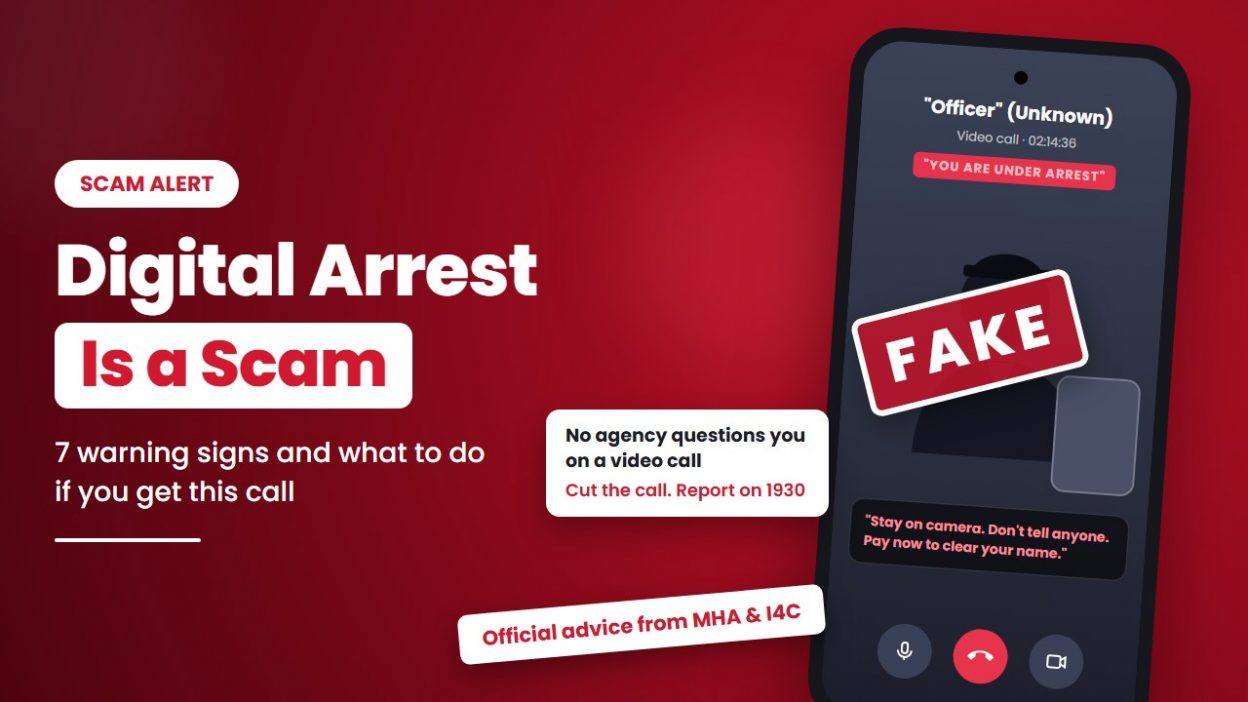
You get a call from someone who says they are from the police, CBI or customs. They say a parcel in your name has drugs in it, or that your Aadhaar is linked to a crime. Then they move you to a video call, show you a “police station” and tell you that you are now under digital arrest. You must stay on camera and pay money to “clear your name”.
- 1 What Is Digital Arrest?
- 2 How the Digital Arrest Scam Works
- 3 The 3 Tricks Scammers Use
- 4 7 Warning Signs of a Digital Arrest Scam
- 5 What to Do If You Get a Digital Arrest Call
- 6 Where to Report: 1930 or Chakshu?
- 7 What the Government and Supreme Court Are Doing
- 8 How to Protect Your Family
- 9 Conclusion
This is not a real arrest. It is one of the biggest phone scams in India right now.
This guide explains what digital arrest is, how the scam works step by step, the warning signs to watch for and exactly what to do if you or someone in your family gets such a call.
What Is Digital Arrest?
Digital arrest is a cyber fraud, not a legal process. Fraudsters pretend to be officers from the police, CBI, Narcotics, RBI, Enforcement Directorate or other agencies. They scare the victim with a fake case, keep them on a video call for hours or days, and force them to transfer money.
In the 115th episode of Mann Ki Baat, the Prime Minister said that “there is no system like digital arrest in the law” (PIB). No real investigative agency questions people or asks for money over a phone or video call.
If you get such a call: cut the call, do not pay, and report it on the cyber crime helpline 1930 or at cybercrime.gov.in.
How the Digital Arrest Scam Works
The Ministry of Home Affairs (MHA) issued a public alert about this scam in May 2024. According to the MHA alert, the scam usually follows this pattern:
Step 1: The scary first call
The fraudster calls and says one of these things:
- A parcel sent by you, or meant for you, contains drugs, fake passports or other illegal items.
- A close family member has been caught in a crime or an accident and is in their custody.
Step 2: The fake “case”
They tell you that a case has been filed against you. Some even send fake documents, warrants or ID cards. They use the names of real agencies to sound believable.
Step 3: The video call “arrest”
The victim is asked to join a video call on Skype or another app and stay visible on camera until the “investigation” ends. MHA says the fraudsters use studios made to look like police stations and government offices, and they wear uniforms to look real.
Step 4: The demand for money
To “settle the case” or “verify” the victim’s money, they ask for a transfer to an account they control. The victim is told not to tell anyone, not even family.
MHA calls this an organised online economic crime, often run by cross-border crime syndicates.
The 3 Tricks Scammers Use
In Mann Ki Baat on 27 October 2024, the Prime Minister explained the three “moves” these gangs use (PIB):
- They collect your personal details first. They may mention where you travelled or where your children study, so you believe they are real officers.
- They create fear. Uniforms, an office set-up and legal sections are used to scare you so much that you cannot think clearly.
- They put you under time pressure. “Decide now or you will be arrested.” The goal is to make you act before you can check anything.
Once you know these three tricks, the scam becomes much easier to spot.
7 Warning Signs of a Digital Arrest Scam
If a call has even one of these signs, treat it as a scam:
- Someone says you are “under digital arrest”. There is no such thing in Indian law.
- An “officer” questions you over a video call. The Prime Minister said that no investigative agency inquires like this through a phone call or a video call.
- They ask you to transfer money to “clear your name”, “verify” your funds or pay a “fine”. No government agency demands money on a video call.
- They tell you not to tell anyone. Scammers want to keep you away from family, who might see through the trick.
- They do not let you end the call. Being told to stay on camera for hours is a clear red flag.
- They talk about a parcel, drugs or your Aadhaar being misused, with no proof you can check.
- You feel scared and rushed. The PM’s advice: if you feel scared, know that something is wrong.
What to Do If You Get a Digital Arrest Call
The government’s advice comes down to three steps: Stop, Think, Take Action (PIB).
1. Stop
- Don’t panic. Stay calm.
- Don’t take any quick steps.
- Don’t share personal details such as your Aadhaar, bank details or OTP.
- If you can, take a screenshot and record the call.
2. Think
- Remember that no government agency threatens you or asks for money on a video call.
- Cut the call. You are not under arrest, and you do not have to stay on it.
3. Take Action
- Call the national cyber crime helpline 1930.
- Report it on cybercrime.gov.in.
- Tell your family and your local police.
- Keep all evidence: the number, screenshots, recordings and any payment details.
Where to Report: 1930 or Chakshu?
There are two different places to report, and each one is for a different situation.
| Your situation | Where to report |
| You lost money or shared bank details | Call 1930 right away, or file a complaint on cybercrime.gov.in |
| You got a fake call but did not lose money | Report the number on Chakshu at sancharsaathi.gov.in or in the Sanchar Saathi app |
According to the Department of Telecommunications (DoT), Chakshu is for reporting suspected fraud calls and messages where a fraud was tried but not actually done. Cases with real money loss are handled by the Indian Cyber Crime Coordination Centre (I4C) under MHA.
On Chakshu, choose the category “Impersonation as Police, CBI, Customs, Aadhaar, RBI etc.” DoT data shows that citizens reported 44,865 such calls in 2024 and 54,639 in 2025 under this category alone.
Why call 1930 quickly? The 1930 helpline is linked to the Citizen Financial Cyber Fraud Reporting and Management System, which was built for quick reporting so that money can be stopped before fraudsters move it. As per MHA, more than ₹4,386 crore had been saved through this system in over 13.36 lakh complaints (as of March 2025). The sooner you report, the better the chance of stopping the money.
What the Government and Supreme Court Are Doing
Digital arrest scams are now being handled at the highest level.
Blocking the tools scammers use. As per MHA (March 2025):
- I4C blocked more than 3,962 Skype IDs and 83,668 WhatsApp accounts used for digital arrest.
- More than 7.81 lakh SIM cards and 2,08,469 IMEIs reported by police were blocked till 28 February 2025.
- A system was set up with telecom operators to block international spoofed calls that show an Indian mobile number.
Supreme Court action. The Supreme Court is hearing a suo motu case on digital arrest victims. In its order dated 4 August 2026, the court noted:
- Complaints on the national portal fell from 1,23,672 in 2024 to 58,239 in 2025, and stood at 16,377 till 30 June 2026.
- The CBI has registered digital arrest cases. In one investigation, it found 238 victims and transactions of about ₹80 crore.
- The Money Restoration Mechanism had returned ₹18.05 crore in 36,290 cases.
The court also directed the RBI to adopt a Standard Operating Procedure (SOP) for banks to place temporary debit holds on accounts linked to money-mule activity and cyber fraud. It also asked the government to study a time-based “kill switch” for audio and video calls.
The fall in complaints is good news, but the court itself said continued monitoring is still needed. The scam has not gone away.
How to Protect Your Family
Older people are often targeted because they may trust callers who claim to be officers. A few simple habits can keep your family safe:
- Talk about it at home. Tell your parents and grandparents that “digital arrest” does not exist, and that real officers never ask for money on a video call.
- Agree on one rule: if anyone gets a scary call about police, a parcel or a case, they cut the call and tell a family member first.
- Save 1930 in everyone’s phone.
- Check the SIMs in your name so no one misuses your identity. See our guide on how to check SIMs registered in your name.
- Block and report spam numbers. Read how to stop spam calls and block a number on Android and iPhone.
Conclusion
Digital arrest does not exist in Indian law. It is a scam that works on fear and time pressure. If anyone calls you as an “officer” on a video call and asks for money, cut the call and report it on 1930 or cybercrime.gov.in.
Fake calls also make people wary of genuine business calls. With CallerDesk, businesses can call from a dedicated virtual number that customers can recognise and trust.
Share this guide with your family. It could save someone’s savings.
Looking for a Cloud Telephony Solution That Grows With Your Business?
Explore how CallerDesk can help your team manage every call with IVR, virtual numbers, call recording and missed call alerts, whether you run a single shop or a full call centre.
Start A Free Trial