
A sales agent speaks to a customer on the phone. It sounds like a normal business call. But before the agent joined, an auto dialer selected the number and placed the call.
- 1 What is an A2P call?
- 2 Why did TRAI address A2P calling?
- 3 What is new under the 2026 A2P rule?
- 4 Does a call become A2P only when it plays a recording?
- 5 How can you tell whether your calling workflow may be A2P?
- 6 Does an A2P declaration give permission to make promotional calls?
- 7 Has TRAI introduced a charge for A2P calls?
- 8 What should an outbound calling team check now?
- 9 Conclusion
Who made that call: the agent or the software?
That question matters under TRAI’s 2026 update on application-to-person (A2P) calls. On 18 September 2026, the Telecom Regulatory Authority of India introduced a definition of A2P calling and a requirement for entities using such calls to declare their use to their telecom service provider in advance.
If your business uses an auto dialer, voice broadcast platform or another system that starts outbound calls, this guide will help you understand what TRAI announced and what to check in your own calling process.
Original source: TRAI’s press release on the Third Amendment to the Telecom Commercial Communications Customer Preference Regulations, 18 September 2026.
What is an A2P call?
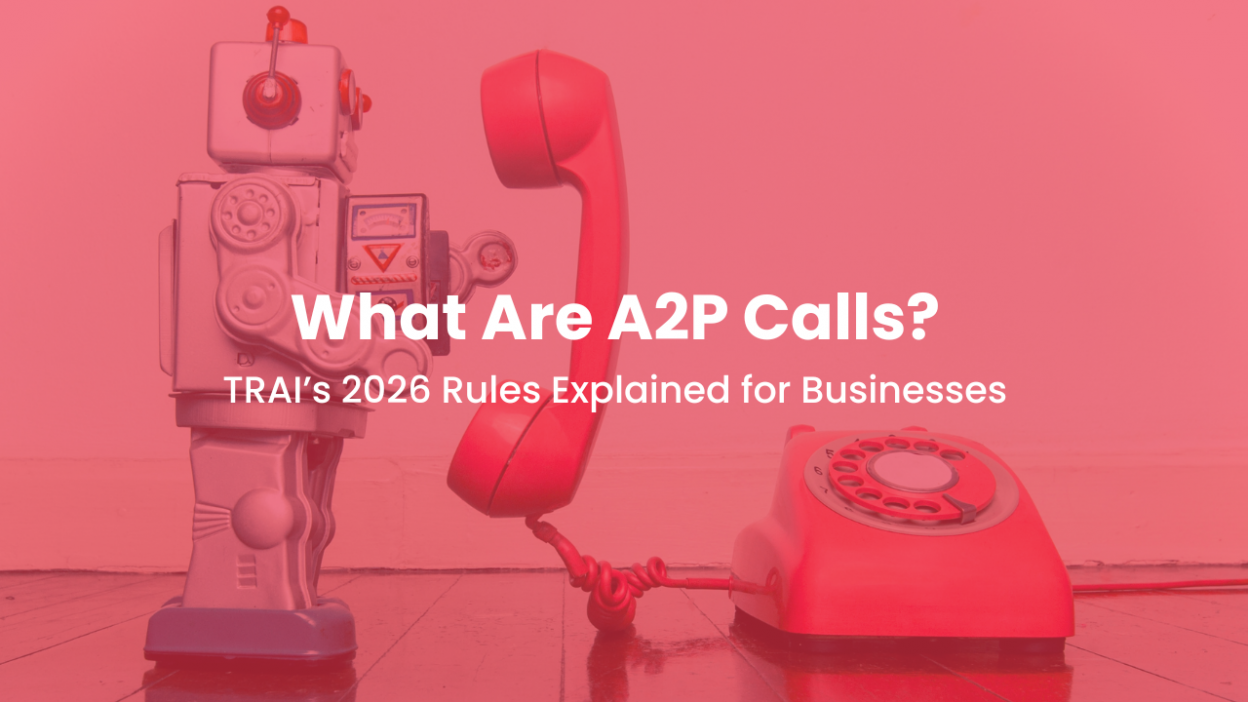
A2P means application-to-person. TRAI defines an A2P call as a voice call initiated by an application, software system or automated platform without direct human dialling.
Its description includes calls made using autodialling, robocalls, prerecorded voice messages and artificial voice technologies. The central point is how the call is initiated: does a person directly dial the customer, or does software start the call?
Consider a delivery company that uses a system to call customers and play a recorded delivery update. The application starts the call. That is an easy example of the kind of calling TRAI describes.
Now consider a sales team. Its software automatically dials the next lead and connects the answered call to an agent. A person conducts the conversation, but the software initiated the call. Businesses using this type of workflow should assess it against TRAI’s A2P definition. The presence of a live agent does not, by itself, answer the question of who dialled.
This is why “automated call” does not always mean “a call with no human involved.” It can refer to the way a call begins.
Why did TRAI address A2P calling?
Software allows businesses to place calls at a scale that would be difficult with manual dialling. It can help teams reach customers about appointments, requests or other updates. The same ability can also be misused to make large numbers of unwanted commercial calls.
TRAI identified that potential for misuse in its September 2026 announcement. Its amendment therefore defines A2P calls and requires entities using them to declare that use before making the calls. The aim is to bring greater accountability to this type of calling within TRAI’s framework for controlling unsolicited commercial communication, or UCC.
The rule does not say that every A2P call is spam. It addresses a particular method of placing calls and sets a requirement for entities that use it.
What is new under the 2026 A2P rule?
The key change is prior declaration.
According to TRAI, every entity using A2P calls must tell its telecom service provider in advance that it uses A2P calling. It must also provide details of the calling line identities, or CLIs, that it will use for those calls. A CLI is the calling number or identity associated with a call.
TRAI also sets out what happens if this requirement is missed: A2P calls made without the required prior declaration will be treated as UCC. That makes it important for a business to identify its A2P calling workflows before running an outbound campaign, rather than reviewing them only after a complaint.
The official press release states the requirement, but it does not give every business a universal, step-by-step submission form in the announcement. Your telecom service provider is the right place to confirm the declaration process and the CLI details it needs for your setup.
Does a call become A2P only when it plays a recording?
No. A prerecorded message is one example in TRAI’s description, but it is not the whole definition. TRAI also mentions autodialling and calls initiated through an application, software system or automated platform without direct human dialling.
This distinction is useful for sales and support teams. A business may assume that the A2P rule applies only to a voice recording that says, “Press 1 for more information.” Yet a system can place a call and connect it to a person. In that case, the business still needs to examine how the outgoing call was started.
Similarly, the name of a product feature is not enough to classify a call. Two businesses could use dialling software in different ways. One workflow may require an agent to dial directly; another may have the application initiate calls. Review the actual workflow rather than assuming that every feature sold as a “dialer” works the same way.
How can you tell whether your calling workflow may be A2P?
Follow one call from the start. Before the customer’s phone rang, what action caused the outbound call to be placed?
| Calling situation | What to examine |
| An agent directly enters and dials a customer’s number | This involves direct human dialling, which is outside the “without direct human dialling” wording in TRAI’s A2P definition. |
| Software works through a list and places calls | The application initiates the calls, so assess the workflow as A2P. |
| A system calls a customer and plays a recorded message | This matches an example TRAI includes in its A2P description. |
| Software calls first, then connects an agent | Check the system’s initiation of the call; the later conversation with an agent does not change how it began. |
| An agent clicks a button and a platform places the call | Examine precisely what the click triggers and confirm the classification with your platform and telecom service provider. |
The table applies TRAI’s published definition to common workflows. It should help your team ask the right questions; TRAI’s press release does not issue a separate ruling for each possible product configuration.
Does an A2P declaration give permission to make promotional calls?
No. Declaring A2P use tells the telecom service provider about the calling method and the CLIs used. It does not, on its own, establish why a particular customer may be contacted.
For example, a customer who requested a call about a product is in a different position from someone who never asked to hear from the business. TRAI’s commercial communication framework also addresses customer preferences, consent and complaints. A calling team therefore needs to consider both how the call is placed and its basis for contacting that customer.
Keeping those questions separate makes internal reviews easier. First, find out whether your process makes A2P calls and whether the required declaration has been made. Then check the campaign’s audience, purpose and supporting customer records.
Has TRAI introduced a charge for A2P calls?
TRAI’s announcement also introduces a termination charge of up to ₹0.05 per minute for A2P calls. The announcement says the terminating access provider may levy this charge on the originating access provider. It does not describe this amount as an automatic, flat fee that every business must pay directly for each minute of auto dialler use.
TRAI states that A2P calls made through a numbering series designated for regulated commercial calls, as well as calls authorised by the Authority, are exempt from the termination charge. This point concerns the charge. Businesses should discuss how the provision affects their service arrangement with their telecom provider and should not assume a charge exemption removes the need to assess other applicable requirements.
What should an outbound calling team check now?
You do not need to start by changing every campaign. Start by finding out exactly how your team places calls.
Identify each outbound workflow. Include manual calls, auto dialler campaigns, recorded voice broadcasts and calls initiated through integrations. Ask who or what causes the customer’s phone to ring.
Record the CLIs used for those workflows. If different campaigns use different calling numbers, make sure your team knows which numbers belong to which calling process.
Confirm the declaration process with your telecom service provider. Explain how your system initiates calls and ask which workflows it considers A2P. Confirm what must be declared and how to provide the CLI details before the calls are made.
Check again when the setup changes. A new calling number or a change from direct human dialling to system-initiated calling can change the facts your team previously reviewed.
These checks are practical ways to apply TRAI’s definition and prior declaration requirement. They also help avoid a common mistake: assuming that because agents speak on the calls, an automated dialling rule cannot apply.
Conclusion
The easiest way to understand TRAI’s A2P update is to look at the first step of the call. If an application, software system or automated platform initiates a voice call without direct human dialling, it falls within TRAI’s A2P definition. Under the September 2026 amendment, entities using A2P calls must declare that use and the relevant CLIs to their telecom service provider in advance. Calls made without the required declaration will be treated as UCC.
If your team uses CallerDesk for outbound calling, review how each campaign starts its calls and discuss the applicable declaration with your telecom provider. To learn more about CallerDesk’s calling features, visit callerdesk.io.