

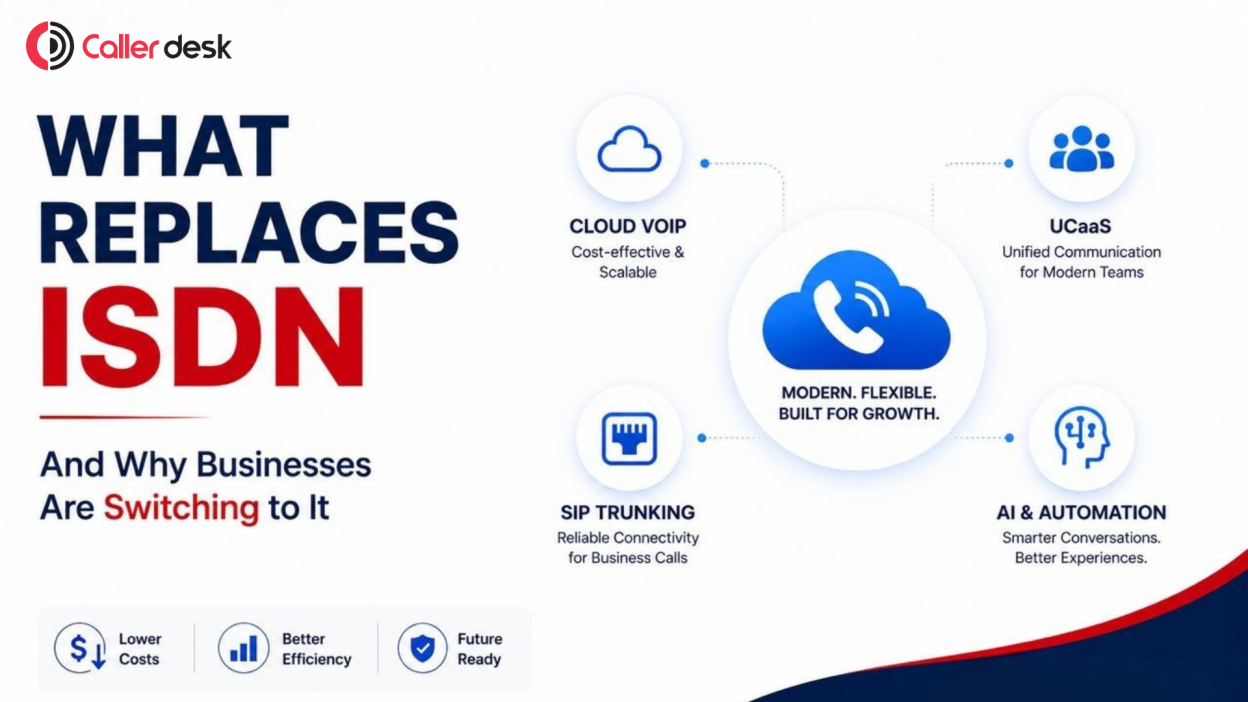
Even in 2026, many businesses are still talking about traditional phone systems. That’s because several organizations continue to use legacy phone systems that were built around it. However, with the ongoing ISDN phase out, businesses are actively looking for modern alternatives that can support today’s communication needs. At the same time, internet-based communication has become the preferred choice because it offers greater flexibility, scalability, and ease of use. Traditional phone systems often struggle to keep up with remote work and changing customer expectations. In this guide, we’ll explore the best ISDN replacement options, why businesses are making the switch, and which solution may be the right fit for your organization.
- 1 Why ISDN Is No Longer Enough for Modern Businesses
- 2 What Has Replaced ISDN in Modern Communication
- 3 ISDN vs Modern Communication Systems
- 4 Why Businesses Are Switching From ISDN
- 5 Benefits of Moving to Cloud-Based Phone Systems
- 6 Which ISDN Replacement Is Right for Your Business?
- 7 Future of Business Communication After ISDN
- 8 Conclusion
- 9 FAQs
Why ISDN Is No Longer Enough for Modern Businesses
For many years, traditional telephony solutions helped businesses communicate reliably, but today’s workplace has very different requirements. Traditional communication systems depend on older infrastructure that can be expensive to maintain and operate. As businesses grow, adding new users or locations often becomes difficult and costly. Older communication technology also struggles to support remote and hybrid work environments, which are now common across many industries. Another challenge is the lack of seamless integration with modern business tools such as CRM platforms and collaboration software. With the PSTN and ISDN ecosystem reaching the end of its lifecycle, many organizations are choosing more flexible, scalable, and future-ready communication solutions.
What Has Replaced ISDN in Modern Communication
Cloud Phone System
A cloud phone system is a business communication solution that operates over the internet instead of traditional phone lines. It eliminates the need for complex hardware and offers greater flexibility. Businesses prefer it because it is easy to manage, scalable, and cost-effective. It also supports remote teams and modern communication needs.
VoIP (Voice over Internet Protocol)
VoIP allows businesses to make and receive calls using an internet connection. VoIP systems convert voice into digital signals and transmit them online. Modern VoIP services offer better flexibility than traditional phone systems. They also provide advanced features while helping businesses reduce communication costs.
SIP (Session Initiation Protocol)
SIP is a technology used to establish and manage voice communication over the internet. It plays an important role in modern communication systems by enabling seamless call connections. SIP helps businesses improve communication efficiency. It also supports voice, video, and messaging services on a single platform.
SIP Trunking
SIP trunking replaces physical ISDN lines with internet-based connectivity. It allows businesses to connect their existing PBX systems to the internet. This helps reduce communication costs while preserving current infrastructure. Many businesses choose this as a practical upgrade path.
Hosted PBX
Hosted PBX is a cloud-based phone system managed by a service provider. Businesses do not need to install or maintain expensive on-site hardware. It offers features such as call routing, extensions, and voicemail. This makes communication management simple and flexible.
Unified Communications (UCaaS)
Unified Communications combines calling, messaging, video meetings, and collaboration tools into one platform. It helps teams communicate more effectively from any location. Businesses benefit from a streamlined communication experience. It also improves productivity by bringing all communication channels together.
ISDN vs Modern Communication Systems
| Feature | ISDN | Modern Communication Systems |
| Infrastructure | Uses physical copper telephone lines | Uses internet-based technology and cloud platforms |
| Cost | Higher setup, maintenance, and line rental costs | Lower operating costs with minimal hardware requirements |
| Scalability | Adding users or lines can be slow and expensive | Easily add or remove users as business needs change |
| Remote Work Support | Limited support for remote and hybrid teams | Employees can work and communicate from anywhere |
| Features | Basic calling features with limited functionality | Advanced features like AI tools, CRM integration, call analytics, IVR, and automation |
| Maintenance | Requires ongoing hardware and infrastructure maintenance | Managed by service providers with minimal maintenance effort |
Why Businesses Are Switching From ISDN
- Lower communication costs help businesses save money every month.
- Remote and hybrid employees can stay connected from anywhere.
- Internet-based calling often provides clear and reliable call quality.
- New users and locations can be added easily as the business grows.
- Features like IVR, call routing, and analytics improve communication efficiency.
- Faster responses and smarter call management enhance customer experience.
- Modern solutions provide a future-proof setup that can adapt to changing business needs.
Benefits of Moving to Cloud-Based Phone Systems
- Employees can communicate from anywhere using any device.
- Setup is quick and requires minimal technical effort.
- Easily connects with CRM and other business tools.
- All communication can be managed from one platform.
- Real-time reports help track performance and improve decisions.
Which ISDN Replacement Is Right for Your Business?
Small Businesses
VoIP systems are perfect for small businesses because they are affordable and easy to set up. They help reduce call costs and improve communication without heavy infrastructure. Even small teams can access advanced calling features like call forwarding and recording. This makes daily business communication simple and efficient.
Growing Businesses
Growing businesses benefit from SIP trunking or hosted PBX as they scale easily. These solutions support more users without major hardware upgrades or high costs. They also help manage multiple calls and locations smoothly. This makes expansion much easier and more flexible.
Enterprises
Enterprises need unified communications to handle large-scale operations efficiently. It combines voice, video, messaging, and collaboration in one platform. This improves productivity and streamlines internal communication. It is ideal for complex business environments.
Multi-location Businesses
Cloud phone systems help multi-location businesses stay connected in real time. They centralize communication across all offices in one platform. Teams can collaborate easily regardless of location. This ensures smooth and consistent communication everywhere.
Future of Business Communication After ISDN
Business communication is clearly moving beyond traditional phone systems into more advanced and flexible systems. We are seeing the rise of unified communications, where voice, video, chat, and collaboration tools work together in one platform. AI-powered communication systems are also improving efficiency by automating tasks and improving customer interactions. Most companies are now shifting toward cloud-first infrastructure, which makes scaling and managing communication much easier. At the same time, mobile-first communication is becoming important as employees work from anywhere using smartphones and laptops. Overall, modern systems like cloud phone systems and VoIP solutions are shaping a faster, smarter, and more connected business future.
Conclusion
The copper-based communication network is being replaced because it can no longer meet the needs of modern businesses. Its limitations, like high costs, low flexibility, and lack of remote support, are pushing companies to upgrade to better systems. Businesses today are choosing cloud communication because it is more scalable, reliable, and cost-efficient. There is a clear shift toward VoIP, SIP trunking, hosted PBX, and UCaaS solutions that offer advanced features and better performance. These modern tools help teams stay connected from anywhere and improve overall efficiency. In the end, businesses are moving away from legacy systems to build a more flexible and future-ready communication setup.
Planning your move away from ISDN? Our complete ISDN in 2026 guide explains the phase-out timeline and the best alternatives available today.
FAQs
1. What replaces ISDN in modern business communication?
ISDN is mainly being replaced by VoIP systems, SIP trunking, hosted PBX, UCaaS, and cloud phone systems. These solutions use the internet instead of traditional lines, offering better scalability, lower costs, and advanced features for modern business communication needs.
2. Why are businesses moving away from ISDN?
Businesses are moving away from ISDN due to high maintenance costs, limited flexibility, and lack of remote work support. Modern communication systems provide cloud-based access, better integration, and scalable features that suit today’s fast-changing work environments.
3. Is VoIP better than ISDN?
Yes, VoIP is generally better than ISDN because it uses the internet for calls, reduces costs, and supports remote work. It also offers advanced features like call routing, analytics, and CRM integration, which traditional phone systems cannot provide.
4. What is a cloud phone system?
A cloud phone system is a communication solution that operates over the internet instead of physical phone lines. It allows businesses to manage calls, messages, and collaboration tools from anywhere, making it flexible, scalable, and ideal for modern teams.
5. Can existing business phone systems be upgraded from ISDN?
Yes, businesses can upgrade from ISDN using SIP trunking or hosted PBX solutions. These allow companies to keep existing infrastructure while moving communication to the internet, making the transition smoother and more cost-effective.