
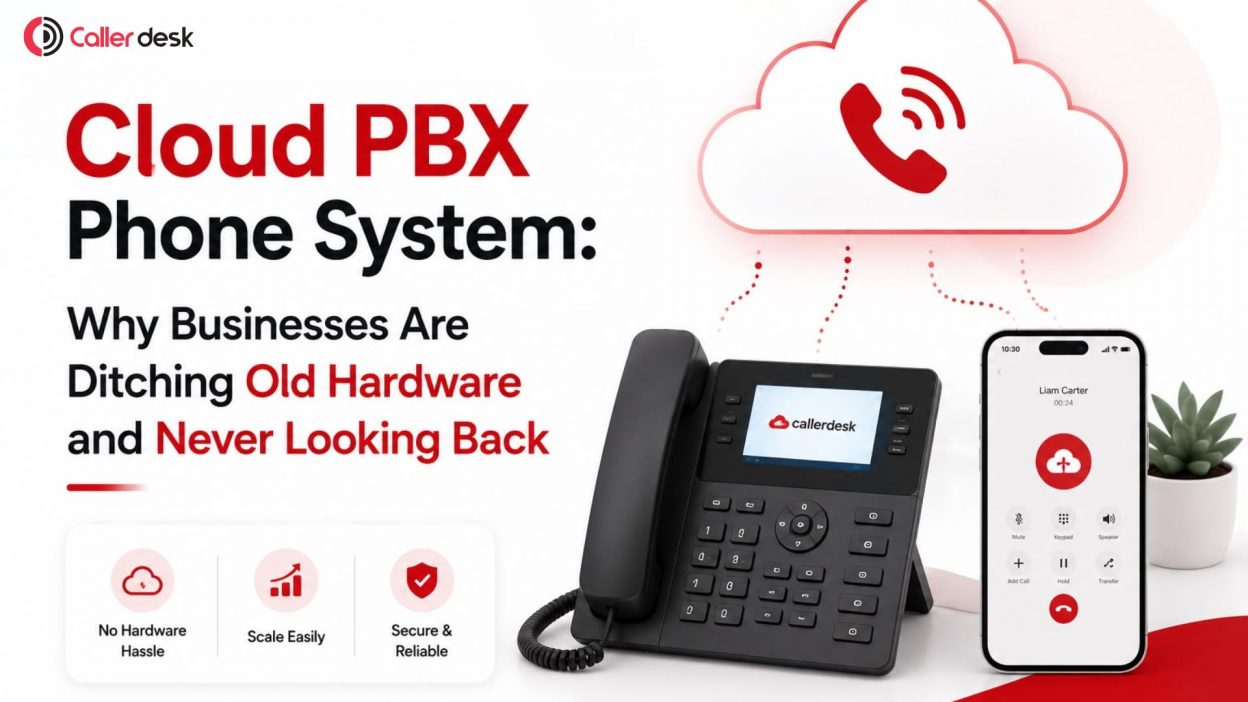
Managing a traditional phone system isn’t easy. There’s an annual maintenance contract to renew, a technician to call for every small issue, and delays whenever you need to add a new line. These costs add up quietly over time. That’s why more businesses are switching to a cloud PBX phone system, it removes the hardware, cuts the maintenance hassle, and lets you manage calls simply, from anywhere.
What is a Cloud PBX Phone System?
A cloud PBX phone system is a cloud phone system that runs a business’s calling, extensions, and IVR entirely over the internet, replacing physical PBX hardware with software hosted by the provider. It lets teams make and receive calls from any location using a mobile app, desktop, or browser, with no on-site setup required.
Old Hardware vs Cloud PBX: Why the Shift Is Happening
Businesses running on traditional hardware know the drill: a physical box in a server room, an AMC contract renewed every year, and a technician on speed dial for every small fix. Moving to a cloud PBX phone system removes all of that overhead, and it’s a shift more businesses are making each year, not just for convenience, but for measurable savings.
- No physical hardware or AMC costs: pricing runs as a predictable monthly subscription instead of upfront equipment purchases and yearly service contracts.
- Setup in days, not weeks: most providers get a business live on cloud PBX within days, without wiring or site visits.
- Add or remove lines instantly: scale your team up during busy seasons or down after, without buying new hardware.
- Works for remote and hybrid teams: agents can answer business calls from home, a co-working space, or while travelling, using just an internet connection.
- Built-in disaster recovery: with no single physical box to fail, calls keep routing even if one office location loses power or internet.
As of 2024, over 68% of businesses globally had adopted some form of cloud-based communication solution, and the average SME using cloud PBX saved more than 38% annually on communication costs (Market Growth Reports, 2024). Separately, SMEs made up over 60% of all VoIP users worldwide in 2024, drawn in by the cost savings, faster deployment, and scalability that cloud-based systems offer (Astute Analytica, 2024). Together, these numbers point to the same conclusion: the shift away from hardware isn’t a trend; it’s already the default for most growing businesses.
Key Benefits of a Cloud PBX Phone System
It isn’t just cheaper than hardware; a good cloud phone system comes packed with features that traditional setups can’t match easily. Here’s what to look for:
- Call forwarding and routing: Automatically sends calls to the right team member or department, even across multiple office locations.
- IVR / auto-attendant: Greets callers and routes them based on their input, so no call reaches a dead end or gets stuck on hold.
- Voicemail-to-email: Converts missed call voicemails into emails automatically, so nothing gets missed even outside office hours.
- Multi-device access: Works on mobile, desktop, and laptop, letting agents answer business calls wherever they’re working from.
- Real-time call analytics: Shows call volume, missed calls, and agent availability instantly, helping managers spot gaps quickly and act on them.
Together, these features turn a basic calling tool into a proper business communication system, one that grows with the company instead of holding it back as the team scales.
Is Cloud PBX Right for Your Business?
Not every business needs the same setup. Before choosing a cloud based pbx provider, run through this checklist:
- Number of team members/locations: a single-location team of five has very different needs than one spread across multiple cities or branches.
- Internet reliability at your office(s): since cloud based pbx runs entirely over the internet, a stable connection at every location is non-negotiable.
- Need for CRM/tool integrations: check whether the system connects with the sales or support tools your team already relies on daily.
- TRAI compliance for Indian numbers: confirm the provider follows TRAI’s guidelines for number provisioning and call routing before signing up.
- Budget model: decide between a metered plan (pay per call) and an unlimited plan, based on your team’s actual call volume and patterns.
Answering these five questions honestly will tell you more about fit than any feature comparison chart ever could.
Case Study: Cloud PBX in Action
Aakash International Business Management (AIBM), a Bangalore-based management institute, was losing prospective students simply because calls went untracked. Enquiries had no structure, calls after office hours went unanswered, and there were no recordings to understand what students actually needed from the team.
AIBM adopted a toll-free number setup with IVR-based call routing and centralized call recording, replacing its scattered, unstructured calling process across branches.
The results were clear: every call was routed automatically to the right person, students received consistent responses regardless of when they called, and the institute finally had a searchable record of every inquiry. What used to be a daily operational struggle in managing student calls became a structured, trackable process, turning missed opportunities into follow-ups that actually happened.
Cloud PBX vs Cloud Contact Center
These two terms are often used interchangeably, but they’re not the same thing. Here’s how they compare:
| Factor | Cloud PBX | Cloud Contact Center |
| Core purpose | Business phone infrastructure | Full customer service and support setup |
| Key features | Calling, extensions, IVR | Call routing, CRM integration, analytics, omnichannel support |
| Best suited for | Teams that only need internal calling and extensions | Support or sales teams handling high call volumes |
| Complexity | Simple, works standalone | Built on top of a PBX foundation, more advanced |
| Reporting | Basic call logs | Real-time reporting and performance analytics |
If your business only needs calling and extensions, cloud PBX on its own is enough. If you’re managing a support or sales team handling high call volumes, you’ll likely need the fuller contact center stack.
Why CallerDesk
CallerDesk offers cloud PBX built specifically for Indian businesses, from small teams to multi-branch operations spread across cities.
Every setup runs on TRAI-compliant infrastructure with guaranteed uptime, so calls stay connected even during peak hours. CallerDesk’s cloud phone system includes call forwarding, IVR, voicemail-to-email, and real-time analytics, all managed from a single dashboard, without any physical hardware to install or maintain.
With Indian businesses across industries already running their calling operations on CallerDesk, the platform is designed around what local teams actually need: fast setup, transparent pricing, and support that understands Indian business hours.
If you’re considering cloud PBX for your team, it’s worth checking how CallerDesk fits your call volume and budget.
FAQs
1. What is a cloud PBX phone system?
Its business phone infrastructure is hosted entirely on the cloud, covering calling, extensions, and IVR without physical hardware. Teams can make and receive calls from any device with an internet connection, from any location.
2. How much does cloud PBX cost in India?
Pricing usually depends on the number of users, call volume, and features needed. Most Indian providers offer monthly per-user plans, with either metered or unlimited calling options based on business requirements.
3. Do I need special hardware for cloud PBX?
No. Cloud PBX runs through an app, browser, or IP phone connected to the internet; there’s no physical PBX box, wiring, or on-site installation required at all.
4. Is cloud PBX secure and TRAI-compliant?
Reputable providers follow TRAI guidelines for number provisioning and call routing, along with encrypted call data and secure storage. Always confirm compliance certifications directly with your provider before signing up.
Sources
- Market Growth Reports, “Cloud-Based PBX Market Report,” 2024
- Astute Analytica / VoIP services market research, 2024
- TRAI (Telecom Regulatory Authority of India) – official guidelines on number provisioning and call routing
- MyOperator, AIBM Case Study