
Summary-
- 1 Summary-
- 2 Introduction-
- 3 What Voice Broadcasting Is Used for in Real Businesses
- 4 How Voice Broadcasting Works with Cloud Telephony
- 5 Why Businesses Move Away from Manual Calling
- 6 Key Benefits of Voice Broadcasting for Business Growth
- 7 Common Use Cases Across Industries
- 8 Voice Broadcasting vs Traditional Outbound Calling
- 9 Why Cloud Telephony Is Essential
- 10 Measuring Voice Broadcasting Campaign Performance
- 11 Practical Guidelines That Improve Results
- 12 How CallerDesk Supports Voice Broadcasting
- 13 Conclusion-
Voice Broadcasting steps in when a business needs to tell a lot of customers the same thing, but doesn’t want its team stuck making endless calls. Instead of repeating themselves all day, someone records the message once, and the system sends it out to everyone automatically. You see this a lot with appointment reminders, alerts, service updates, or any announcement that doesn’t need a reply.
When it’s part of a Cloud Telephony system, the team just picks when the calls go out, checks which ones are connected, and tracks everything in one place no more messy spreadsheets or chasing people for updates. It makes life easier for the team, keeps costs steady, and handles bigger customer lists without missing a beat.
Introduction-
Customer communication becomes complicated as businesses grow. What starts as a manageable calling task slowly turns into delays, missed updates, and stretched teams. Agents spend hours repeating the same information, while customers still complain about not being informed on time. This is the point where Voice Broadcasting becomes relevant.
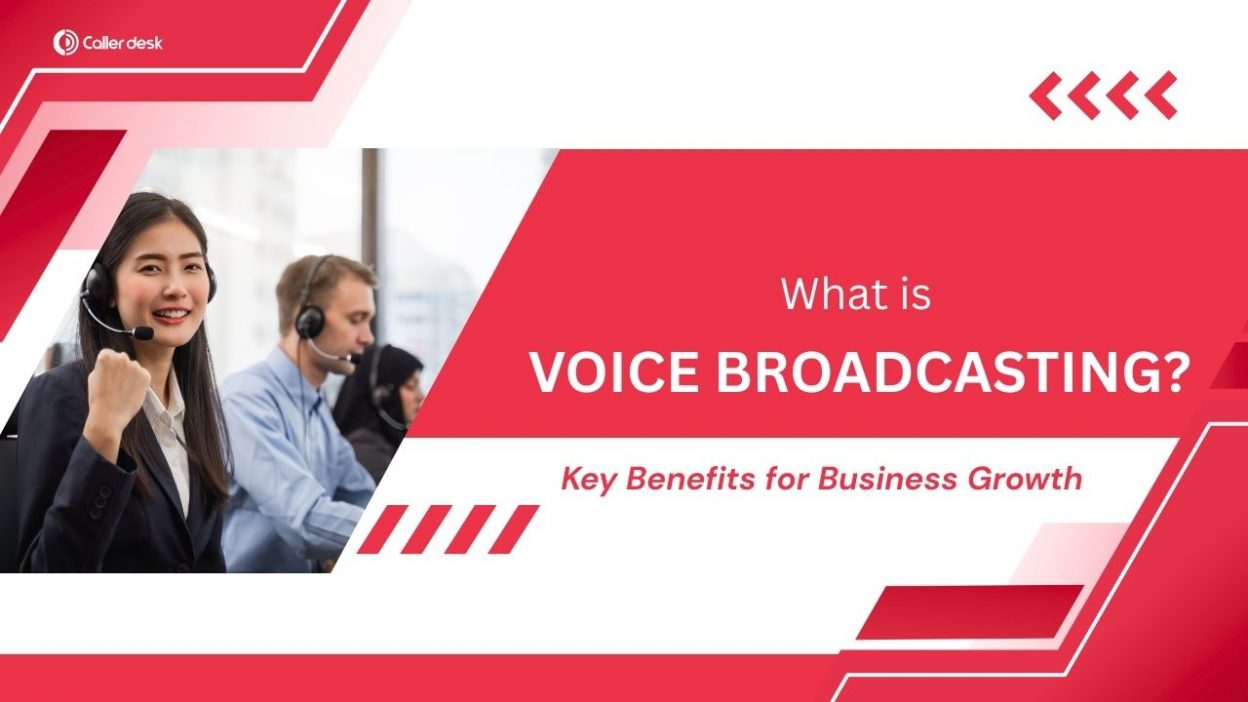
It allows businesses to send one voice message to a large group of customers without manual calling. When Voice Broadcasting is supported by Cloud Telephony, the process becomes organised, trackable, and easy to control. It is not meant to replace conversations but to handle routine communication efficiently. This blog explains how Voice Broadcasting works in real business environments and why it supports steady Business Growth.
What Voice Broadcasting Is Used for in Real Businesses
Voice Broadcasting is an automated way of delivering information through voice calls. A single recorded message is sent to multiple phone numbers at the same time. The call plays the message and ends. There is no live interaction involved.
Businesses use Voice Broadcasting when the message needs to reach many people without discussion. Payment reminders, service updates, delivery information, and policy announcements fall into this category.
Because Voice Broadcasting runs on Cloud Telephony systems, there is no need for physical infrastructure or large outbound teams. Campaigns are created, launched, and monitored digitally.
How Voice Broadcasting Works with Cloud Telephony
Voice Broadcasting depends on Cloud Telephony for execution and control.
A message is first recorded or created using text-to-speech. A contact list is selected from a CRM or uploaded database. The business defines calling rules such as retry attempts and calling hours.
Once the campaign starts, the Cloud Telephony system handles dialing automatically. Calls that connect play the message. Numbers that are busy or unreachable are retried later.
Everything is logged. Call status, delivery reports, and completion data are available without manual tracking.
Why Businesses Move Away from Manual Calling
Manual outbound calling works only at low volumes. As the list grows, the cracks show.
Agents repeat the same lines for hours. Tone drops. Errors increase. Reporting becomes unreliable. Voice Broadcasting removes this dependency on individual performance.
The message is fixed. Delivery follows rules. Timing stays controlled. Businesses gain consistency without micromanagement.
For organisations planning structured Business Growth, this predictability matters more than personal interaction for routine communication.
Key Benefits of Voice Broadcasting for Business Growth
Faster Information Delivery
Voice Broadcasting allows businesses to reach a large audience in a short time. Messages that would otherwise take days to communicate manually are delivered within minutes.
This speed is useful during service changes, deadline reminders, and operational updates. Faster communication reduces confusion and unnecessary follow-up calls.
Reduced Load on Call Center Teams
In many call centers, outbound calls consume a significant part of the day.
Voice Broadcasting shifts repetitive communication away from agents. Automated campaigns handle bulk outreach, while agents focus on inbound queries and problem resolution.
This improves efficiency without increasing headcount.
Message Consistency Across Calls
Human communication varies. Automated communication does not.
Voice Broadcasting ensures that every customer hears the same message, in the same tone, with the same information. This is important for professional and compliance-related communication.
Consistency reduces misunderstandings and builds trust.
Predictable Communication Costs
Scaling manual calling requires more people. Scaling Voice Broadcasting does not.
The same system supports small and large campaigns. Costs remain stable as volume increases.
Predictable costs support long-term Business Growth planning.
Voice Still Commands Attention
Emails and SMS messages are easy to overlook. Voice calls demand more attention.
Voice Broadcasting works well when the message needs to be acknowledged. Customers are more likely to listen to a short voice message than read long text updates.
This improves engagement without extra effort.
Easy Integration with Existing Tools
Voice Broadcasting platforms integrate with CRM systems and Cloud Telephony setups.
Contact lists remain updated. Campaigns can be automated. Reports stay centralised.
This reduces manual work and improves accuracy.
Scales with Business Expansion
As customer bases grow, communication volume increases.
Voice Broadcasting handles this growth without additional setup. The same workflow applies regardless of campaign size.
This scalability makes Voice Broadcasting suitable for ongoing Business Growth.
Common Use Cases Across Industries
Voice Broadcasting is used wherever timely information matters.
Call centers use it for reminders and notifications. Educational institutions send announcements. Healthcare providers confirm appointments.
Logistics companies share delivery updates. Utilities send outage alerts. The industry changes, but the requirement stays the same.
Voice Broadcasting vs Traditional Outbound Calling
Traditional outbound calling depends on people. Availability, consistency, and fatigue affect outcomes.
Voice Broadcasting depends on systems. Calls are placed automatically. Retry rules are applied evenly. Reports are accurate.
For businesses focused on efficiency and Business Growth, Voice Broadcasting offers a more reliable structure.
Why Cloud Telephony Is Essential
Without Cloud Telephony, Voice Broadcasting lacks flexibility.
Cloud-based systems allow campaigns to be managed remotely, scaled instantly, and monitored in real time. There is no reliance on physical infrastructure.
Cloud Telephony provides stability, analytics, and operational control.
Measuring Voice Broadcasting Campaign Performance
Voice Broadcasting campaigns generate measurable data.
Businesses can track pickup rates, failed calls, retries, and completion status. This data helps refine message timing and campaign structure.
Small adjustments based on data improve results over time.
Practical Guidelines That Improve Results
Short messages perform better. One clear point per call is enough.
Calling during suitable hours improves pickup rates. Segmenting audiences increases relevance.
Reliable Cloud Telephony platforms ensure smoother execution.
How CallerDesk Supports Voice Broadcasting
CallerDesk provides Voice Broadcasting as part of its Cloud Telephony offering. Businesses can manage campaigns, control retries, and track results from a single dashboard.
The platform is designed for real call center workflows and operational use.
Conclusion-
Voice Broadcasting helps businesses communicate at scale without overloading teams. It removes repetitive calling, maintains message consistency, and keeps communication costs under control. When paired with Cloud Telephony, Voice Broadcasting becomes reliable, measurable, and easy to manage.
This allows call centers and growing businesses to focus on meaningful interactions instead of routine updates. For organisations planning steady Business Growth, Voice Broadcasting fits naturally into the communication process. It simplifies outreach without reducing clarity. To see how this approach works in real business scenarios, you can visit callerdesk.io.