

Summary-
- 1 Summary-
- 2 Introduction-
- 3 How WebRTC Actually Feels in Daily Use
- 4 Traditional VoIP in Real Operations
- 5 Where the Real Difference Shows Up
- 6 Setup and Agent Onboarding
- 7 Call Quality in Real Conditions
- 8 Security Without Complexity
- 9 Scaling Without Buying Hardware
- 10 Cloud Telephony and Call Center Workflows
- 11 What Customers Notice
- 12 Cost Over Time
- 13 Remote and Hybrid Teams
- 14 Where Traditional VoIP Still Makes Sense
- 15 Why WebRTC Is Becoming the Practical Choice
- 16 WebRTC with CallerDesk
- 17 Conclusion-
As call volumes increase, problems don’t appear all at once. They show up quietly. Calls take a few extra seconds to connect. Agents switch between tools more than they should. Customers stay on hold longer. For a long time, teams live with it because traditional VoIP still does the job. But once teams expand, work remotely, or need faster workflows, the cracks become visible. That’s where WebRTC starts to feel different.
Calls happen inside the browser or app, without phones, installs, or complicated setup. Traditional VoIP remains dependable in fixed office setups, but it often struggles to keep up with change. This comparison looks at how both actually behave during real workdays, not ideal scenarios, helping teams decide what fits their current way of working.
Introduction-
Every business reaches a point where calling becomes a bottleneck. Calls take time to connect. Agents juggle too many tools. Customers wait longer than they should. Most teams don’t notice this at first because Traditional VoIP has been “good enough” for years. But things change once scale kicks in. This is where WebRTC quietly enters the picture.
Not as a replacement overnight, but as a simpler way to handle real conversations. Web Real-Time Communication removes layers that slow calling down. In this blog, we compare WebRTC vs. Traditional VoIP in the context of real business use. Not theory. Not buzzwords. Just how both technologies behave inside cloud telephony and call center operations.
How WebRTC Actually Feels in Daily Use
WebRTC works inside a browser or mobile app. That’s the biggest difference, and it shows immediately.
An agent opens a dashboard. A call comes in. They answer. No phone. No softphone. No switching tabs endlessly. It feels natural, like replying to a message.
From the customer’s side, it’s even simpler. They click a call button on a website and speak to a real person. No dialing. No waiting for IVR prompts.
This is why WebRTC fits so well into cloud telephony setups. It removes steps without making noise about it.
Traditional VoIP in Real Operations
Traditional VoIP has powered business calling for a long time. It relies on SIP-based systems, IP phones, or softphones connected to PBX infrastructure.
In structured office environments, it works well. Teams know the process. Devices are fixed. Routing is predictable.
But Traditional VoIP shows friction when things change. New agents need configuration. Remote setups require extra handling. Even small updates often depend on technical support.
It’s reliable, yes. Flexible, not always.
Where the Real Difference Shows Up
Both WebRTC and Traditional VoIP use the internet. That’s where similarities end.
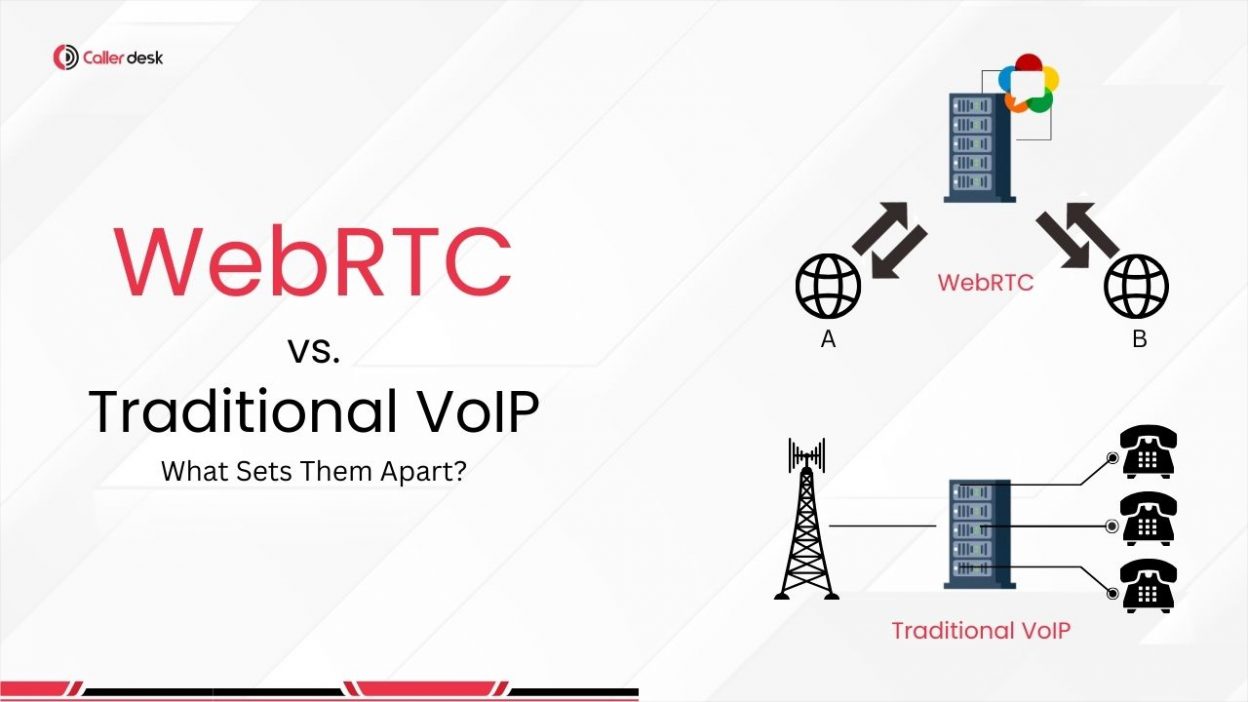
WebRTC lives inside browsers and apps. Traditional VoIP lives on devices and installed software. One removes layers. The other manages them.
This difference becomes obvious when teams scale, move remote, or integrate calling into CRM-driven workflows.
Setup and Agent Onboarding
The WebRTC setup is almost invisible. An agent logs in and starts taking calls. That’s it.
Traditional VoIP needs preparation. Phones or softphones must be installed. Credentials must be assigned. Testing is required.
For fast-growing call center teams, WebRTC saves time before the first call even happens.
Call Quality in Real Conditions
WebRTC is designed for live communication. It adapts to network changes automatically and handles packet loss better than older models.
Traditional VoIP can deliver excellent quality, but only when networks are well-tuned and devices are consistent.
In cloud telephony environments where agents work from different locations, WebRTC tends to stay stable with less manual effort.
Security Without Complexity
WebRTC enforces encryption by default. There’s no toggle. It’s always on.
Traditional VoIP supports encryption, but it depends on configuration. Miss one setting, and gaps appear.
For businesses handling sensitive customer conversations, WebRTC reduces risk simply by design.
Scaling Without Buying Hardware
WebRTC scales cleanly. Adding agents does not require phones or physical devices. Capacity can increase during peak seasons and shrink afterward.
Traditional VoIP scaling usually means more licenses, more devices, or more infrastructure.
For modern call center operations, WebRTC supports growth without slowing teams down.
Cloud Telephony and Call Center Workflows
WebRTC integrates directly with cloud telephony platforms, CRMs, and analytics tools. Agents work from a single interface.
Traditional VoIP integrations often require connectors, middleware, or parallel systems.
This is why many modern call center setups lean toward WebRTC-first designs.
What Customers Notice
Customers don’t care about protocols. They care about speed.
With WebRTC, calling feels instant. Click. Connect. Talk.
Traditional VoIP still depends on dialing, IVR flows, and waiting queues.
From the customer’s point of view, WebRTC simply feels easier.
Cost Over Time
WebRTC reduces long-term costs by removing hardware, replacements, and maintenance overhead.
Traditional VoIP includes device costs and ongoing support.
For digital-first businesses, WebRTC becomes more cost-efficient as teams grow.
Remote and Hybrid Teams
WebRTC works wherever a browser works. Location does not matter much.
Traditional VoIP performs best in fixed office environments.
As remote and hybrid work becomes normal, WebRTC adapts more naturally.
Where Traditional VoIP Still Makes Sense
Traditional VoIP remains useful for businesses with existing PBX systems, fixed offices, and desk phone-heavy workflows. In such setups, it continues to perform reliably.
Why WebRTC Is Becoming the Practical Choice
WebRTC focuses on simplicity, speed, and flexibility. It fits modern cloud telephony and call center environments where change is constant and downtime is costly.
WebRTC with CallerDesk
Platforms like CallerDesk use WebRTC to simplify business calling while keeping control intact. Teams manage agents, calls, and insights from a single browser-based system built for real operations, not demos.
Conclusion-
The debate between WebRTC and Traditional VoIP is no longer about features. It is about usability. Traditional VoIP still supports structured environments well. WebRTC, however, removes friction that slows modern teams down. It speeds up onboarding, improves customer experience, and fits naturally into cloud telephony and call center workflows. Businesses that value flexibility and efficiency are moving in this direction for a reason.
If you want to see how browser-based calling works in real business scenarios, explore modern communication with CallerDesk at callerdesk.io.