
Telecom companies already use artificial intelligence (AI) in many ways: to manage network traffic, spot spam calls, answer customer questions and predict faults before they happen. But what happens when an AI system makes a mistake?
To answer that, the Telecom Regulatory Authority of India (TRAI) has released draft guidelines on the responsible use of AI in telecom. They set out how telecom companies should test, watch over and take responsibility for the AI they use.
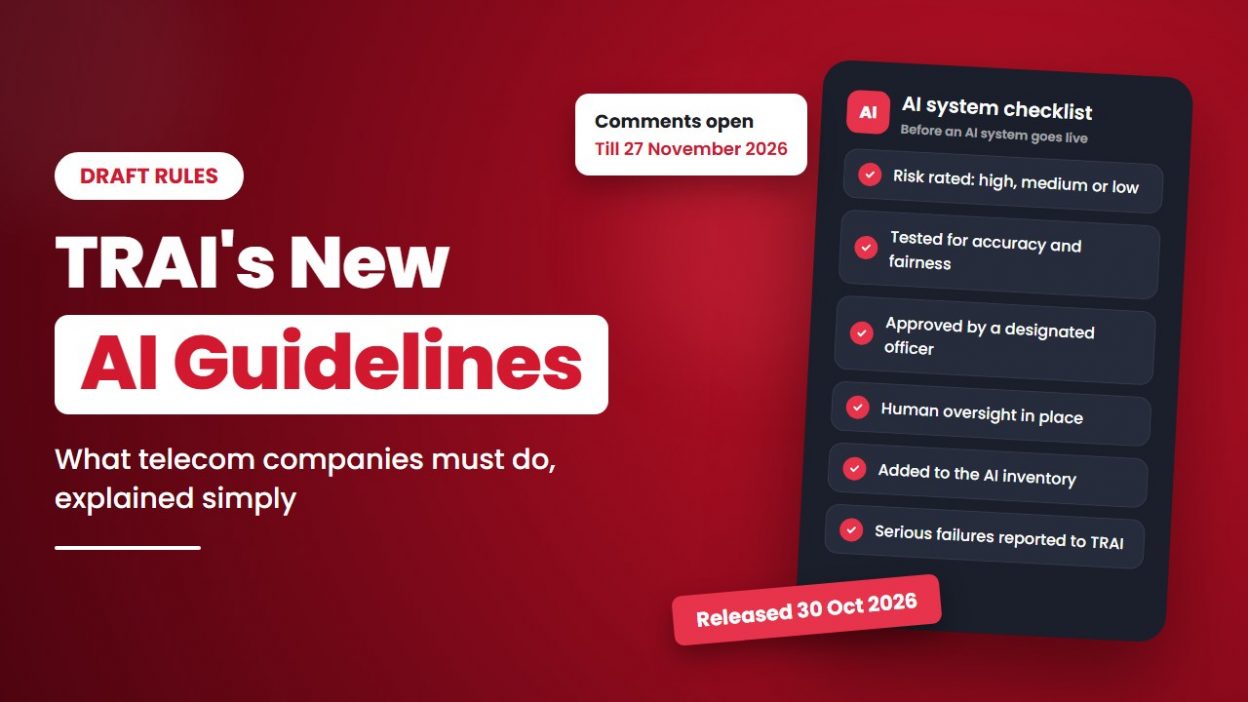
The rules are still a draft. TRAI is asking for public comments until 27 November 2026.
This guide explains what the draft says in simple words, who it applies to and what it means for businesses and mobile users.
Quick Summary
| Name | Draft Guidelines on Responsible Use of Artificial Intelligence (AI) in Telecommunication Networks and Provision of Telecommunication Services |
| Released by | TRAI |
| Release date | 30 October 2026 |
| Status | Draft, open for comments |
| Last date for comments | 27 November 2026 |
| Applies to | Licensed or authorised telecom service providers and network operators that use AI |
Source: TRAI Press Release No. 145/2026 and the draft guidelines.
Why Has TRAI Made These Guidelines?
In February 2026, the Government of India released the India AI Governance Guidelines. They are built on seven principles, including “People First”, “Fairness & Equity”, “Accountability” and “Safety, Resilience & Sustainability”.
TRAI wants these principles to be followed in the same way across the telecom sector.
The draft explains why. AI can make telecom networks work better, but it can also bring new risks if it is not checked properly. TRAI names three examples:
- Bias that creeps into an AI system while it is being trained or used
- Model drift, where an AI system slowly starts behaving differently from how it was designed
- Adversarial attacks, where someone deliberately tries to fool the AI
Because telecom networks support banking, government services, business and emergency response, TRAI says these risks need careful handling.
Who Do the Guidelines Apply To?
The draft applies to any entity that:
- holds a licence under the Telegraph Act, 1885 or an authorisation under the Telecommunications Act, 2023 to provide telecom services, or
- holds an authorisation to set up, run or expand telecom networks,
and uses, or plans to use, AI in its networks or services.
In simple words, this mainly covers telecom companies such as mobile operators and network providers. It does not directly cover ordinary businesses or mobile users.
What the Draft Guidelines Say
1. Every telecom company needs an internal AI policy
Each company must write an internal AI policy, and its board of directors must approve it. The policy must cover:
| Area | What it means |
| Risk classification | Every AI system is rated high, medium or low risk, based on how important it is and how much it could affect consumers |
| Approval before use | No AI system can be used until a designated officer approves it |
| Incident classification | AI failures are rated critical, high, moderate or low severity |
| Incident handling | AI incidents are recorded, fixed, investigated and, if serious, reported to TRAI |
| Human oversight | Every AI system must be supervised by people |
| Data governance | Data used by AI must be collected, stored and deleted lawfully and securely |
| Consumer complaints | Harms caused by AI and reported by users must be fixed within a reasonable time |
The company must review this policy at least once a year and send it to TRAI within seven working days of it coming into effect.
2. Checks before an AI system goes live
Before using a new AI system, or changing an existing one, the company must test it for:
- Accuracy: Does it give correct results?
- Robustness: Does it keep working well in different situations?
- Explainability: Can people understand why it made a decision?
- Fairness: Is it free from harmful bias?
- Drift resilience: Does it stay reliable over time?
For fairness, the draft suggests using the Telecommunication Engineering Centre (TEC) standard 57050:2023, or a suitable international standard.
3. A list of all AI systems in use
The company must keep an up-to-date inventory of every AI system, including active, inactive and retired ones. Each entry must show where the AI came from, what it does and its risk level. No AI system can be used unless it is on this list.
4. Rules for AI bought from other companies
Many telecom companies buy AI tools from outside suppliers. The draft says the telecom company must:
- check the supplier and the AI system carefully before buying it,
- ask suppliers to disclose any AI built into the equipment or software they sell, and
- add enforceable terms to supplier contracts covering audits, incident handling and responsibility.
Most importantly, the telecom company stays responsible for what the AI does, whether it built the system itself or bought it from someone else.
5. Serious AI failures must be reported to TRAI
Companies must keep a central record of all AI incidents. Critical and high-severity incidents must be reported to TRAI, including major malfunctions, repeated failures and the steps taken to fix them.
TRAI says it may use this information to learn lessons across the sector and issue advice or preventive measures.
6. A special committee to watch over AI
Each company must set up an AI Governance and Safety Committee (AGSC), approved by its board. It will include people from network operations, IT, regulatory and consumer affairs, among others.
The committee is led by a senior AI Governance and Safety Officer (AGSO). It reviews the AI systems at least once a year, and it can ask for a system to be changed or switched off if needed.
What Does This Mean for Mobile Users?
If the guidelines are finalised, your telecom provider will have to:
- keep people in charge of the AI systems that affect your service,
- check its AI for unfair results before using it, and
- fix complaints about harm caused by AI within a reasonable time.
You don’t need to do anything right now. These are duties for telecom companies, not for users.
What Does This Mean for Businesses Using AI for Calls?
The draft is written for licensed telecom companies. It does not set new rules for a business that uses AI tools, such as an AI voice agent, to call its own customers.
However, businesses should still keep a few points in mind:
- Suppliers to telecom companies may be asked to disclose AI in their products and accept audit and incident terms in contracts.
- Existing rules still apply. The draft says it does not replace any other law. For example, automated and AI-voice calls already fall under TRAI’s anti-spam rules for Application-to-Person (A2P) calls. Read more in TRAI New Rules 2026: What the Anti-Spam Amendment Means for Your Business Calls.
- Good practice is the same. Testing, human oversight and clear records are sensible steps for any business using AI in customer communication.
To understand how AI is used in business calling, read What Is an AI Voice Agent? A Simple Guide.
TRAI has invited comments from all stakeholders.
- Last date: 27 November 2026
- Send to: Shri Akhilesh Kumar Trivedi, Advisor (Networks, Spectrum & Licensing), TRAI
- Email: advmn@trai.gov.in
- Format: Preferably by email. TRAI asks for detailed input with reasons.
TRAI says the comments it receives will be posted on its website.
Frequently Asked Questions
What are TRAI’s AI guidelines?
They are draft rules on how telecom companies should use AI responsibly in their networks and services. They cover risk ratings, testing, human oversight, incident reporting and accountability.
When were the TRAI AI guidelines released?
TRAI released the draft on 30 October 2026.
Are the TRAI AI guidelines final?
No. They are a draft. TRAI is collecting comments until 27 November 2026 before finalising them.
Who must follow the guidelines?
Telecom service providers and network operators that hold a licence or authorisation and use AI in their networks or services.
Do the guidelines apply to ordinary businesses?
Not directly. They are meant for licensed telecom companies. Other laws, such as TRAI’s anti-spam rules for automated calls, still apply to businesses.
What is an AI incident?
The draft defines it as an event where an AI system malfunctions, gives unintended results or behaves unpredictably, which may cause harm or break the law.
What happens if a telecom company’s AI makes a mistake?
The company must record it, fix it and investigate it. If it is critical or high-severity, the company must report it to TRAI.
Conclusion
TRAI’s draft AI guidelines aim to make sure telecom companies use AI carefully. Every AI system would be rated by risk, tested before use, watched over by people and recorded in a central list, and serious failures would be reported to TRAI. The telecom company stays responsible for its AI, even if a supplier built it.
The rules are not final yet. If your business works with telecom companies or uses AI in communication, read the draft and share your views with TRAI before 27 November 2026.
Using AI or automation for business calls? CallerDesk’s cloud calling tools, including IVR, call recording and call logs, help teams keep a clear record of customer calls. Records like these make it easier to review how your calls are handled. Explore CallerDesk